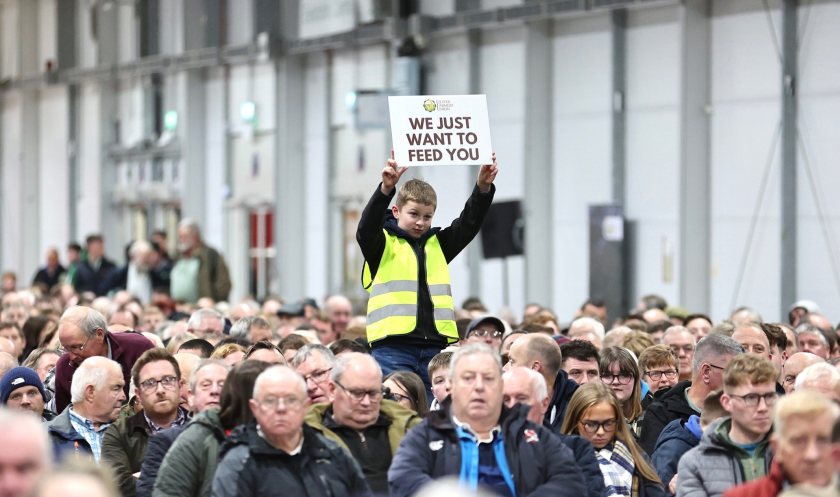
The demonstration, estimated by police to have drawn 13,000 participants, saw protesters holding signs such as “Stand with a farmer, not Starmer”…reports Asian Lite News
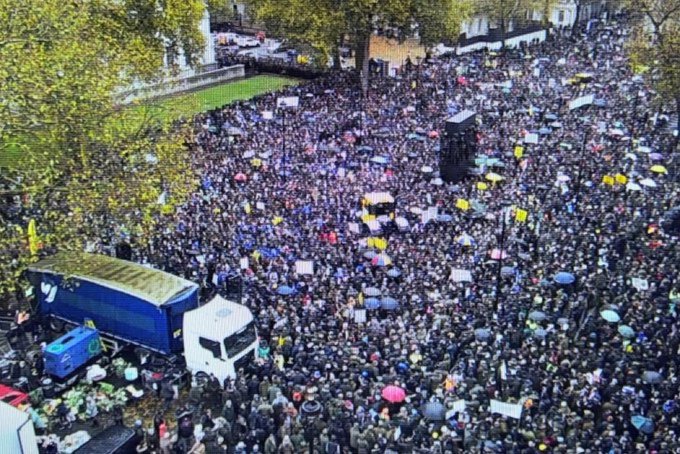
With banners, bullhorns, and toy tractors, thousands of British farmers gathered outside Parliament on Tuesday to protest against a tax hike they claim will deal a “hammer blow” to struggling family farms.
British farmers, typically less militant than their European counterparts, have refrained from staging large-scale demonstrations like those seen in France and elsewhere in Europe. However, they now warn they will escalate their actions if the government fails to respond.
At the centre of the discontent is the government’s decision to abolish a longstanding tax break from the 1990s that exempts agricultural property from inheritance tax. Under the new rules, farms valued at over £1 million will face a 20% tax when transferred to the next generation upon the owner’s death, effective from April 2026.
“Everyone’s furious,” said Olly Harrison, co-organiser of the protest, which saw demonstrators flood the streets near Prime Minister Keir Starmer’s Downing Street office. Harrison said many farmers are ready “to block roads and go full French.”
Protest organisers urged participants not to bring heavy machinery into central London, but a few tractors adorned with banners reading “the final straw” and “no farmers, no food” rolled past Downing Street.
The demonstration, estimated by police to have drawn 13,000 participants, saw protesters holding signs such as “Stand with a farmer, not Starmer.” Children on toy tractors circled Parliament Square following speeches, including one by former Top Gear presenter and celebrity farmer Jeremy Clarkson. Inside Parliament, 1,800 farmers joined a “mass lobby” organised by the National Farmers’ Union (NFU).
NFU President Tom Bradshaw criticised the policy as “simply unacceptable,” saying, “It undermines British food security at a time when we need it most.”
The tax change adds to mounting challenges for farmers, including volatile weather worsened by climate change, global instability, and the impact of Brexit. Many view the tax hike as the final straw in a series of setbacks.
Starmer’s Labour government argues that the majority of farms—around 75%—will remain unaffected by the tax, with various exemptions allowing farming couples to pass estates worth up to £3 million tax-free. The 20% levy is half the 40% inheritance tax applied to other property.
Camilla Marshall, a spokesperson for Starmer, acknowledged the decision was “difficult” but confirmed it would not be reconsidered.
Proponents of the tax argue it will target wealthy individuals who have purchased farmland as an investment, driving up costs and pricing out younger farmers. “High land prices are robbing young farmers of the dream of owning their own farm,” wrote Environment Secretary Steve Reed.
However, the NFU contends that more than 60% of working farms could be affected, noting that while farms may appear valuable on paper, profits are often modest. Government data shows that average farm incomes declined last year, with grazing livestock farms earning around £17,000 and specialist poultry farms generating £143,000.
British farmers have endured a turbulent decade. Many supported Brexit, seeing it as an opportunity to escape the EU’s complex Common Agricultural Policy. While some welcomed subsequent reforms, such as payments for promoting biodiversity and restoring nature, others say these benefits have been overshadowed by inflation, mismanagement, and trade deals allowing cheap imports from countries like Australia and New Zealand.
Meanwhile, Keir Starmer has denied that he is mounting a class war by targeting wealthy landowners and private schools, after the head of the National Farmers’ Union accused the government of an extraordinary “betrayal” over inheritance tax changes.
In an escalating war of words between food producers and ministers, the NFU president, Tom Bradshaw, called the government’s budget measures a “stab in the back”, after the sector had been previously told that taxes such as agricultural property relief (APR) would not be changed. He was addressing hundreds of farmers who had travelled to London to lobby their local MPs.
Starmer told reporters at the G20 in Rio de Janeiro that the government was taking a “balanced approach” to fund public services and called on farmers to think about the money needed for schools and hospitals in rural communities.
Asked if he was mounting a class war on the wealthiest, Starmer told Sky: “It isn’t at all what we’re doing. It’s a balanced approach. We have to fill a black hole which was left by the last government.”
In London, Bradshaw told a room of about 600 farmers: “I don’t think I have ever seen the industry this angry, this disillusioned, this upset.”
He described the budget measures as a “shocking policy, built on bad data, and launched with no consultation with anybody that understands”. Bradshaw was applauded by farmers as he commented on the “human impact of this policy” and warned that government measures including changes to national insurance contributions, coupled with a competitive retail environment, would push up food prices.
Separately, thousands of food producers gathered close to Downing Street on Tuesday morning for a rally flanked by tractors. Previously, farming businesses qualified for 100% relief on inheritance tax on agricultural and business property. But now the tax is being imposed on farms worth more than £1m, with an effective rate of 20% on assets above that threshold, rather than the normal 40% rate for inheritance tax.
Ministers have said the threshold for farmers paying inheritance tax could be £3m for a couple, once various exemptions were taken into account.
The NFU has rejected the government’s claims that most farms will not be affected by the change, and believes that it will apply to 75% of what it calls “commercial farm businesses”.
A group of farmers from Wales and Wiltshire attending the NFU lobby said they believed all of their farms would fall into the remit of inheritance tax under the budget measures.
ALSO READ: UK expected to give Ukraine Storm Shadow missiles