March 14, 2025
3 mins read

Syrian leader signs constitutional declaration 

The declaration enshrines several fundamental rights, including freedom of opinion, expression, the press, and access to information. 

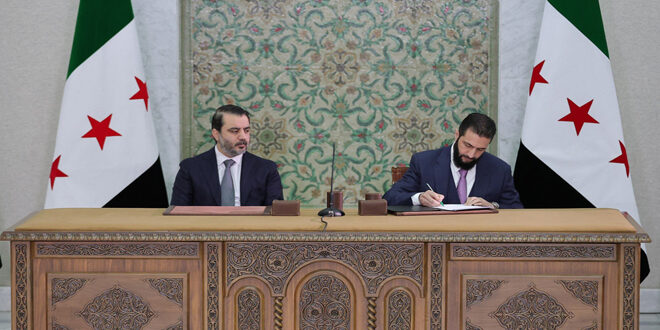
Syrian President Ahmad al-Sharaa signed the draft Constitutional Declaration on Thursday, marking a significant step in the country’s transition. The declaration outlines a framework for governance during the five-year transitional period following the end of Bashar al-Assad’s rule. 

“We hope this step will open a new chapter for the Syrian people, leading to progress, reconstruction, and development,” President al-Sharaa stated after receiving the document from the drafting committee. “May it replace ignorance with knowledge and suffering with mercy,” he added, signalling hopes for national unity and reform. 

The Committee of Experts tasked with drafting the declaration announced at a press conference that it had worked diligently since its formation. The document is based on the outcomes of the National Dialogue Conference, reflecting key principles aimed at stabilising the country. 

The declaration enshrines several fundamental rights, including freedom of opinion, expression, the press, and access to information. It also reaffirms the state’s commitment to national unity and respect for Syria’s diverse cultural identities. 

“We made sure to include a dedicated chapter on rights and freedoms to balance societal security with personal liberty,” the committee stated. The document guarantees property rights, women’s access to education and employment, and their political participation. 

Judicial independence is another key provision, with the declaration emphasising the autonomy of judges and their rulings. The People’s Assembly is granted full legislative authority, while executive powers rest with the President of the Republic. Any dismissal or reduction in the powers of a People’s Assembly member will be handled internally by the legislative body. 

The declaration sets a five-year transitional period, during which the President has the authority to declare a state of emergency if necessary. 

The signing of the draft declaration marks a crucial step in Syria’s political transition, but challenges remain as the country navigates its path toward stability and governance. 

In a significant development, Al-Sharaa announced on Monday that his government had reached a landmark agreement with the US-backed Kurdish-led authorities in northeastern Syria. The pact includes a ceasefire and an agreement to integrate Kurdish-led forces into the central government’s security apparatus. 

This deal follows intense fighting last week, when government forces and their allies quashed an insurgency launched by Assad loyalists. Rights groups report that hundreds of civilians, particularly from Assad’s Alawite sect, were killed in retaliatory attacks during the conflict. 

The international response to Syria’s evolving political landscape remains cautious. The United States and European nations have so far refrained from lifting stringent sanctions imposed during Assad’s rule, citing concerns over whether the new leadership will establish an inclusive political system and protect minority rights. Al-Sharaa and other regional leaders have urged Western powers to reconsider their stance, warning that continued economic instability could further destabilize the country. 

Xxx 

Humanitarians help Syria’s coastal residents 

The United Nations and partners have mobilised relief efforts to help residents in Syria’s western Latakia Governorate recover from recent violence, UN humanitarians said.  The UN Office for the Coordination of Humanitarian Affairs (OCHA) said power outages continue in several regions, including the governorate’s capital city of Latakia. Water distribution is affected by the outages, mainly in rural areas, Xinhua news agency reported. 

Schools in Latakia and Tartous have been suspended. Bakeries are operational, and shops are reopening, though essential materials and fuel remain scarce. The UN Children’s Fund (UNICEF) supplied 38 tonnes of water treatment supplies to Latakia’s water authority, covering more than two months of needs. 

The agency also provided five water tanks to Jableh National Hospital in Latakia to replace damaged ones. UNICEF and its partners are helping maintain the Al Sin Spring generator in Tartous to ensure a drinking water supply for the population. Health partners delivered emergency supplies, including 64 trauma and emergency surgical kits and non-communicable disease treatments to Tartous and Latakia. 
Previous Story

Sheikh Mohammed Hosts Ramadan Gathering 

Next Story

Can AI Transform the Future of India-GCC Ties? 

Previous Story

Sheikh Mohammed Hosts Ramadan Gathering 

Next Story

Can AI Transform the Future of India-GCC Ties? 

Latest from -Top News

Pakistan Risks Overstretching Itself in Yemen War

Pakistan’s expanding military role in Saudi Arabia amid the Yemen conflict could strain its defence resources and fragile finances…reports Asian Lite News Desk Pakistan’s military involvement in the war in Yemen may prove unsustainable because of mounting financial pressures and competing security demands, according to a new report. Islamabad’s growing military presence in Saudi Arabia risks stretching its defence resources while exposing the country to greater strategic and economic challenges. An article by Andrew Wilson in One World Outlook describes Pakistan’s involvement as a case of “fiscal and strategic overreach”, arguing that the country lacks the financial flexibility to sustain an expanded military commitment. Pakistan’s external finances depend heavily on an International Monetary Fund (IMF) programme, financial support from Gulf countries and remittances from Pakistani workers in the region. The report argues that deeper military involvement in the conflict could place additional pressure on these sources of financial stability. It also warns that deploying troops and military equipment abroad could weaken Pakistan’s capacity to address security challenges along its eastern border and deal with two domestic insurgencies. The move could also draw Islamabad into a conflict it has sought to approach cautiously. A Reuters report in May, citing Pakistani security and government sources, said Islamabad had deployed around 8,000 troops, a squadron of approximately 16 aircraft, mostly JF-17 fighter jets, two drone squadrons and a Chinese HQ-9 air-defence battery to Saudi Arabia. According to those sources, Riyadh was financing the deployment, with Pakistani personnel operating the equipment. The sources also said a confidential agreement contemplated the possibility of deploying up to 80,000 troops. Islamabad has not confirmed those figures, although it has acknowledged its military presence in Saudi Arabia, including the deployment of fighter jets at King Abdulaziz Air Base from April. The One World Outlook article argues that Saudi financial support can cover allowances and operating expenses but cannot easily replace military equipment needed elsewhere or resolve the political and strategic challenges of participating in the Yemen conflict. Pakistan’s defence budget is another concern. For the 2026-27 financial year, the federal government allocated PKR 3 trillion, or approximately $10.8 billion, to defence services. The allocation represents an 18 per cent increase from the original PKR 2.55 trillion provision and amounts to around 2.1 per cent of projected gross domestic product (GDP). Defence spending accounts for approximately 16 per cent of the federal government’s PKR 18.8 trillion expenditure. Military pensions are budgeted separately at PKR 822 billion, while debt servicing costs stand at approximately PKR 8 trillion, more than two-and-a-half times the defence allocation. The report argues that these competing financial obligations leave little room for additional military expenditure without placing further pressure on public finances. Pakistan’s reliance on IMF assistance also limits its fiscal flexibility. The country must meet the conditions attached to the programme, including a primary budget surplus target of 2 per cent of GDP and continued restraint on development spending. According to the article, these requirements make it difficult for Islamabad to finance an additional military commitment without compromising other budgetary priorities. Pakistan’s economic indicators offer limited reassurance. Economic growth for the 2025-26 financial year is estimated at between 3.6 and 3.7 per cent, while inflation reached approximately 10.3 per cent in September following an energy price shock. Foreign exchange reserves stood at around $21.5 billion at the end of September. Although this marks an improvement from the low levels recorded in 2023, the report notes that the reserves cover only a few months of imports. Financial assistance from Gulf partners remains central to Pakistan’s external stability. The article says Islamabad holds approximately $8 billion in Saudi deposits at its central bank. In July, the State Bank of Pakistan said Riyadh had extended the maturity of $5 billion in deposits to December 2028, easing the country’s immediate external financing requirements. A further $3 billion deposit was also extended in the spring. However, the article argues that these arrangements provide temporary relief rather than long-term financial independence, particularly as regional conflict threatens the stability of the Gulf economies on which Pakistan relies. The report concludes that Pakistan faces a difficult balance between supporting Saudi Arabia militarily and preserving the financial and military resources needed to address its domestic and regional challenges.

UK and Germany Ratify Kensington Treaty

Britain and Germany ratify the Kensington Treaty, agreeing new cooperation on AI, quantum research, defence and security while targeting investment, jobs and Russian hybrid threats…reports Asian Lite News Desk Britain and Germany
Go toTop

Don't Miss

US special ops raid in Northwestern Syria kills 13

The operation was thought to be the biggest of its

Assad thanks UAE for quake relief

UAE Foreign Minister Sheikh Abdullah has visited areas affected by