One Kashmir builds, another boils: The widening divide across the LoC … writes Dr Sakariya Kareem
There are moments when geography itself seems to tell a story. High in the Himalayas, a tunnel boring machine has been steadily eating its way through rock, opening a new passage between Kashmir and Ladakh. Hundreds of kilometres of roads and railway lines are being added or upgraded across some of the most difficult terrain in South Asia.
Trains now cross bridges that were once regarded as engineering impossibilities, while tourism is reaching destinations that were previously separated from the rest of the country by distance and winter weather.
Across the Line of Control (LoC), meanwhile, the defining images of 2026 have come from streets rather than construction sites.
Pakistan-occupied Jammu and Kashmir (PoJK) has experienced repeated protests, shutdowns and clashes linked to questions of political representation, governance and economic demands.
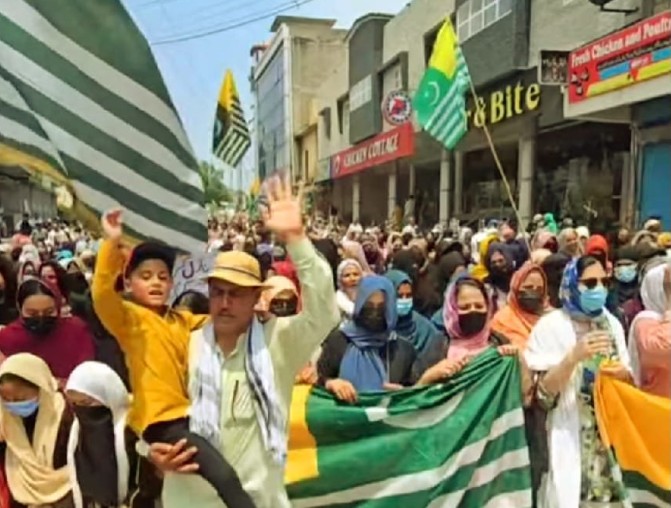
The unrest intensified around the Joint Awami Action Committee (JAAC) and the controversy over 12 assembly seats reserved for refugees living outside the territory. Reuters reported that at least 24 people had died during the recent unrest in June, while further clashes in July brought additional casualties.
The juxtaposition is striking not because the two sides have suddenly become different, but because their contrasting trajectories have become increasingly visible.
On the Indian side, infrastructure is creating a new economic geography. On the other side, political mobilisation continues to dominate public life.
Economic Progress
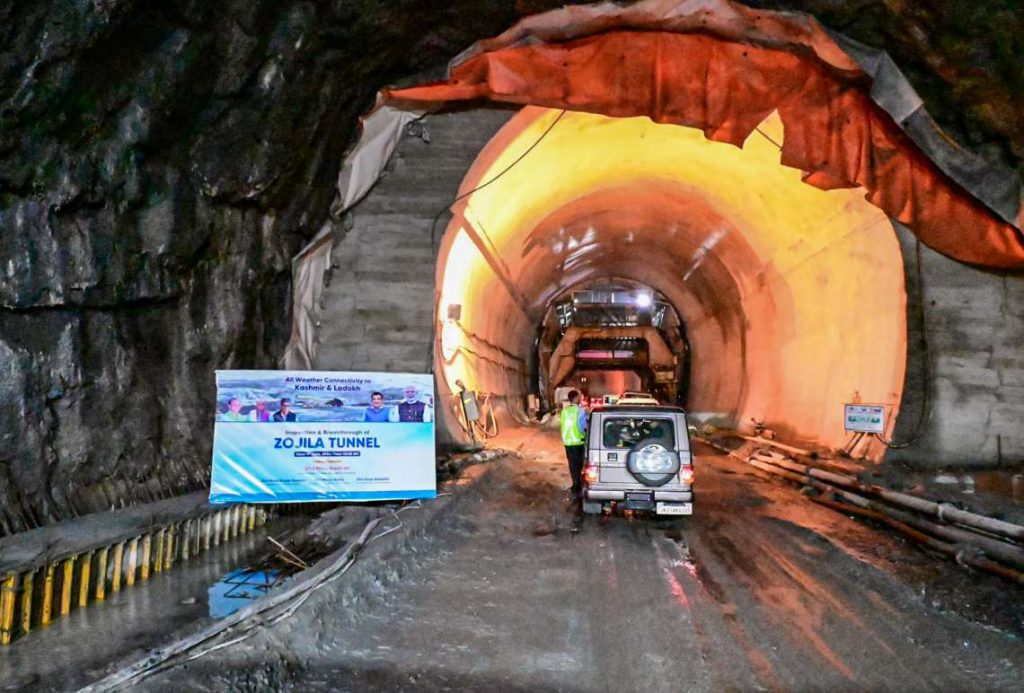
In early June, Indian Road Transport and Highways Minister Nitin Gadkari witnessed the breakthrough of the main tunnel of the Zojila Tunnel project.
The 13.153-kilometre tunnel, together with 17.030 kilometres of approach roads, forms a 30.18-kilometre project with an estimated cost of $732.2 million (INR 6,809.69 crore).
It is being built to establish all-weather connectivity between Jammu and Kashmir and Ladakh through one of the most challenging Himalayan corridors.
The significance of Zojila lies in what it can unlock.
The Zojila Pass has historically been vulnerable to heavy snowfall and prolonged winter closures.
Once the tunnel is fully operational, the route will provide a much more reliable connection between Sonamarg and the Ladakh region. Government information has indicated that travel time between Sonamarg and Minamarg could fall from nearly two hours to about 30 minutes.
It is another example of infrastructure being used not simply to shorten journeys, but to change the economic possibilities of an entire region.
That logic is visible across Jammu and Kashmir.
Vande Bharat
The Zojila project is part of a much larger transportation transformation.
In 2025, the completion of the Udhampur-Srinagar-Baramulla Rail Link connected the Kashmir Valley with the wider Indian railway network. The project includes the Chenab Rail Bridge, the world’s highest railway arch bridge, and the Anji Khad Bridge, India’s first cable-stayed railway bridge.
The achievement was followed by another significant development in April 2026, when Indian Railways extended the Jammu-Srinagar Vande Bharat service to Jammu Tawi and increased the train from eight to 20 coaches.
The railway ministry described the expansion as a step towards strengthening tourism, freight movement and the movement of essential commodities.
The transformation is important because railway connectivity changes more than passenger travel.
It creates a dependable channel for goods, expands access to markets and gives businesses greater certainty over movement. For a mountainous region, where road transportation has traditionally been heavily influenced by weather and terrain, the railway represents a structural change.
The network is also continuing to expand. Detailed project reports have been prepared for doubling the 118-kilometre Qazigund-Srinagar-Budgam section and for a 40-kilometre Baramulla-Uri railway line. Plans have also progressed for additional links towards Rajouri, Poonch and other border areas.
The direction is clear: connectivity is being treated as an economic asset.
Tourism growth
The most immediate beneficiary of better connectivity is tourism.
Jammu and Kashmir’s mountains, lakes, forests, pilgrimage sites and cultural heritage have long attracted visitors. What is changing is the ease with which people can reach them.
Government data shows the scale of this transformation. Jammu and Kashmir recorded more than 20 million domestic tourist visits to the Jammu region alone in 2024, alongside international visitors, according to figures cited by the Union Tourism Ministry.
The region also recorded more than 2.3 crore tourist arrivals in 2024 across Jammu and Kashmir, according to the Union government.
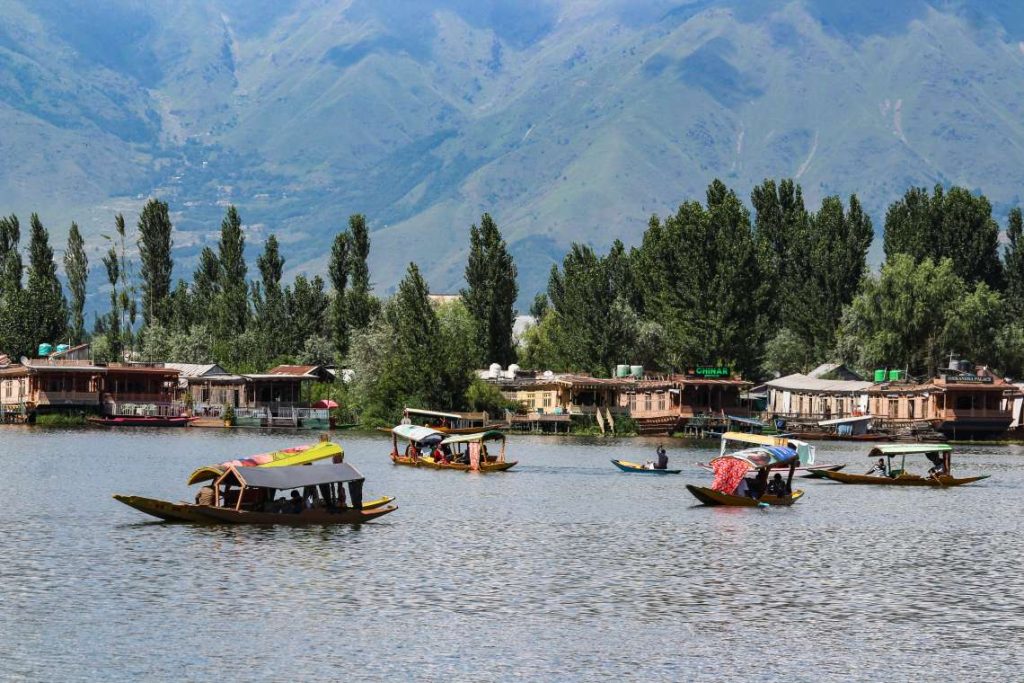
Tourism infrastructure is expanding alongside visitor numbers. Six projects under the Himalayan Circuit of the Swadesh Darshan scheme were sanctioned with an investment of about $56 million (INRR 519.58 crore), and the government says all six have been physically completed.
The revamped Swadesh Darshan 2.0 programme has shifted towards developing sustainable tourism destinations.
The significance of this goes well beyond hotels and sightseeing.
Tourism supports transport operators, restaurants, homestays, handicraft producers, guides, retailers and a wide range of small businesses. Better roads and railways allow these economic activities to reach a larger market.
In this sense, connectivity is becoming a bridge between infrastructure and household-level economic opportunity.
The broader economic indicators reinforce the infrastructure story.
The Jammu and Kashmir Economic Survey 2025-26 estimates real GSDP growth of 5.82 percent during 2025-26 and nominal GSDP growth of 8.89 percent.
The size of the economy is estimated at approximately $30.75 billion (INR 2.86 lakh crore) in nominal terms. The survey also estimates per capita income at $1,800 (INR 1,68,243) in 2025-26.
The 2026-27 budget estimates the Union Territory’s GSDP at $33.98 billion (INR 3.16 lakh crore) at current prices, representing projected growth of 9.5 percent over the revised estimate for 2025-26.
These numbers matter because the transformation is no longer confined to construction.
Infrastructure is being accompanied by investment, employment, entrepreneurship, tourism and institutional expansion.
The Union government has said that 63 major development projects worth about $8.60 billion (INR 80,000 crore) have been approved in Jammu and Kashmir, with more than $5.48 billion (INR 51,000 crore) invested and 53 projects completed.
It also reported more than 41,000 government jobs created between 2019 and May 2026 and self-employment opportunities extended to more than 9.81 lakh people over the preceding four years.
Another indication of the changing development model is the emphasis on innovation.
In May 2026, the Atal Innovation Mission, in partnership with the Jammu and Kashmir administration and the University of Kashmir, opened applications for 500 new Atal Tinkering Labs across the Union Territory.
The initiative is intended to expand access to innovation and technology education in geographically challenging areas and connect schools, universities, industry and innovation institutions.
This marks an important shift in the development narrative.
The economic future of Jammu and Kashmir is increasingly being linked not only with roads, railways and tourism but also with skills, technology and entrepreneurship.
That combination gives infrastructure a second life: connectivity brings people and markets closer, while education and innovation create the capacity to use that connectivity productively.
The contrast becomes sharper when developments in PoJK are viewed alongside this expansion.
The territory has its own legislative assembly and government, but the structure of political representation has remained a major source of debate.
The current dispute centres particularly on 12 assembly seats reserved for refugees from Indian-administered Jammu and Kashmir who live elsewhere in Pakistan.
The seats are part of the 45 directly elected constituencies in the regional assembly. Protesters associated with JAAC have argued that the arrangement affects local political representation.
The issue became a major trigger for the 2026 protests.
The regional government banned JAAC in June, after which demonstrations and confrontations escalated. Reuters reported that the unrest caused shutdowns and disruptions to banking, roads and internet services. Further clashes occurred in July as regional elections approached.
The election itself was conducted in stages because of security concerns. In the first phase, the Pakistan Muslim League-Nawaz won nine of 13 contested seats, while Pakistan Tehreek-e-Insaf boycotted the election.
The immediate political developments are therefore closely tied to the broader debate over representation and the relationship between the territory and Islamabad.
Two different meanings of development
The most revealing contrast between the two sides is not simply the number of roads, tunnels or protests.
It is the way development is being experienced.
On the Indian side, the dominant development vocabulary is increasingly centred on connectivity. A railway line connects the Valley to the national network. A bridge carries trains across one of the world’s deepest river gorges. A tunnel is being driven through the Zojila mountains. New road projects are reducing travel times. Tourism infrastructure is expanding. Innovation programmes are reaching schools.
Each project becomes part of another project.
A railway encourages tourism and freight. Better roads support tourism and local commerce. Tunnels make roads more dependable. Connectivity encourages investment. Investment creates employment and services.
This is how infrastructure gradually becomes an economic ecosystem.
Meanwhile, in PoJK, the dominant public mobilisation has been around governance, political representation and economic demands.
The protests have demonstrated the strength of public engagement with regional political questions, but they have also meant that political events continue to occupy a central place in the territory’s public narrative.
LoC is becoming a sharper development divide
For decades, Kashmir’s story has largely been told through the language of conflict, territory and geopolitics.
The emerging picture adds another dimension: development.
On one side, a long chain of public investment is physically connecting remote communities to larger markets and national networks. On the other, political mobilisation remains a powerful force shaping public life.
The difference is visible from the mountains themselves.
A train crossing the Chenab Bridge is not merely an engineering spectacle. It represents a new connection between Kashmir and the rest of India’s economic system. A Vande Bharat service reaching Jammu changes the practical meaning of distance. The Zojila Tunnel promises to make a strategically and economically important Himalayan route more reliable.
These projects collectively point towards a Jammu and Kashmir increasingly defined by movement.
Kashmir’s new story is increasingly about opportunity
The LoC still divides the region politically and geographically, but the latest developments show that its two sides are also producing sharply different development narratives.
Jammu and Kashmir’s recent trajectory has been marked by infrastructure construction, railway integration, tourism expansion, investment, entrepreneurship and new economic activity.
Official economic estimates show continued growth, while major transport projects are steadily changing the physical landscape.
PoJK’s 2026 headlines, by contrast, have been dominated by political protests and electoral disputes, with the JAAC movement becoming a major vehicle for demands concerning representation and governance.
The comparison is increasingly visible in everyday realities.
One side is putting tunnels through mountains and extending railway lines into previously difficult terrain. The other is spending considerable political energy on questions of representation and regional authority.
The mountains have not changed. The LoC has not moved. But the development story around it is changing. And perhaps the most important feature of the present moment is that Kashmir is increasingly being judged not only by the politics of its past, but also by the infrastructure, connectivity, economic activity and opportunities being built for its future.