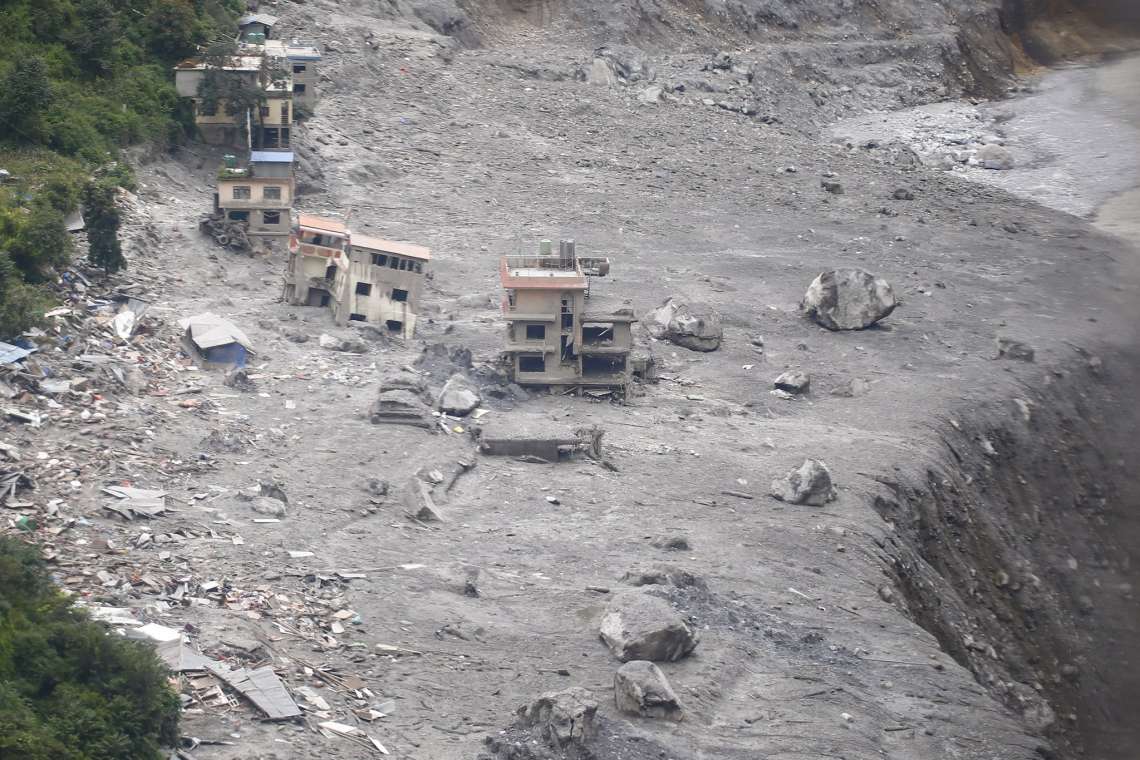
Nepal’s economic growth is forecast to slow to 3.7 per cent in 2026-27 after devastating August floods disrupted energy, transport, trade and tourism….reports Asian Lite News Desk
The World Bank has cut its economic growth forecast for Nepal to 3.7 per cent for the 2026-27 fiscal year, citing the impact of devastating floods in August that damaged infrastructure and disrupted economic activity. The new projection is down from the 4.2 per cent forecast made by the global development lender in April.
In its Nepal Development Update: Building Back Differently for the Future, released on Tuesday, the World Bank said the floods were expected to affect the economy mainly through energy, transportation, trade and tourism.
“Agriculture and banking and insurance are also channels through which the economy would be affected, but with relatively lower potential impact,” it said.
The energy sector, particularly hydropower, was identified as the most critical channel through which the disaster could affect economic activity.
The floods damaged 12 hydropower projects, including seven operational projects with a combined capacity of 256.1 MW and five projects under construction with a combined capacity of 395.02 MW. A 25 MW solar facility was also affected.
“Damage to transmission infrastructure disrupted an additional 149.6 MW, bringing total affected generation and transmission capacity to approximately 430.7 MW, equivalent to 10.6 per cent of Nepal’s FY26 installed hydropower and solar capacity,” the bank said.
The World Bank said transportation and trade were also significant channels because Nepal’s domestic and international trade is concentrated along a limited number of corridors.
The disaster has caused significant loss of life and widespread infrastructure damage. According to Nepal’s National Disaster Risk Reduction and Management Authority, 1,455 people have been confirmed dead and 5,285 remain missing.
A Rapid Disaster Needs Assessment prepared by a joint technical team of the National Planning Commission and the National Disaster Risk Reduction and Management Authority estimated physical damage from the floods at 274.48 billion Nepali rupees, equivalent to about $1.93 billion.
Overall losses and damages were estimated at 408.28 billion rupees, or about $2.87 billion.
More than 723 billion rupees is expected to be needed for reconstruction and recovery of affected infrastructure and assets. The Nepali government is also carrying out a Post-Disaster Needs Assessment for a more extensive evaluation of the damage.
The World Bank expects industry to be the biggest drag on economic growth, citing damage to hydropower, solar energy, electricity transmission and transport infrastructure.
“For instance, it took nearly a year to fully restore generation at the 111 MW Rasuwagadhi Hydropower Project, which was severely damaged by the July 8, 2025, Bhotekoshi (Lhende River) flood,” it said.
The same project has again been badly affected by the August floods.
“This illustrates the potential for flood-related damage to disrupt electricity supply and impose substantial reconstruction costs,” the global development lender said.
“Hydropower construction in areas not directly affected by the flood is expected to continue, although projects could face higher insurance premiums, financing reassessments, and cost overruns,” it added.
The services sector is also expected to face disruption through effects on trade, transport, tourism and financial activity, while agricultural losses are expected to have a limited impact on overall economic output but could significantly affect livelihoods in affected areas.
Tourism could face a prolonged impact, with the World Bank citing physical disruption and increased perceptions of travel risks.
More than 200 hotels and restaurants were damaged across affected districts, while access to major trekking and pilgrimage destinations, including Langtang, Gosaikunda and the Kailash Mansarovar corridor, has been disrupted.
Despite the short-term economic impact, the World Bank expects activity to gradually recover in 2027-28 as reconstruction gathers pace and damaged infrastructure and productive capacity are restored.