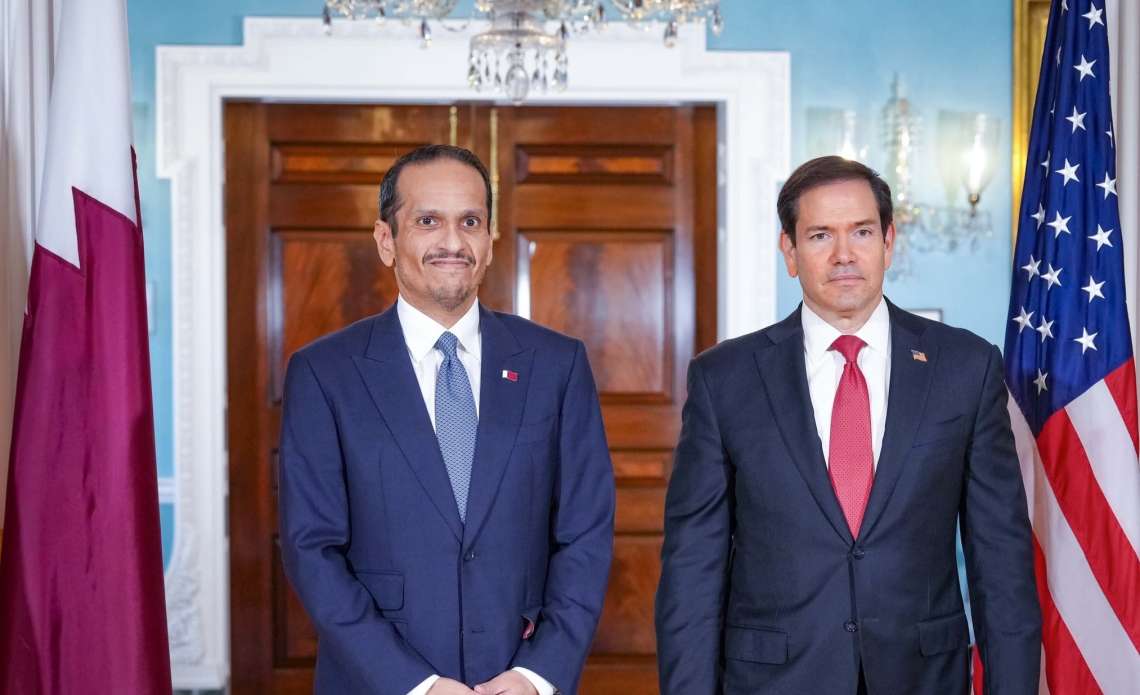
The United States and Qatar have signed a critical minerals framework and reaffirmed their commitment to safe passage through the Strait of Hormuz…reports Asian Lite News Desk
The United States and Qatar have agreed to strengthen cooperation on critical minerals and reaffirmed their commitment to ensuring freedom of navigation through the strategically important Strait of Hormuz. The agreements came as the two countries expanded their economic, energy and defence partnership amid continuing diplomatic efforts to ease tensions between Washington and Tehran.
The eighth US-Qatar Strategic Dialogue was held in Washington on Monday, led by US Secretary of State Marco Rubio and Qatari Prime Minister and Foreign Minister Sheikh Mohammed bin Abdulrahman Al Thani.
In a joint statement, both governments reaffirmed their commitment to maintaining freedom of navigation through the Strait of Hormuz, describing safe and unimpeded passage through the waterway as essential to regional security, reliable energy supplies and global economic stability.
The critical minerals framework is intended to align the two countries’ strategies for diversifying supply chains and strengthening their resilience. However, the joint statement did not provide details of the framework, identify specific projects or announce any financial commitments.
The agreement comes amid the strategic importance of the Strait of Hormuz to global energy markets. According to estimates from the US Energy Information Administration, around a fifth of global liquefied natural gas (LNG) trade passed through the strait in 2024, with Qatar accounting for a significant share of the shipments.
China, India and South Korea collectively received 52 per cent of the LNG transported through the waterway during that year, underlining its importance to major Asian energy consumers.
Rubio thanked Qatar’s leadership for its international mediation efforts during the discussions. A separate US State Department readout said he emphasised the importance of close coordination between the two countries to deter threats and promote stability across the Middle East.
Qatar has continued to position itself as a diplomatic intermediary amid tensions between Washington and Tehran. On November 17, Foreign Ministry spokesperson Majed bin Mohammed Al Ansari said Doha’s efforts to narrow differences between the two countries were ongoing.
He said representatives were meeting periodically to discuss proposals, warning that any escalation in the Gulf could threaten maritime navigation, disrupt the global economy and undermine prospects for reaching an agreement.
The strategic dialogue also covered cooperation in advanced computing, digital infrastructure, cybersecurity, energy and critical minerals.
Washington welcomed Qatar’s participation in Pax Silica, an initiative focused on strengthening technology cooperation and securing supply chains. The initiative reflects the growing importance of strategic partnerships in areas such as advanced technology and critical infrastructure.
Defence cooperation was another key component of the discussions. Both governments reviewed progress under an existing $38 billion statement of intent and explored potential investments in munitions and military equipment to improve interoperability between their armed forces.
The two sides also highlighted the Golden Pass LNG project as an important element of their energy partnership.
Regional security developments featured prominently in the talks, with Iran, Gaza, Syria, Lebanon and Afghanistan among the issues discussed. The governments also reviewed joint efforts to combat terrorism, money laundering and transnational organised crime.
The latest dialogue reflects the expanding scope of US-Qatar relations, which increasingly encompass energy security, strategic minerals, advanced technology and regional diplomacy.
According to the joint statement, discussions on defence, security, counterterrorism, law enforcement and cultural cooperation will continue into early 2027.