An informed observer pointed out the rally was led by Sikhs For Justice (SFJ), a US-based secessionist group with a presence in the British capital, and Babbar Khalsa, both proscribed in India. Both are suspected to have links with Pakistan’s Inter-Services Intelligence (ISI) …. Writes Ashis Ray from London

The massive Indian farmers’ movement against the Narendra Modi government’s recent Farm Acts, which among commissions and omissions, do not provide a minimum support price (MSP) guarantee for agricultural products, has elicited enormous awe and respect among Indians. Indeed, while the agitation is spearheaded by tillers of the soil in Punjab – the granary of India – it has spread to other states.
The assembly of protestors at arterial entry points to Delhi represent Haryana, Uttar Pradesh, Rajasthan and Madhya Pradesh and stretch to hundreds of thousands of disgruntled men and women. One tailback of tractors and trucks was as long as 13 kilometres. But the farmers need to be wary of elements inimical to India hijacking their campaign and thereby bringing discredit to it.
They must immediately distance themselves from Khalistani organisations outside India who are attempting to identify with the demonstration to garner support among Indian Sikhs. What is essentially a nationalist struggle – for it is about livelihoods of agriculturalists who provide food to all Indians – if tainted by acceptance of support from separatists – will dilute the sympathy it has so far attracted from the Indian masses. Their opponents will be quick to divide the farmers on the issue.

Canada is a G7 country. When the prime minister of such a nation wades into India’s internal affairs – as Justin Trudeau has now twice done – you wonder what could be behind it. This is not the first time the Canadian establishment has disappointed Indians. Their failure to bring to justice perpetrators of the terrorist bombing of Air India’s Kanishka left a bitter taste in the mouth. But Ottawa does not habitually behave irresponsibly; and there has been close cooperation with Delhi as well.
Canadian Sikhs, who mostly hail from Punjab, constitute a vote bank in the country’s politics. Economically, they punch above their weight; and a majority of Sikh MPs are in Trudeau’s Liberal Party. But a section of them subscribe to a homeland for Sikhs carved out of India; and this element has opportunistically jumped in to identify with the farmers’ confrontation with the Indian central government. It’s none of their business, for they are Canadian nationals, but that’s the way it is.
In an online address on 30 November to mark Sikhism’s founder Guru Nanak’s birth anniversary, Trudeau said: “Canada will always be there to defend the right of peaceful protest.”
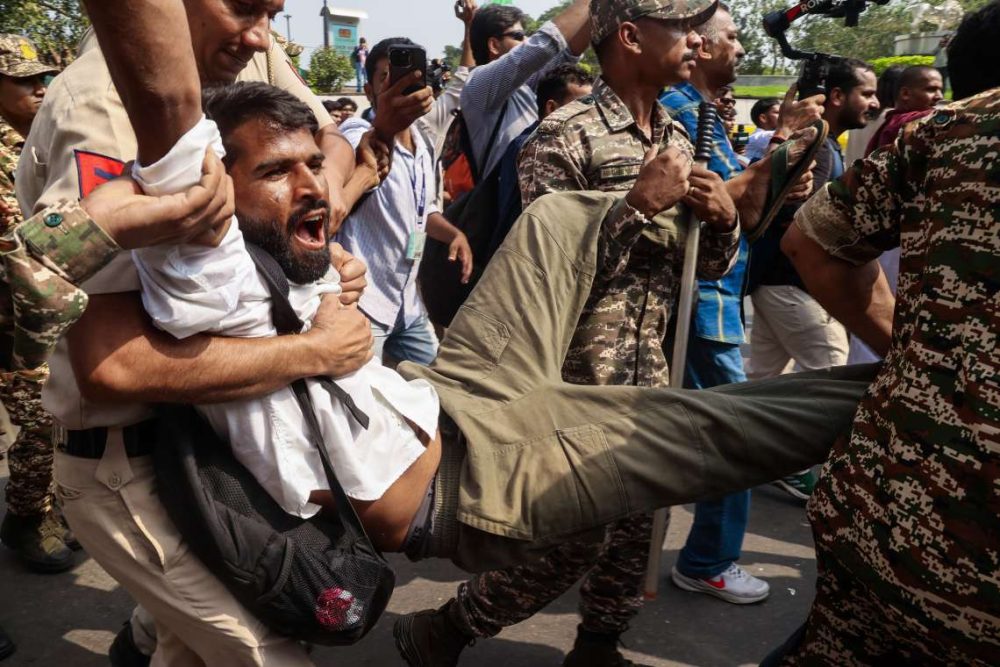
This was clearly in the context of police in India employing teargas, water cannons and lathis to counter Punjabi, mainly Sikh farmers’ caravan to Delhi. Now jammers are allegedly being used to deny them access to electronic communication networks.
Unsurprisingly, the spokesman for India’s Ministry of External Affairs pounced on Trudeau’s remarks, calling them ill-informed and unwarranted. The fact that there’s no love lost between Modi and Trudeau hasn’t helped. It’s a moot point whether petulance or constructive engagement should be the Indian External Affairs Minister Subrahmanyam Jaishankar’s response.

Normally the MEA’s reaction would have been justified. However, after Modi himself incredibly interfered in the United States’ presidential election with a high profile endorsement of Donald Trump, his government may have forfeited its right to object to a foreign power complaining about democratic principles being compromised in India.
Canada, like western Europe, has called out China on its crackdown on non-violent pro-democracy activists in Hong Kong.
Which brings us to Britain. Tanmanjit Singh Dhesi is the first and one of two Sikh MPs in Britain. He with 35 other lawmakers in the House of Commons shot off a letter to the British Foreign Secretary Dominic Raab, seeking an urgent meeting and asking him to make a representation to Jaishankar on the issue.
Dhesi claimed in his communication, “92% of UK Sikhs have ties with agricultural land in India”. This may well be true. But his source was Sikh Council UK. This body was ravaged by mass resignations last year on grounds of it coming under the influence of Sikh Federation UK (SFUK), a marked Khalistani organisation and successor to International Sikh Youth Federation, which was banned for some time by the British government.
Notably, the other Sikh MP, Preet Kaur Gill, was missing among the signatories to the letter, perhaps because she is now a shadow spokeswoman for the opposition Labour party. She tweeted though to say: “The right to peacefully protest is our democratic right. I come from a family of farmers (in Punjab)…No one wants to see violence used against peaceful protesters.” This was re-tweeted by SFUK.

Both Dhesi and Gill have Sikh voters in their Slough and Birmingham Edgbaston constituencies. The former hails from Gravesend, an area with a history of Khalistani hardliners. The latter is chair of the All Party Parliamentary Group for British Sikhs, which in tandem with SFUK approached the British Office of National Statistics (ONS) to list Sikhs as an ethnic group separate from Indians. The two accompanied Dabinderjit Singh Sidhu – known to be a militant Khalistani – to submit the petition to the ONS, which of course rejected the request. Sidhu was filmed at a gurdwara in Leicester advocating violence to establish an independent Sikh state of Khalistan.
All except seven of the MPs who wrote to Raab belong to Labour, including its former leader and deputy leader Jeremy Corbyn and John McDonnell, both left extremists with softness for the Khalistani cause. The party under the new stewardship of Keir Starmer is unlikely to be likewise supportive.
Dhesi’s missive was signed by four MPs of Pakistani origin. One of them – Afzal Khan is vice-president of the All Party Parliamentary Group on Kashmir, canvasses support from British parliamentarians, highlights abuses of human rights in Indian-controlled Kashmir and supports self-determination there.
SFUK went to town on Twitter on 6 December posting photos and videos of what they proclaimed was a “siege of the Indian High Commission in London in support of farmers peacefully protesting in Delhi”. Ignoring COVID19 restrictions, about 4000 gathered in front of the mission, which was barricaded by London’s police. They descended from as far as the West Midlands of England to billow black and yellow smoke as they stood with placards before the diplomatic premises. News agency Press Association reported 13 protesters were arrested. Scotland Yard had urged the demonstrators to reconsider, but this went unheeded.

An informed observer pointed out the rally was led by Sikhs For Justice (SFJ), a US-based secessionist group with a presence in the British capital, and Babbar Khalsa, both proscribed in India. Both are suspected to have links with Pakistan’s Inter-Services Intelligence (ISI).
Dhesi was careful not to play up the scene outside India House. But his politics borders on endorsing Sikh separatism in Indian Punjab. Consequently, the legitimacy of his appeal is coloured by this fissiparous tendency. Besides, as a UK citizen – regardless of representing British families who are related to Punjabi farmers – he has arguably little locus standi to accuse India of “failing to protect farmers from exploitation” – as asserted in his letter to Raab.
This is a matter for Indians to decide. Indian kisans will do well to discourage solidarity from Khalistanis.