Upon the 50th anniversary of the restoration of its lawful seat in the United Nations, China has pledged to continue to be a builder of world peace, a contributor to global development…reports Asian Lite News
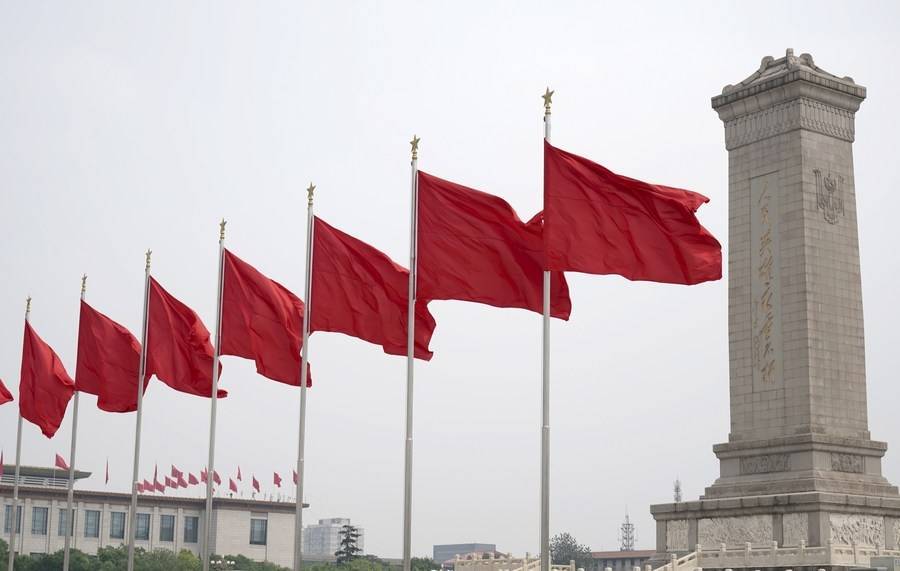
Five decades ago, the United Nations General Assembly (UNGA) voted to restore all lawful rights of the People’s Republic of China (PRC) in the United Nations, opening a new era of interaction between the Asian country and the world body.
Over the past 50 years, China has offered full support for the UN cause by upholding the purposes and principles of the UN Charter, played a constructive and increasingly important role in international affairs, and made great contributions to world peace and development, Xinhua news agency reported.
Upon the 50th anniversary of the restoration of its lawful seat in the United Nations, China has pledged to continue to be a builder of world peace, a contributor to global development, a defender of the international order and a provider of public goods.
Choice of history
On October 25, 1971, the UNGA at its 26th session adopted Resolution 2758 with an overwhelming majority to restore all the rights of the PRC and to recognize the representatives of its government as the only legitimate representatives of China to the United Nations.
“I have never seen such a resounding applause in my life,” said Iftikhar Ali, a Pakistani journalist who witnessed the moment, recalling that cheers and applause filled the air and people were hugging each other.
That moment came more than two decades after the founding of the PRC, which had been kept out of the international organization mainly due to the hostility of and obstruction by the United States.
Yet, from the 1950s to the early 1970s, the third world — mainly comprising newly independent countries in Asia, Africa and Latin America — gradually took shape and became a significant force in the world.
The profound transformation of the international landscape eventually broke the blockade of the United States and its allies, making the restoration of China’s lawful seat in the UN a historical inevitability.
Recalling the “historic meeting” in 1971, former Chilean President Ricardo Lagos Escobar, who was a member of his country’s delegation to the 26th session of the UNGA, said restoring China’s lawful seat strengthened the role of the world body and increased its representation at the global level.
“There was a sense that we were going to have a more realistic UN, more in line with what the world is, and in that sense, there was a feeling that the UN was being strengthened as the true place where international issues must be resolved,” Lagos said.
That echoes the view of former UN Secretary-General Ban Ki-moon. With the restoration of China’s lawful seat, “the United Nations became a universal organization in terms of its size and contents,” he told Xinhua in a recent interview.
Contributor to world peace, development
Over the past five decades, China — the world’s largest developing country and a permanent member of the UN Security Council — has proven to be a staunch supporter of the noble cause of the UN.
To help preserve world peace, China, holding high the banner of peace, development and win-win cooperation, has been committed to taking objective and just positions, resolving differences through dialogue and consultation, and the principle of non-interference in internal affairs of other countries.
Since 1990, it has dispatched over 50,000 peacekeepers to nearly 30 UN peacekeeping missions. It is the second largest funding contributor to UN peacekeeping operations and has contributed more peacekeepers than any other permanent member of the Security Council.
In terms of development, China has also made indelible contributions. By eliminating absolute poverty in China, it has met the poverty eradication target of the 2030 Agenda for Sustainable Development 10 years ahead of schedule, which stands as an enormous contribution to global poverty reduction and sustainable development endeavors.
Committed to common development, Chinese President Xi Jinping put forward in 2013 the Belt and Road Initiative, which has now become the largest platform for international cooperation, and is playing a significant role in keeping the world economy afloat against the impact of the COVID-19 pandemic.
In the spirit of building a community with a shared future for mankind, China has also been working tirelessly to advance international cooperation against such major threats as climate change. It has pledged to peak carbon dioxide emissions before 2030 and achieve carbon neutrality before 2060.
During the past five decades, China has not only made outstanding achievements in promoting its own political and economic development, but also “been actively engaged in the noble cause of peace and development in many places around the world,” Ban said.
“China has stood with pride and contributed to the international community,” commented Abdulla Shahid, president of the 76th session of the UNGA. “China has played a very, very important role in multilateralism and strengthening the United Nations.”
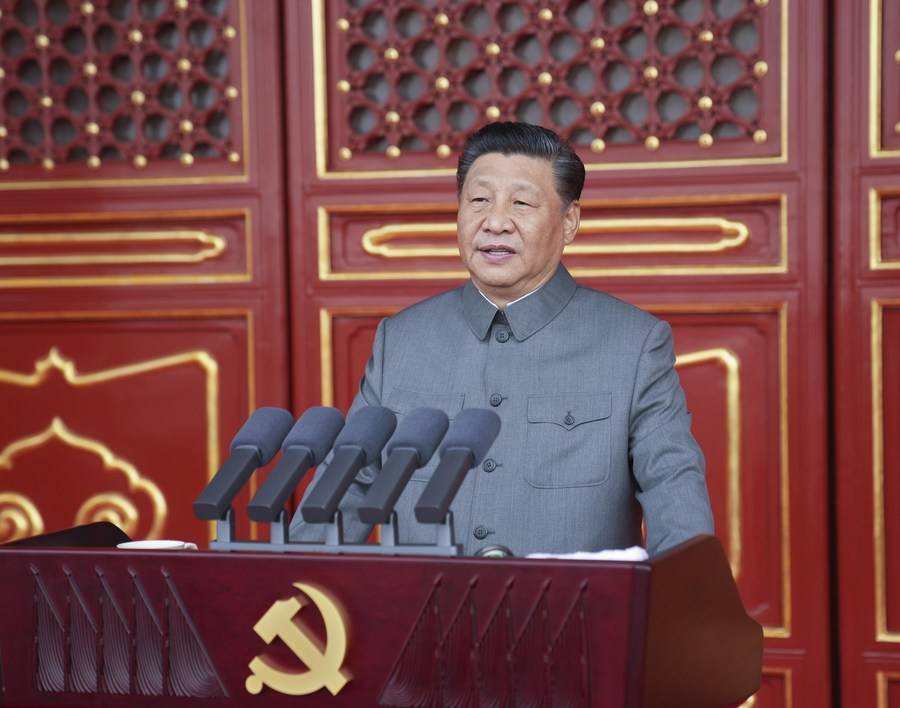
Champion of multilaterism
“Both climate change and COVID-19 have shown us that we, as a species, as humanity, we can survive only through multilateralism,” Shahid stressed in a recent exclusive interview with Xinhua.
“That is why China as a permanent member of the United Nations Security Council, as a responsible member of the international community, has a very important role to play,” he added.
Indeed, China has always been a staunch supporter and practitioner of true multilateralism over the past 50 years. In a newly published position paper, China says it believes that international affairs should be addressed through consultation by all, and that the future of the world should be decided by all countries together.
“China firmly opposes unilateralism, protectionism and bullying acts, and firmly rejects pseudo-multilateralism in such disguises as group politics and small circles,” said the position paper. “China is committed to making the global governance system more just and equitable.”
“In the world, there is only one international system, i.e. the international system with the United Nations at its core. There is only one international order, i.e. the international order underpinned by international law. There is only one set of rules, i.e. the basic norms governing international relations underpinned by the purposes and principles of the UN Charter,” President Xi stressed in his statement delivered via video at the general debate of the 76th session of the UNGA.
Those remarks struck a chord with Ali, the Pakistani journalist. “China has been a strong advocate of multilateralism, and it continues to be an important supporter of developing countries,” he said, adding that China has constantly insisted that decisions regarding international affairs should be reached through consultation between all members.
Looking into the future, China said it is ready to work with the international community to advocate peace, development, equity, justice, democracy and freedom, which are the common values of humanity, and advance the building of a community with a shared future for mankind.
Commenting on the vision of building a community with a shared future, Shahid said that “the COVID pandemic and climate change have clearly shown to us that we, as a species, can survive only if we work together.”