October 18, 2021
3 mins read

Boris to Lead Commons Tributes to David Amess

UK Home Secretary Priti Patel is considering offering lawmakers police protection at their surgeries, and the use of airport-style scanners was under consideration, reports Asian Lite Newsdesk

Prime Minister Boris Johnson will lead tributes to Sir David Amess, who was stabbed to death in an attack that is being treated as a terrorist incident by police, in the House of Commons on Monday.

This comes as debate rages about how drastically to step up security in the wake of the fatal attack on the Southend MP at his constituency surgery, the Guardian reported.

On Sunday night Amess’s family appealed for public unity, urging people to “set aside their differences and show kindness and love to all”.

In a statement, his relatives said they were “absolutely broken” but had drawn strength from the tributes to him from across the political spectrum.

The latest killing has reopened a debate about the safety of politicians as they conduct meetings with their constituents.

Many MPs insist on face-to-face meetings with constituents to discuss their problems and issues, known as a surgery, which is one of the hallmarks of political life in Britain.

The home secretary, Priti Patel, said on Sunday that she was considering offering MPs police protection at their surgeries, and the use of airport-style scanners was under consideration, it was reported.

Asked how quickly such measures could be brought in, Patel told Sky News that all MPs were being contacted by their local police forces. “This isn’t a case of let’s wait for two weeks, three weeks, four weeks. These are immediate changes, and measures that are actively being put in place, and it starts with MPs.”

She had also asked all police forces in Britain to review security arrangements for MPs with immediate effect following the attack.

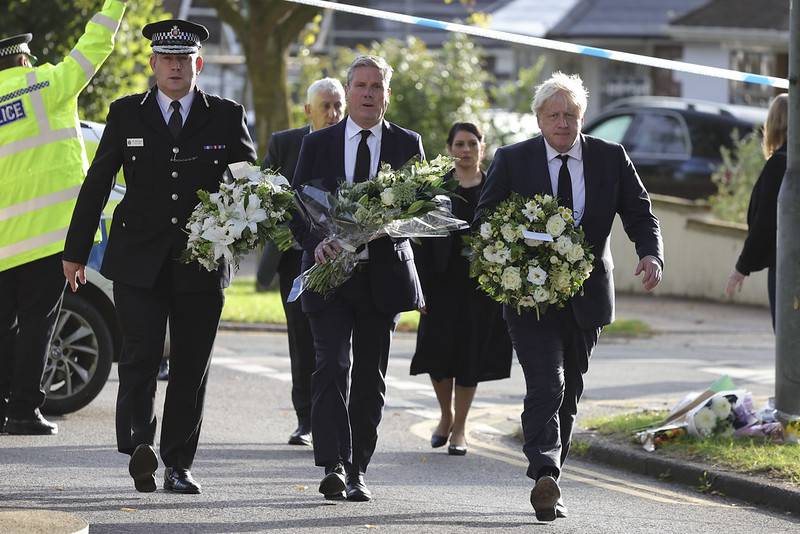
On Saturday, Prime Minister Johnson and Labour party leader, Sir Keir Starmer, paid tribute to David Amess.

Johnson and Starmer laid flowers at the front of Belfairs Methodist church in Leigh-on-Sea, Essex, where Amess was attacked on Friday while holding a meeting with his constituents.

Following the attack, the Essex Police said a 25-year-old UK citizen was arrested at the scene on suspicion of murder.

Earlier on Saturday, the Metropolitan Police announced that the fatal stabbing of the lawmakers had been declared a terrorist incident, with the investigation being led by the Counter Terrorism Command.

“The early investigation has revealed a potential motivation linked to Islamist extremism,” the force said in a statement.

As part of the investigation, police are currently carrying out searches at two addresses in the London area.

It is believed the suspect acted alone, police say.

Meanwhile, flags are flying at half-mast at 10 Downing Street and at the Houses of Parliament where Amess served as MP for Southend West in Essex.

Amess was the second MP in Britain to be murdered within five years. Yorkshire MP Jo Cox was murdered by a far-right extremist in 2016.

The murder of Amess has recalled a similar attack suffered by Labour lawmaker Jo Cox ahead of the Brexit referendum in 2016, and has prompted a review of the security of UK members of Parliament.

Earlier, Punjab-origin British Labour Party MP Tanmanjeet Singh Dhesi on Sunday expressed sadness at the tragic killing of Sir David Amess, who last week led a cross-party Parliamentary delegation to Qatar.

“Given increasing international importance of #Qatar, including in Afghanistan, and to foster greater ties between our nations, glad to join cross-party Parliamentary delegation last week, led by Sir David Amess, who was sadly brutally taken away from us upon his return to the UK,” Dhesi informed in a tweet.

In his earlier tweet, Dhesi said: “Having spent past week with Sir David Amess, I’m numbed that a gentleman of enormous experience, intellect and warmth has been taken away.”

“MPs must be able to serve without fear of attack. Will miss his smile and sense of humour. Heartfelt condolences to his family. May he RIP.”

ALSO READ-Tory MP David Amess Dies After Stabbing

READ MORE-UK pays tribute to much-loved MP

Previous Story

Sultan bin Khalifa receives President of Sierra Leone

Next Story

BAME and poorer Londoners face air quality risk

Previous Story

Sultan bin Khalifa receives President of Sierra Leone

Next Story

BAME and poorer Londoners face air quality risk

Latest from -Top News

Pakistan Risks Overstretching Itself in Yemen War

Pakistan’s expanding military role in Saudi Arabia amid the Yemen conflict could strain its defence resources and fragile finances…reports Asian Lite News Desk Pakistan’s military involvement in the war in Yemen may prove unsustainable because of mounting financial pressures and competing security demands, according to a new report. Islamabad’s growing military presence in Saudi Arabia risks stretching its defence resources while exposing the country to greater strategic and economic challenges. An article by Andrew Wilson in One World Outlook describes Pakistan’s involvement as a case of “fiscal and strategic overreach”, arguing that the country lacks the financial flexibility to sustain an expanded military commitment. Pakistan’s external finances depend heavily on an International Monetary Fund (IMF) programme, financial support from Gulf countries and remittances from Pakistani workers in the region. The report argues that deeper military involvement in the conflict could place additional pressure on these sources of financial stability. It also warns that deploying troops and military equipment abroad could weaken Pakistan’s capacity to address security challenges along its eastern border and deal with two domestic insurgencies. The move could also draw Islamabad into a conflict it has sought to approach cautiously. A Reuters report in May, citing Pakistani security and government sources, said Islamabad had deployed around 8,000 troops, a squadron of approximately 16 aircraft, mostly JF-17 fighter jets, two drone squadrons and a Chinese HQ-9 air-defence battery to Saudi Arabia. According to those sources, Riyadh was financing the deployment, with Pakistani personnel operating the equipment. The sources also said a confidential agreement contemplated the possibility of deploying up to 80,000 troops. Islamabad has not confirmed those figures, although it has acknowledged its military presence in Saudi Arabia, including the deployment of fighter jets at King Abdulaziz Air Base from April. The One World Outlook article argues that Saudi financial support can cover allowances and operating expenses but cannot easily replace military equipment needed elsewhere or resolve the political and strategic challenges of participating in the Yemen conflict. Pakistan’s defence budget is another concern. For the 2026-27 financial year, the federal government allocated PKR 3 trillion, or approximately $10.8 billion, to defence services. The allocation represents an 18 per cent increase from the original PKR 2.55 trillion provision and amounts to around 2.1 per cent of projected gross domestic product (GDP). Defence spending accounts for approximately 16 per cent of the federal government’s PKR 18.8 trillion expenditure. Military pensions are budgeted separately at PKR 822 billion, while debt servicing costs stand at approximately PKR 8 trillion, more than two-and-a-half times the defence allocation. The report argues that these competing financial obligations leave little room for additional military expenditure without placing further pressure on public finances. Pakistan’s reliance on IMF assistance also limits its fiscal flexibility. The country must meet the conditions attached to the programme, including a primary budget surplus target of 2 per cent of GDP and continued restraint on development spending. According to the article, these requirements make it difficult for Islamabad to finance an additional military commitment without compromising other budgetary priorities. Pakistan’s economic indicators offer limited reassurance. Economic growth for the 2025-26 financial year is estimated at between 3.6 and 3.7 per cent, while inflation reached approximately 10.3 per cent in September following an energy price shock. Foreign exchange reserves stood at around $21.5 billion at the end of September. Although this marks an improvement from the low levels recorded in 2023, the report notes that the reserves cover only a few months of imports. Financial assistance from Gulf partners remains central to Pakistan’s external stability. The article says Islamabad holds approximately $8 billion in Saudi deposits at its central bank. In July, the State Bank of Pakistan said Riyadh had extended the maturity of $5 billion in deposits to December 2028, easing the country’s immediate external financing requirements. A further $3 billion deposit was also extended in the spring. However, the article argues that these arrangements provide temporary relief rather than long-term financial independence, particularly as regional conflict threatens the stability of the Gulf economies on which Pakistan relies. The report concludes that Pakistan faces a difficult balance between supporting Saudi Arabia militarily and preserving the financial and military resources needed to address its domestic and regional challenges.
Go toTop

Don't Miss

UK puts army on standby to tackle fuel crisis

The military drivers will now receive specialised training before deploying,

Lalit Modi fights legal challenge in UK court

However, Maag says this meant losses for her as she