August 17, 2022
2 mins read

Teesta moves SC seeking bail

In her appeal before the apex court, Setalvad has taken objection to a long gap of one-and-a-half months in the hearing of her bail application…reports Asian Lite News

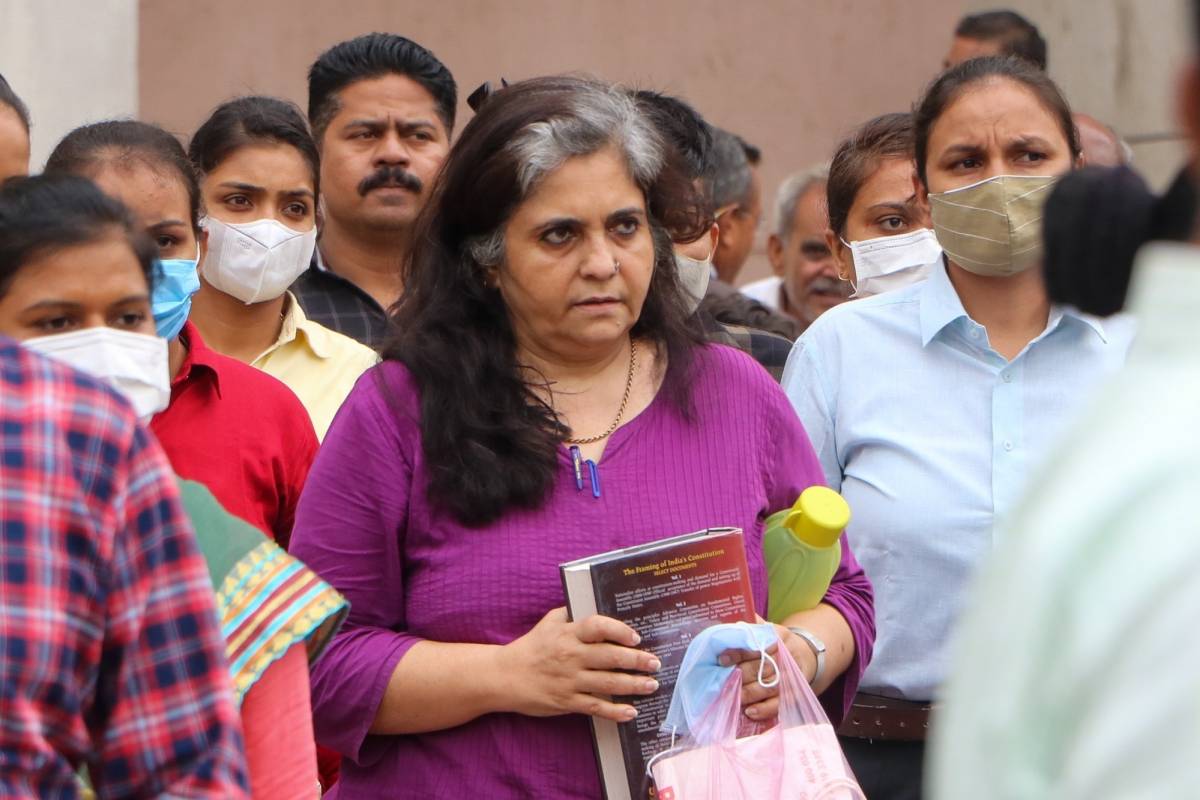
Activist Teesta Setalvad has moved the Supreme Court seeking bail after she was arrested for allegedly fabricating documents to frame high-ranking officials, including then Gujarat Chief Minister Narendra Modi, in the 2002 riots cases.

A bench headed by Chief Justice N.V. Ramana and comprising justices J.K. Maheshwari and Hima Kohli said: “Upon being mentioned by Aparna Bhat, Advocate on Record for the petitioner seeking urgent listing of the matter, the registry is directed to list the matter on August 22 before a bench presided over by Justice Uday Umesh Lalit.”

Earlier this month, the Gujarat High Court had issued a notice to the SIT seeking a reply to the bail applications filed by Setalvad and former Gujarat DGP R.B. Sreekumar. The high court is scheduled to hear the matter in September.

In her appeal before the apex court, Setalvad has taken objection to a long gap of one-and-a-half months in the hearing of her bail application, and cited the ruling of the top court in the Satendar Kumar Antil vs CBI case, contending that bail matters must be heard expeditiously.

In July, a session court in Ahmedabad had declined to grant bail to her and Sreekumar. Rejecting the bail application, the court had noted: “If the applicants are enlarged on bail, it would impliedly encourage to the wrong doers that in spite of such type of accusations against the then Chief Minister and others, the court has enlarged the accused on bail. Therefore, looking at the above facts and circumstances, even though the applicant is a lady and another is a retired IPS officer and aged person, they are not required to be enlarged on bail.”

On June 24, the Supreme Court had dismissed the an appeal filed by Zakia Jafri, the wife of Congress leader Ehsan Jafri who was killed during the violence at Ahmedabad’s Gulberg Society in 2002, challenging the SIT’s clean chit to then Gujarat CM Narendra Modi and others during the riots in the state.

A bench headed by Justice A.M. Khanwilkar said intriguingly, the present proceedings have been pursued for last 16 years (from submission of complaint dated June 8, 2006 running into 67 pages and then by filing 514-page protest petition dated April 15, 2013), including with the audacity to question the integrity of every functionary involved in the process of exposing the devious stratagem adopted.

“To keep the pot boiling, obviously, for ulterior design. As a matter of fact, all those involved in such abuse of process, need to be in the dock and proceeded with in accordance with law,” the top court had said.
ALSO READ: India, Sri Lanka to issue stamps on democracy

Previous Story

Roads flooded as heavy rain hit parts of Britain

Next Story

‘Govt working in spirit of cooperative federalism’

Previous Story

Roads flooded as heavy rain hit parts of Britain

Next Story

‘Govt working in spirit of cooperative federalism’

Latest from Asia News

Economic tide is turning in Bangladesh

If there is one thing that can bring some comfort to the struggling Bangladeshi economy, it is good relations with India. Bangladesh should remember that Delhi’s backing, through easy supplies of essentials

DP World Lands 15-Year Bangladesh Port Deal

The agreement between the Chittagong Port Authority (CPA) and DP World covers the New Mooring Container Terminal…reports Asian Lite News Desk Bangladesh has signed a 15-year concession agreement with global ports operator

Nepal Floods Cause $1.66 Billion In Damage, Says World Bank

Nepal’s August 2026 floods caused an estimated US$1.66 billion in direct physical damage, with infrastructure accounting for 83 per cent of the total…reports Asian Lite News Desk Nepal’s devastating floods in August 2026 caused an estimated US$1.66 billion in direct physical damage, with infrastructure accounting for 83 per cent of the total, according to a World Bank report. The estimate, included in the World Bank’s Nepal Development Update unveiled this week, is close to the Nepal government’s preliminary Rapid Damage and Needs Assessment (RDNA), which put physical damage at US$1.81 billion. The government’s assessment also estimated losses beyond physical assets at US$883.32 million, taking the total economic effects of the disaster to approximately US$2.7 billion. The World Bank’s Global Rapid Post-Disaster Damage Estimation (GRADE) found that infrastructure suffered the greatest damage, estimated at US$1.38 billion, or 83 per cent of the total. Residential buildings accounted for US$185 million, or 11 per cent, while non-residential buildings sustained damage worth US$101 million, or 6 per cent. The floods along the Bhotekoshi and Trishuli rivers caused extensive damage to hydropower projects, solar energy facilities, electricity transmission infrastructure and transport networks. The energy sector, particularly hydropower, was among the worst affected. The August 2026 floods affected 12 hydropower projects and one solar project, involving 281.1 MW of operational capacity and 395.02 MW of capacity under construction. Damage to transmission lines and substations also disrupted the transmission of 149.6 MW of electricity to the national grid. The total affected capacity reached approximately 430.7 MW, equivalent to 10.6 per cent of Nepal’s installed hydropower and solar capacity at the end of fiscal year 2025-26, which concluded in mid-July. The disaster also severely damaged transport infrastructure along the 82-km Rasuwa trade corridor, which connects Kathmandu with the Rasuwagadhi border point with China. More than 55 km of the corridor was damaged, including 40 km that was completely destroyed. The floods also damaged 37 motorable bridges and 68 suspension bridges. The disaster resulted in significant human losses along the affected corridor and beyond. According to Nepal’s National Disaster Risk Reduction and Management Authority, 1,455 people had been confirmed dead, while 5,285 remained missing following the disaster. The World Bank report found that the physical damage was concentrated in three districts in central Nepal: Rasuwa, Nuwakot and Dhading. Rasuwa was the worst-affected district, accounting for US$1.07 billion, or 64 per cent, of the total direct damage. Nuwakot recorded an estimated US$551 million in damage, while Dhading suffered approximately US$39 million. “The findings highlight the concentration of physical damage in a small number of districts and the disproportionate impact on infrastructure, underscoring the scale of the reconstruction challenge facing the affected areas,” the World Bank said. The global development financier said the floods had demonstrated the scale and complexity of disaster risks in Nepal’s Himalayan environment. The event also showed how a single extreme weather event could trigger cascading impacts across sectors and geographical areas. The report said recovery efforts should extend beyond restoring infrastructure to its pre-disaster condition. While the principle of “Build Back Better” remained relevant, the World Bank stressed that rebuilding infrastructure to higher engineering standards in the same locations might not always be sufficient. “In some cases, simply rebuilding the same infrastructure in the same location to a higher engineering standard may not be sufficient. Nepal may need to build differently — based on a better understanding of risk, more careful decisions about location and design, greater redundancy in critical networks, stronger monitoring and early warning, and a more integrated approach to infrastructure development in the Himalayas,” the report said. The World Bank said Nepal’s recovery strategy should incorporate improved risk assessment, more informed infrastructure planning, stronger monitoring systems and better early warning mechanisms. The report emphasised that reconstruction should not only restore damaged assets but also reduce the impact of future disasters, particularly in the country’s vulnerable Himalayan regions.

Vaccine Delays Fuel Bangladesh Measles Outbreak

More than 32,000 suspected cases and over 250 deaths have been reported since mid-March, with children making up most of the fatalities….reports Asian Lite News Desk Bangladesh’s measles outbreak has intensified, with
Go toTop

Don't Miss

Vijayan says Kerala-TN ties mode of cooperative federalism 

Vijayan, who shares a special friendship with Stalin, said the

A Decade of Economic Transformation in India

The economy, in the past ten years, not only just