December 28, 2022
4 mins read

India had become the voice of Global South, says Kamboj

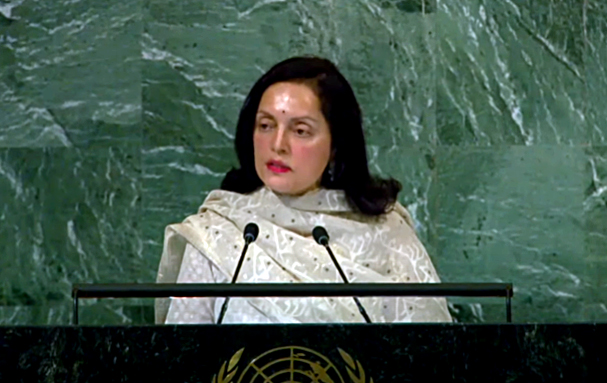
India’s Permanent Representative to the UN, Ruchira Kamboj says New Delhi has reinforced commitment to multilateralism and UN reforms during its two-year tenure at the United Nations Security Council…reports Asian Lite News

Highlighting India’s two-year tenure at the United Nations Security Council, which is coming to an end on December 31, India’s Permanent Representative to the UN, Ruchira Kamboj on Wednesday said New Delhi was the voice of the entire Global South, and reinforced commitment to multilateralism and UN reforms.

Ambassador Kamboj said, “We were the voice of the entire Global South and we reinforced our commitment to the basic principles, including multilateralism, rule of law, and fair and equitable international system.” India assumed the monthly rotating presidency of the UN Security Council (UNSC) on December 1, the second time in its two-year tenure, as an elected member of the Council in 2021-22. India had earlier assumed the UNSC presidency in August 2021.

Summing up last two years for Indian Mission at UN, underscoring India’s December Presidency, she said, “At the high-level week of UNGA in 2020, where we before entered the Security Council, our Prime Minister Narendra Modi had said that we will use the prestige and experience of being the largest democracy in the world for the benefit of the whole world.”

Lauding India’s tenure and achievements, Kamboj said, “We can take pride in saying that India stood by those words. In the last two years, we spoke out in support of peace, security and prosperity. We did not hesitate in raising our voice against the common enemies of humanity, such as, terrorism.”

She emphasised that India raised voice against terrorism in these two years, bringing attention to its various expressions which need to be addressed by the international community through solidarity and unity.

“In October 2022 as you all know, we brought the Security Council, the famous horse-shoe table to India for the very first time, adopting the Delhi Declaration, where the Security Council spoke with one voice in countering terrorism in all its forms and manifestations,” said the Indian envoy to the UN to ANI.

She reiterated that India brought the Council together in presenting a united front against terrorism.

“In keeping up with the momentum, we piloted statement on counter-terrorism and during our December Presidency, we once again brought the Council together in presenting a united front against terrorism,” she added.

On multilateralism and reforms in UN, she said, “We focussed our attention to the urgent need of reformed multilateralism through a signature event on December 14, for it to be fit for the purpose that UN needs to be urgently reformed to deal those with current and future challenges”.

Over 70 countries participated in an open discussion chaired by External Affairs Minister S Jaishankar and many affirmed support to India in an expanded Security Council.
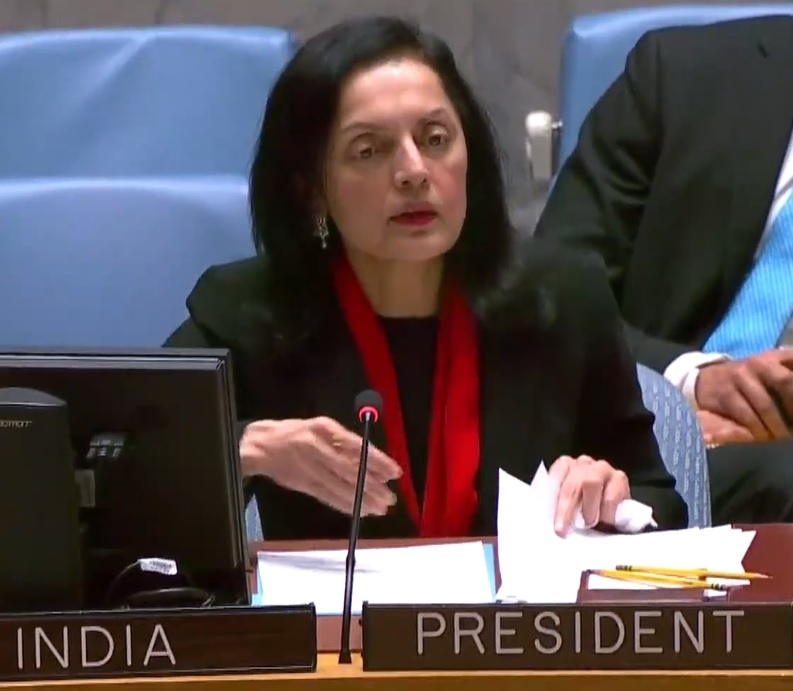
Caption for MyanmarUNSC.jpg: India’s Permanent Representative Ruchira Kamboj preisdes over a meeting of the United Nations Security Council meeting on Myanmar on Wednesday, December 21, 2023. (Photo Source: UN)

She also dwelt on the unveiling of a bust of Mahatma Gandhi at the United Nations Headquarters in New York.

Secretary General of the United Nations Antonio Guterres and the President of the 77th UN General Assembly Csaba Korosi and Permanent Representative Ambassador Ruchira Kamboj joined the EAM for the unveiling of the bust.

“Significantly, and again during December Presidency Gandhiji arrived at UN Headquarters, when the very first sculpture of Mahatma Gandhi was unveiled by EAM in the North lawn Gardens of UN in the presence of UN Secretary-General and the President of UN General Assembly . He will remain here now as beacon and symbol of peace,” she said.

On maritime security, Kamboj said until not too long ago, the Security Council was focused only on the issue of piracy, whereas maritime security encompasses far larger issues as well as a large troop-contributing country.

“During our August Presidency of 2021, we organized an open debate on maritime security. As you may recall, this was the first time that Indian Prime Minister chaired the Security Council meeting. It was also the first time that Security Council had adopted a product in a holistic manner on maritime security, whereas earlier, it was focussed only on piracy and armed robbery,” said Kamboj.

“As a large troop contributing country, we also brought attention to peace-keeping in August 2021, piloting Resolution 2589, which was adopted in a meeting chaired by EAM Jaishankar. It calls for accountability in cases of crimes against peace-keepers,” she added.

The Indian envoy said overall, India’s has been an effective presence in the Council as it was leaving behind the imprint of a caring and contributive country.

“We are only elected member to hold two Presidencies during its tenure in the Security Council this time. While, the UAE Mission applauded us in avwrap-up session as a veteran Security Council member with a principled foreign policy and a constructive approach, the Swiss Mission to UN complimented us for an extremely efficient December Presidency — managing in three weeks what is usually done in four,” said Kamboj. (ANI)
ALSO READ: Moscow-led CIS backs India’s connectivity plan using Chabahar

Previous Story

US winter storm death toll rises

Next Story

Innovation turns discarded food into renewable energy source

Previous Story

US winter storm death toll rises

Next Story

Innovation turns discarded food into renewable energy source

Latest from -Top News

Pakistan Risks Overstretching Itself in Yemen War

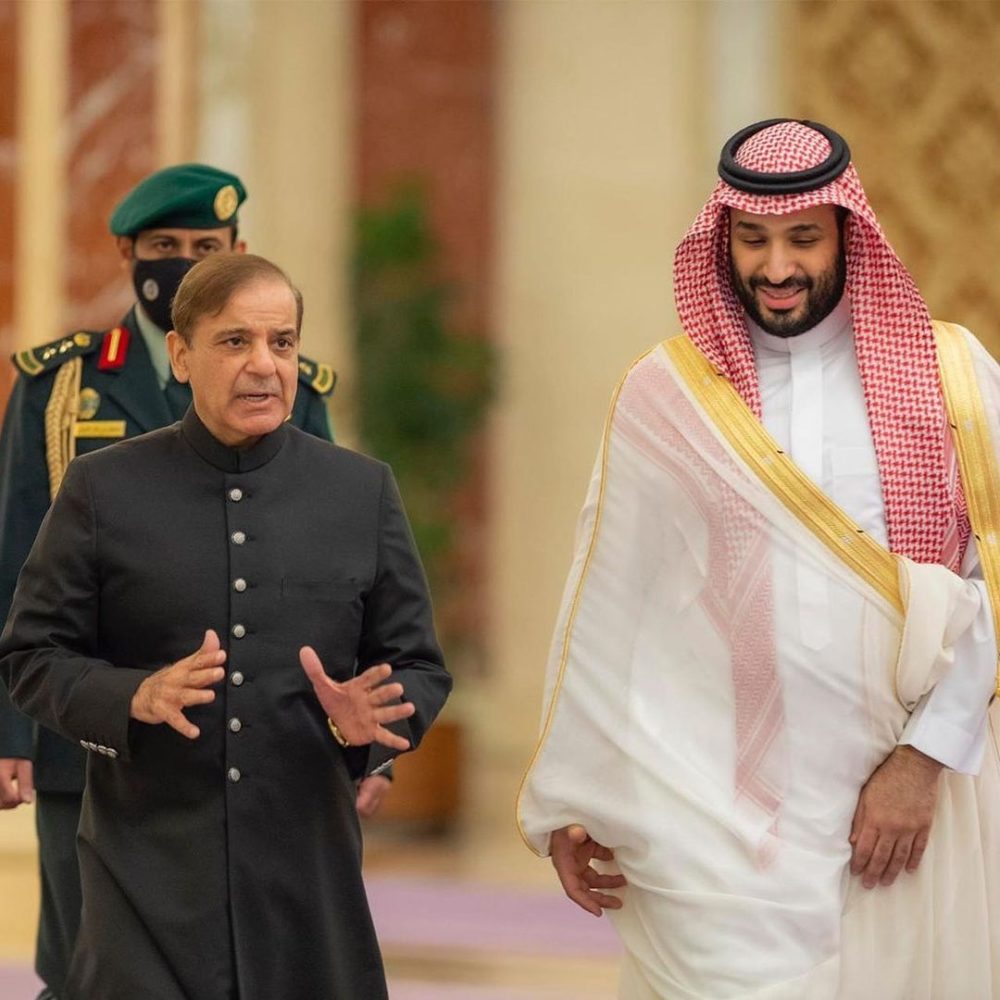
Pakistan’s expanding military role in Saudi Arabia amid the Yemen conflict could strain its defence resources and fragile finances…reports Asian Lite News Desk Pakistan’s military involvement in the war in Yemen may prove unsustainable because of mounting financial pressures and competing security demands, according to a new report. Islamabad’s growing military presence in Saudi Arabia risks stretching its defence resources while exposing the country to greater strategic and economic challenges. An article by Andrew Wilson in One World Outlook describes Pakistan’s involvement as a case of “fiscal and strategic overreach”, arguing that the country lacks the financial flexibility to sustain an expanded military commitment. Pakistan’s external finances depend heavily on an International Monetary Fund (IMF) programme, financial support from Gulf countries and remittances from Pakistani workers in the region. The report argues that deeper military involvement in the conflict could place additional pressure on these sources of financial stability. It also warns that deploying troops and military equipment abroad could weaken Pakistan’s capacity to address security challenges along its eastern border and deal with two domestic insurgencies. The move could also draw Islamabad into a conflict it has sought to approach cautiously. A Reuters report in May, citing Pakistani security and government sources, said Islamabad had deployed around 8,000 troops, a squadron of approximately 16 aircraft, mostly JF-17 fighter jets, two drone squadrons and a Chinese HQ-9 air-defence battery to Saudi Arabia. According to those sources, Riyadh was financing the deployment, with Pakistani personnel operating the equipment. The sources also said a confidential agreement contemplated the possibility of deploying up to 80,000 troops. Islamabad has not confirmed those figures, although it has acknowledged its military presence in Saudi Arabia, including the deployment of fighter jets at King Abdulaziz Air Base from April. The One World Outlook article argues that Saudi financial support can cover allowances and operating expenses but cannot easily replace military equipment needed elsewhere or resolve the political and strategic challenges of participating in the Yemen conflict. Pakistan’s defence budget is another concern. For the 2026-27 financial year, the federal government allocated PKR 3 trillion, or approximately $10.8 billion, to defence services. The allocation represents an 18 per cent increase from the original PKR 2.55 trillion provision and amounts to around 2.1 per cent of projected gross domestic product (GDP). Defence spending accounts for approximately 16 per cent of the federal government’s PKR 18.8 trillion expenditure. Military pensions are budgeted separately at PKR 822 billion, while debt servicing costs stand at approximately PKR 8 trillion, more than two-and-a-half times the defence allocation. The report argues that these competing financial obligations leave little room for additional military expenditure without placing further pressure on public finances. Pakistan’s reliance on IMF assistance also limits its fiscal flexibility. The country must meet the conditions attached to the programme, including a primary budget surplus target of 2 per cent of GDP and continued restraint on development spending. According to the article, these requirements make it difficult for Islamabad to finance an additional military commitment without compromising other budgetary priorities. Pakistan’s economic indicators offer limited reassurance. Economic growth for the 2025-26 financial year is estimated at between 3.6 and 3.7 per cent, while inflation reached approximately 10.3 per cent in September following an energy price shock. Foreign exchange reserves stood at around $21.5 billion at the end of September. Although this marks an improvement from the low levels recorded in 2023, the report notes that the reserves cover only a few months of imports. Financial assistance from Gulf partners remains central to Pakistan’s external stability. The article says Islamabad holds approximately $8 billion in Saudi deposits at its central bank. In July, the State Bank of Pakistan said Riyadh had extended the maturity of $5 billion in deposits to December 2028, easing the country’s immediate external financing requirements. A further $3 billion deposit was also extended in the spring. However, the article argues that these arrangements provide temporary relief rather than long-term financial independence, particularly as regional conflict threatens the stability of the Gulf economies on which Pakistan relies. The report concludes that Pakistan faces a difficult balance between supporting Saudi Arabia militarily and preserving the financial and military resources needed to address its domestic and regional challenges.

UK and Germany Ratify Kensington Treaty

Britain and Germany ratify the Kensington Treaty, agreeing new cooperation on AI, quantum research, defence and security while targeting investment, jobs and Russian hybrid threats…reports Asian Lite News Desk Britain and Germany

Economic tide is turning in Bangladesh

If there is one thing that can bring some comfort to the struggling Bangladeshi economy, it is good relations with India. Bangladesh should remember that Delhi’s backing, through easy supplies of essentials
Go toTop

Don't Miss

Startup20 Engagement Group holds inception meeting

Startup20 Chair, Dr Chintan Vaishnav launched the Startup 20X, which

Modi busy in his US trip

The meeting that drew the most attention was with Tesla