The move comes amid growing concern by the US and allies about China’s growing military assertiveness in the Pacific, reports Asian Lite News
The United States, United Kingdom and Australia plan to work together via the recently created security alliance known as AUKUS to develop hypersonic missiles, according to a Biden administration official. An announcement could come as soon as Tuesday.
The move comes amid growing concern by the US and allies about China’s growing military assertiveness in the Pacific. The US official was not authorized to comment publicly and spoke on the condition of anonymity to discuss the plans.
The US, Russia and China have all looked to develop hypersonic missiles a system so fast that it cannot be intercepted by any current missile defense system.
In October, Gen. Mark Milley, the chairman of the Joint Chiefs of Staff, confirmed that China had conducted a test of a hypersonic weapon system as part of its aggressive effort to advance in space and military technologies.
Milley described the Chinese test as a “very significant event of a test of a hypersonic weapon system, and it is very concerning, in a Bloomberg Television interview.
The Pentagon’s 2023 budget request already includes $4.7 billion for research and development of hypersonic weapons. It includes planning that would have a hypersonic missile battery fielded by next year, a sea-based missile by 2025 and an air-based cruise missile by 2027.
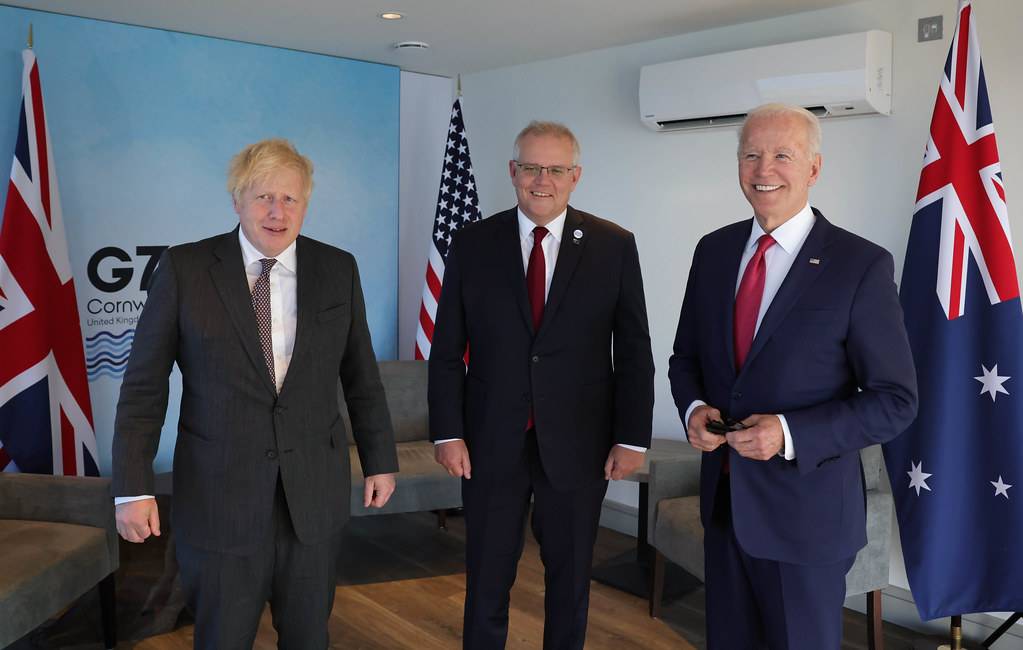
President Joe Biden, British Prime Minister Boris Johnson and Australian Prime Minister Scott Morrison in September announced the creation of AUKUS, a new Indo-Pacific security alliance that will allow for greater sharing of defense capabilities, including helping equip Australia with nuclear-powered submarines.
The latest AUKUS plan was first reported by the Financial Times.
“We reaffirmed our commitment to AUKUS and to a free and open Indo-Pacific. In light of Russia’s unprovoked, unjustified, and unlawful invasion of Ukraine, we reiterated our unwavering commitment to an international system that respects human rights, the rule of law, and the peaceful resolution of disputes free from coercion. We are pleased with the progress in our trilateral programme for Australia to establish a conventionally armed, nuclear‑powered submarine capability. We are fully committed to establishing a robust approach to sharing naval propulsion technology with Australia that strengthens the global non-proliferation regime.” The three leaders said in a statement.
One British official said the UK, which has no hypersonic weapon systems, will pool its scientific resources with the US and Australia, which have a joint programme to develop hypersonic cruise missile technology.
London will then decide whether to develop its own hypersonic programme or to focus on counter hypersonic systems.
“Hypersonic missiles are hard to target, travel very fast and can overcome area denial capabilities,” said another UK official, referring to anti-missile defence systems. “We need to think best how to exploit this technology and defend ourselves.”
ALSO READ-US sanctions key actors in Iran’s ballistic missile programme