June 9, 2022
3 mins read

Boris to promise a return to a strong economy

Part of the reset includes a speech in northwest England on Thursday to “set out a clear vision to continue to tackle the rising cost of living”, his Downing Street office said…reports Asian Lite News

Prime Minister Boris Johnson will on Thursday outline plans to tackle Britain’s cost-of-living crisis, as he seeks to move on from a damaging series of scandals and a confidence vote called by his own MPs.

Johnson won the vote but with 40 percent of his own side refusing to back him, he was likened to a “Monty Python” character who refuses to admit he is mortally wounded following another harrowing week.

The Conservative leader on Wednesday faced parliament for the first time since surviving the vote, which commentators said had left his scandal-tainted premiership still in peril.

Backers in the House of Commons staged a noisy show of support at his weekly question-and-answer session. But Tory rebels sitting behind looked glum and laughed along with opposition jibes.

Johnson has called his 211-148 victory “decisive” and wants to move on from repeated calls for him to resign over the “Partygate” scandal about lockdown-breaching parties in Downing Street.

“As for jobs, I’m going to get on with mine,” he reiterated in the Commons, after defending his government’s record on employment, health and Ukraine.

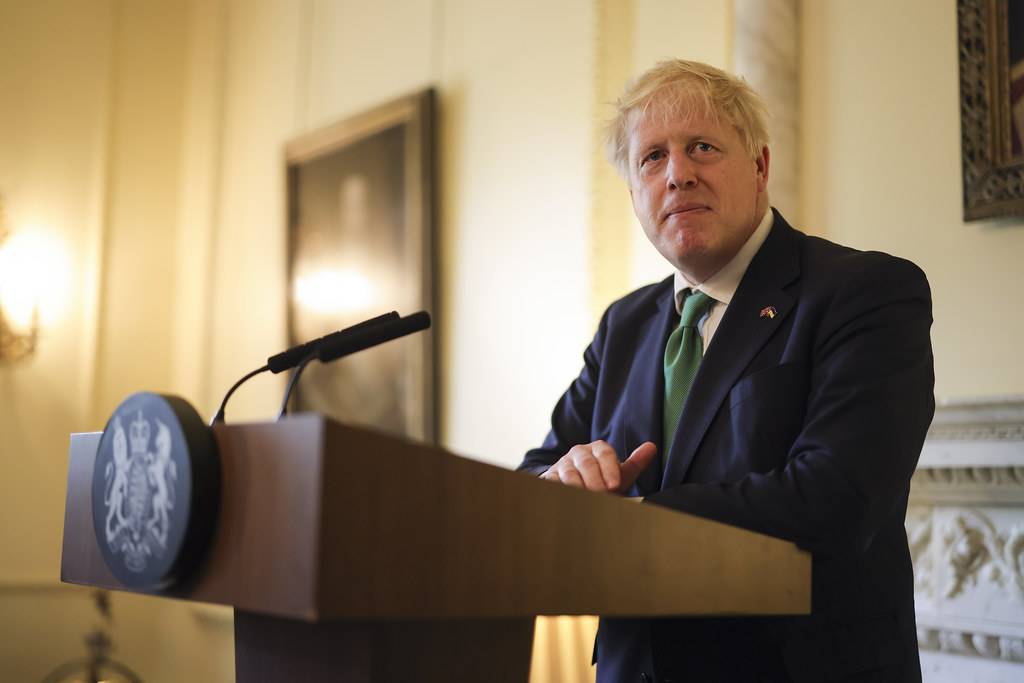
Part of the reset includes a speech in northwest England on Thursday to “set out a clear vision to continue to tackle the rising cost of living”, his Downing Street office said.

“We have the tools we need to get on top of rising prices. The global headwinds are strong. But our engines are stronger,” he will say.

“And, while it’s not going to be quick or easy, you can be confident that things will get better, that we will emerge from this a strong country with a healthy economy.”

Johnson faced repeated taunts on Wednesday about Monday’s vote, including comparisons to Monty Python’s “Black Knight” character, who declares “it’s just a flesh wound” when he has his arms and legs chopped off in a duel.

“No amount of delusion and denial will save the prime minister from the truth: this story won’t go away until he goes away,” said the Scottish National Party’s Westminster leader Ian Blackford.

Johnson’s Tory opponents fear that public disgust over “Partygate” is crippling their party’s electoral chances.

Some want a return to “Conservative values” including lower taxes after the Covid-19 pandemic.

Downing Street has set the stage for a policy blitz in the coming days, including on Britain’s skewed property market, where sky-high prices have deprived younger people of the hope of home ownership.

Johnson’s enemies on his own side still appear to be manoeuvring, with reports he faces a “war of attrition” and “vote strikes” to paralyse the government’s legislative agenda.

Such “vote strikes” hurt Theresa May’s three-year stint in Downing Street, before she was brought down in 2019 by Johnson and his allies over how to execute Britain’s departure from the European Union.

The Conservatives are braced for two parliamentary by-elections this month, and an upcoming investigation by MPs into whether Johnson lied to parliament over Partygate.

“Johnson achieved a remarkable election victory in 2019. But he has let things slide since then,” former cabinet member David Davis, who voted against him Monday, wrote in The Times.

“His victory in (Monday’s) vote provides his last chance to get his act together.”

Under current Tory rules Johnson cannot be challenged again for a year, which leaves little time for any new leader to emerge before the next general election due by 2024.

ALSO READ-Boris faces Parliament for 1st time since trust vote 

Previous Story

Oil prices are yet to peak: UAE energy minister

Next Story

Bin Touq leads delegation on visit to Morocco

Previous Story

Oil prices are yet to peak: UAE energy minister

Next Story

Bin Touq leads delegation on visit to Morocco

Latest from -Top News

Pakistan Risks Overstretching Itself in Yemen War

Pakistan’s expanding military role in Saudi Arabia amid the Yemen conflict could strain its defence resources and fragile finances…reports Asian Lite News Desk Pakistan’s military involvement in the war in Yemen may prove unsustainable because of mounting financial pressures and competing security demands, according to a new report. Islamabad’s growing military presence in Saudi Arabia risks stretching its defence resources while exposing the country to greater strategic and economic challenges. An article by Andrew Wilson in One World Outlook describes Pakistan’s involvement as a case of “fiscal and strategic overreach”, arguing that the country lacks the financial flexibility to sustain an expanded military commitment. Pakistan’s external finances depend heavily on an International Monetary Fund (IMF) programme, financial support from Gulf countries and remittances from Pakistani workers in the region. The report argues that deeper military involvement in the conflict could place additional pressure on these sources of financial stability. It also warns that deploying troops and military equipment abroad could weaken Pakistan’s capacity to address security challenges along its eastern border and deal with two domestic insurgencies. The move could also draw Islamabad into a conflict it has sought to approach cautiously. A Reuters report in May, citing Pakistani security and government sources, said Islamabad had deployed around 8,000 troops, a squadron of approximately 16 aircraft, mostly JF-17 fighter jets, two drone squadrons and a Chinese HQ-9 air-defence battery to Saudi Arabia. According to those sources, Riyadh was financing the deployment, with Pakistani personnel operating the equipment. The sources also said a confidential agreement contemplated the possibility of deploying up to 80,000 troops. Islamabad has not confirmed those figures, although it has acknowledged its military presence in Saudi Arabia, including the deployment of fighter jets at King Abdulaziz Air Base from April. The One World Outlook article argues that Saudi financial support can cover allowances and operating expenses but cannot easily replace military equipment needed elsewhere or resolve the political and strategic challenges of participating in the Yemen conflict. Pakistan’s defence budget is another concern. For the 2026-27 financial year, the federal government allocated PKR 3 trillion, or approximately $10.8 billion, to defence services. The allocation represents an 18 per cent increase from the original PKR 2.55 trillion provision and amounts to around 2.1 per cent of projected gross domestic product (GDP). Defence spending accounts for approximately 16 per cent of the federal government’s PKR 18.8 trillion expenditure. Military pensions are budgeted separately at PKR 822 billion, while debt servicing costs stand at approximately PKR 8 trillion, more than two-and-a-half times the defence allocation. The report argues that these competing financial obligations leave little room for additional military expenditure without placing further pressure on public finances. Pakistan’s reliance on IMF assistance also limits its fiscal flexibility. The country must meet the conditions attached to the programme, including a primary budget surplus target of 2 per cent of GDP and continued restraint on development spending. According to the article, these requirements make it difficult for Islamabad to finance an additional military commitment without compromising other budgetary priorities. Pakistan’s economic indicators offer limited reassurance. Economic growth for the 2025-26 financial year is estimated at between 3.6 and 3.7 per cent, while inflation reached approximately 10.3 per cent in September following an energy price shock. Foreign exchange reserves stood at around $21.5 billion at the end of September. Although this marks an improvement from the low levels recorded in 2023, the report notes that the reserves cover only a few months of imports. Financial assistance from Gulf partners remains central to Pakistan’s external stability. The article says Islamabad holds approximately $8 billion in Saudi deposits at its central bank. In July, the State Bank of Pakistan said Riyadh had extended the maturity of $5 billion in deposits to December 2028, easing the country’s immediate external financing requirements. A further $3 billion deposit was also extended in the spring. However, the article argues that these arrangements provide temporary relief rather than long-term financial independence, particularly as regional conflict threatens the stability of the Gulf economies on which Pakistan relies. The report concludes that Pakistan faces a difficult balance between supporting Saudi Arabia militarily and preserving the financial and military resources needed to address its domestic and regional challenges.

UK and Germany Ratify Kensington Treaty

Britain and Germany ratify the Kensington Treaty, agreeing new cooperation on AI, quantum research, defence and security while targeting investment, jobs and Russian hybrid threats…reports Asian Lite News Desk Britain and Germany

Economic tide is turning in Bangladesh

If there is one thing that can bring some comfort to the struggling Bangladeshi economy, it is good relations with India. Bangladesh should remember that Delhi’s backing, through easy supplies of essentials
Go toTop

Don't Miss

UAE, Indonesia discuss boosting economic ties at Expo

The UAE Ministry of Finance and its Indonesian counterpart have

UK cuts Covid self-isolation period to boost economy

Javid noted that data from the UK Health Security Agency