This will be one of the longest missions for the rocket as well as for Indian Space Research Organisation (ISRO), reports Venkatachari Jagannathan
India’s Polar Satellite Launch Vehicle-C57 (PSLV-C57) lifted off with the country’s Aditya-L1 spacecraft to study the Sun, on Saturday morning.
The PSLV-XL variant rocket carries the 1,480.7 kg Aditya-L1 spacecraft as its sole passenger that will study the solar activities.
The 44.4 metre tall PSLV-C57 rocket with a lift off mass of 321 ton carrying Aditya-L1 — named after the Sun God in Hindu mythology — blasted off from the second launch pad at the Satish Dhawan Space Centre (SDSC) here at 11.50 a.m.
Slowly rising up towards the skies with a thick orange flame at its tail, the rocket gained speed with a sound resembling rolling thunder and went up and up leaving a thick plume while the people assembled at the viewing gallery clapped their hands with pride.
Interestingly, this will be one of the longest missions for the rocket as well as for Indian Space Research Organisation (ISRO).
About 63 minutes after the lift off, the rocket will eject Aditya-L1 and the whole mission comes to an end at about 73 minutes with the passivation of the fourth stage.
“We have to meet the argument of perigee of the satellite. For that we are following two burn strategies for the fourth stage. After first burn there is a long coasting to achieve the argument of perigee that occurs naturally,” Dr S. Unnikrishnan, Director, Vikram Sarabhai Space Centre (VSSC) told IANS about the long flight duration.
The flight plan includes switching off the rocket’s fourth stage twice, allowing it to coast for about 30 minutes – 26 minutes after the first cut off and about 3 minutes after the second cut off.
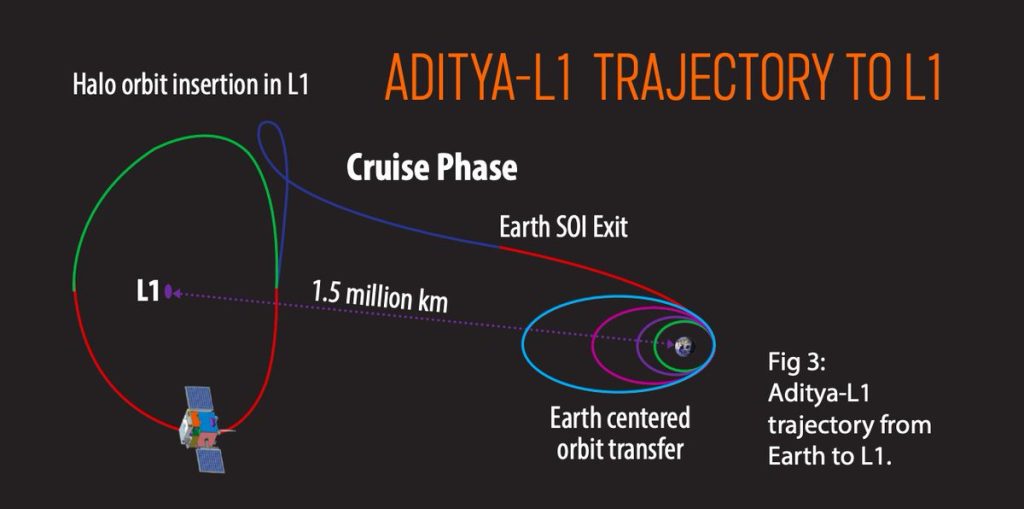
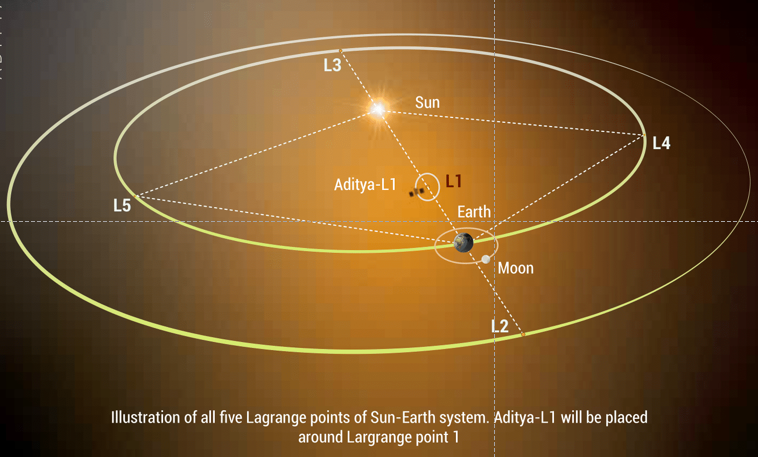
Initially, Aditya-L1 will be ejected in a low earth orbit (LEO). Then the orbit will be elliptical. As the spacecraft travels towards the Sun-Earth Lagrange Point (L1), it will exit the earth’s gravitational Sphere of Influence (SOI).
After exit from SOI, the cruise phase will start and subsequently the spacecraft will be injected into a large halo orbit around the L1 — the point where the gravitational pull of two large bodies – Sun and Earth- will be equal and hence the spacecraft will not gravitate towards any one of the planet.
The total travel time from launch to L1 would take about four months for Aditya-L1 and the distance will be about 1.5 million km from the Earth.
The distance between the Earth and the Moon is about 3,84,000 km.
“A satellite placed in the halo orbit around the L1 point has the major advantage of continuously viewing the Sun without any occultation/eclipses. This will provide a greater advantage of observing the solar activities and its effect on space weather in real time,” the ISRO said.
The scientific objectives of Aditya-L1 mission includes, study of coronal heating, solar wind acceleration, Coronal Mass Ejections (CME), dynamics of solar atmosphere and temperature anisotropy.
In its normal configuration PSLV is a four stage/engine expendable rocket powered by solid and liquid fuels alternatively with six booster motors strapped on to the first stage to give higher thrust during the initial flight moments.
The rocket that flew on Saturday was the XL variant – with longer strap-on motors.
Interestingly, the XL variant rocket was used for the first time for India’s first interplanetary mission – the Chandrayaan-1 or Moon Mission -1. Later the rocket was used for Chandrayaan-2 and Mars Mission/Mars Orbiter Mission.
And Saturday’s PSLV-XL variant is flying for the 25th time for another interplanetary mission.
The Saturday rocketing comes soon after India landing on the Moon on August 23 with its lander safely landing on the lunar soil in a text book style. Later the rover rolled down and started doing experiments.
Be that as it may, the Indian space agency said, the Aditya-L1 spacecraft carries seven payloads to observe the photosphere, chromosphere, and the outermost layers of the Sun (the corona) using electromagnetic and particle and magnetic field detectors.
“Using the special vantage point L1, four payloads directly view the Sun and the remaining three payloads carry out in-situ studies of particles and fields at the Lagrange point L1, thus providing important scientific studies of the propagatory effect of solar dynamics in the interplanetary medium,” ISRO said.
Aditya-L1’s seven payloads are expected to provide the most crucial information to understand the problem of coronal heating, coronal mass ejection, pre-flare and flare activities and their characteristics, dynamics of space weather, propagation of particle and fields and others, the Indian space agency said.
The ISRO said the major science objectives of Aditya-L1 mission are: Study of solar upper atmospheric (chromosphere and corona) dynamics, study of chromospheric and coronal heating, physics of the partially ionised plasma, and initiation of the coronal mass ejections, and flares.
It will also observe the in-situ particle and plasma environment providing data for the study of particle dynamics from the Sun.
Other objectives are physics of solar corona and its heating mechanism, the diagnostics of the coronal and coronal loops plasma: Temperature, velocity and density, development, dynamics and origin of Coronal Mass Ejections (CME), to identify the sequence of processes that occur at multiple layers (chromosphere, base and extended corona) which eventually leads to solar eruptive events, magnetic field topology and magnetic field measurements in the solar corona, and the drivers for space weather (origin, composition and dynamics of solar wind).
ISRO said that the Sun estimated to be 4.5 billion years old is a hot glowing ball of hydrogen and helium gases and is the source of energy for the solar system.
“The gravity of the Sun holds all the objects of the solar system together. At the central region of the sun, known as ‘core’, the temperature can reach as high as 15 million degree Celsius,” it said.
At this temperature, a process called nuclear fusion takes place in the core which powers the Sun. The visible surface of the sun known as photosphere is relatively cool and has a temperature of about 5,500 degree Celsius, the ISRO said.
The Sun is the nearest star and therefore can be studied in much more detail as compared to other stars. By studying the Sun, we can learn much more about stars in our Milky Way as well as about stars in various other galaxies, the ISRO said.
The Sun is a very dynamic star that extends much beyond what we see. It shows several eruptive phenomena and releases immense amounts of energy in the solar system. If such explosive solar phenomena is directed towards the earth, it could cause various types of disturbances in the near earth space environment.
Various spacecraft and communication systems are prone to such disturbances and therefore an early warning of such events is important for taking corrective measures beforehand.
In addition to these, if an astronaut is directly exposed to such explosive phenomena, he/she would be in danger. The various thermal and magnetic phenomena on the sun are of extreme nature.
Thus, the Sun also provides a good natural laboratory to understand those phenomena which cannot be directly studied in the lab.
The Indians space agency said all the seven payloads carried by Aditya-L1 are indigenously developed by different laboratories in the country in close coordination with it.
The Visible Emission Line Coronagraph (VELC) instrument is developed at the Indian Institute of Astrophysics, Bengaluru; Solar Ultraviolet Imaging Telescope (SUIT) instrument at Inter University Centre for Astronomy & Astrophysics, Pune; Aditya Solar wind Particle Experiment (ASPEX) at Physical Research Laboratory, Ahmedabad; Plasma Analyser Package for Aditya (PAPA) at Space Physics Laboratory, Vikram Sarabhai Space Centre, Thiruvananthapuram; Solar Low Energy X-ray Spectrometer (SoLEXS) and High Energy L1 Orbiting X-ray Spectrometer (HEL1OS) payloads at U R Rao Satellite Centre, Bengaluru and the Magnetometer at the Laboratory for Electro Optics Systems, Bengaluru.