Dubai’s Real Gross Domestic Product (GDP) grew 2.8 percent year-on-year in the first quarter of the year to reach AED111.3 billion surpassing average global growth rates for Q1 2023…reports Asian Lite News
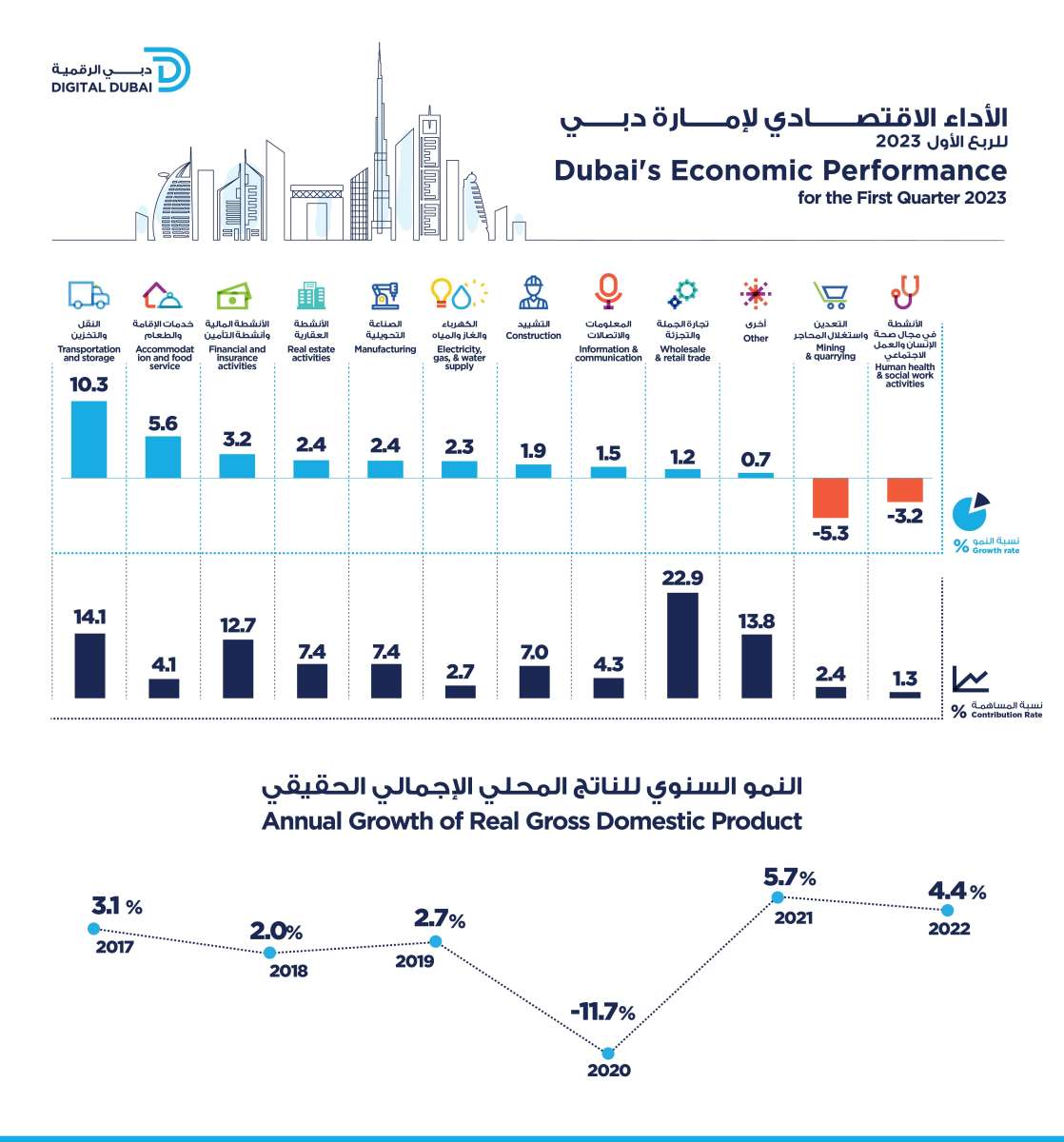
Dubai 2.8% surge maintains the robust momentum of growth achieved in 2022, when the emirate experienced a 4.4 percent expansion of the economy.
“The continued high growth in the first quarter of the year is yet another testament to Dubai’s strong fundamentals, sustainability and resilience and its capacity to constantly create fresh pathways for enterprise and innovation to flourish,” said H.H. Sheikh Hamdan bin Mohammed bin Rashid Al Maktoum, Crown Prince of Dubai and Chairman of Dubai Executive Council. “The city’s ability to sustain growth further reflects the ambitious development vision of His Highness Sheikh Mohammed bin Rashid Al Maktoum, Vice President, Prime Minister and Ruler of Dubai. Supported by its outstanding investment environment, robust infrastructure and business-enabling ecosystem, Dubai continues to outpace some of the world’s leading economies.
“The introduction of the Dubai Economic Agenda D33, which seeks to double the size of the emirate’s economy over the next decade and consolidate its status as one of the world’s top three cities, has created a strategic springboard to usher in a new cycle of growth and value creation. Powered by the harmonious partnership between the public and private sectors, Dubai will continue to raise its role in shaping the future of the global economy.”
Dubai’s growth in Q1 2023 is significantly higher than that of some of the most developed countries in the world. Data issued by the Organisation for Economic Cooperation and Development (OECD) indicate a seasonally adjusted growth of 1.6 percent for OECD countries. The European Union grew by 1.1 percent, while the US economy grew by 1.8 percent in the first quarter of the year.
The transportation and storage sector was the biggest contributor to overall growth at 48 percent. This was followed by the financial and insurance sector, which accounted for 15percent, and trade at 10 percent, according to data issued by the Dubai Data and Statistics Establishment of the Dubai Digital Authority.
Hamad Obaid Al Mansoori, Director General of the Dubai Digital Authority, said: “Dubai’s success in the economic field is an inevitable result of economic policies that express the vision of the leadership to make Dubai a leading global business and investment destination for all sectors. We at Digital Dubai will continue to work in cooperation with other government entities to ensure the sustainability of the city’s economic momentum by providing a strong digital infrastructure and the highest standards of cybersecurity, in addition to seamless access to open data, all of which will enhance the investment climate and build an environment that supports growth and prosperity.”
Helal Saeed Al Marri, Director General of Dubai’s Department of Economy and Tourism, said: “We continue to see accelerated momentum across both core sectors and new growth segments for the economy, which is being further reinforced by strong cross-industry and public-private collaboration to deliver the vision of our leadership’s 10-year Dubai Economic Agenda D33. This vision is further fortified by comprehensive strategies centered around economic diversification, entrepreneurship and the attraction of both talent and investment across sectors. This economic framework will continue to serve as a key lever for D33 as we seek to bolster Dubai’s offering as a top three global city, and the best place to invest, live, work and visit.”
The report revealed that wholesale and retail trade continued to be the largest contributor to the economy, accounting for 22.9 percent of the GDP, followed by the transportation sector, which accounted for 14.1percent. These results highlight the dynamic, diversified structure of Dubai’s economy, in which the interdependence and inter-connectedness of various sectors create synergistic growth.
Younus Al Nasser, CEO of the Dubai Data and Statistics Establishment, said: “Numbers have always been the true mirror that reflect the reality of economic activity, and today, with our entry into the era of artificial intelligence, the importance of data and statistics has increased not only in exploring the current reality, but also in foreseeing the future by analysing statistical patterns to enable decision-makers to make the right call. The data collected by the Dubai Data and Statistics Establishment reveals the significant economic progress the emirate is making, driven by the clear vision of our leadership, and the collaborative efforts of all stakeholders.”
The trade sector recorded a 1.2 percent growth in the first quarter of 2023, compared to the same period in 2022, bringing an added value of AED25.5 billion. The sector accounted for 22.9percent of the economy and contributed 10 percent of overall recorded Q1 2023 growth. It encompasses a wide range of companies dealing in various consumer and capital goods. Trade, which has a notable impact on various other activities, includes some of the largest companies in the country and the region, whose commercial activities cover a wide range of consumer and capital goods.

Transportation and storage outperformed all other sectors with a significant growth of 10.3 percent in Q1 2023, compared to the same period last year. The sector contributed 48 percent to the overall recorded first quarter growth, bringing AED15.6 billion in added value. The transportation and storage sector included activities related to land transport for individuals and goods, maritime transport, handling and storage, postal services, air transport for individuals and goods, and related supporting activities.
Air transport accounts for the largest proportion of the transport and storage sector given its sizeable production volume. The sub-sector’s performance was positively impacted by the increase in the demand for the services of national carriers, which recorded 68 percent growth in passenger numbers in Q1 2023, compared to the same period last year.
The accommodation and food services sector reported a 5.6 percentgrowth rate in the first quarter of 2023, with an added value of approximately AED4.5 billion. The sector contributed 4.1 percent to the economy and 8 percent to overall recorded growth in Q1. The emirate welcomed 4.67 million international visitors, a 18 percent increase from the 3.97 million welcomed during the same period in 2022, according to figures from Dubai’s Department of Economy and Tourism.
These results were made possible by the efforts of various initiatives of stakeholders to attract visitors, including international conferences and exhibitions throughout the year.
The Dubai Data and Statistics Establishment report revealed that real estate activities grew by 2.4percent, contributing 7.4 percent to the economy and 6 percent to the overall recorded growth, driven by the growth in real estate margins on property sales, which grew significantly in Q1 2023, according to Dubai Land Department figures.
The sector benefitted from the leadership’s directives, as well as the economic stimulus packages the Dubai Government offered, coupled by the flexibility, transparency, and confidence that the sector offers to investors and consumers.
Financial and insurance activities recorded a growth of 3.2 percent in the first quarter of 2023, contributing 12.7p ercent to the GDP and AED14.2 billion in added value. The sector accounted for 15percent of Dubai’s overall Q1 growth. Data from the UAE Central Bank indicated a 3.5 percent growth in credit balances and a 14.9 percent growth in deposit balances compared to the same period last year.
Meanwhile, other economic sectors experienced a growth rate of 1.5 percent in the first quarter of 2023, contributing a combined 35.5 percent.