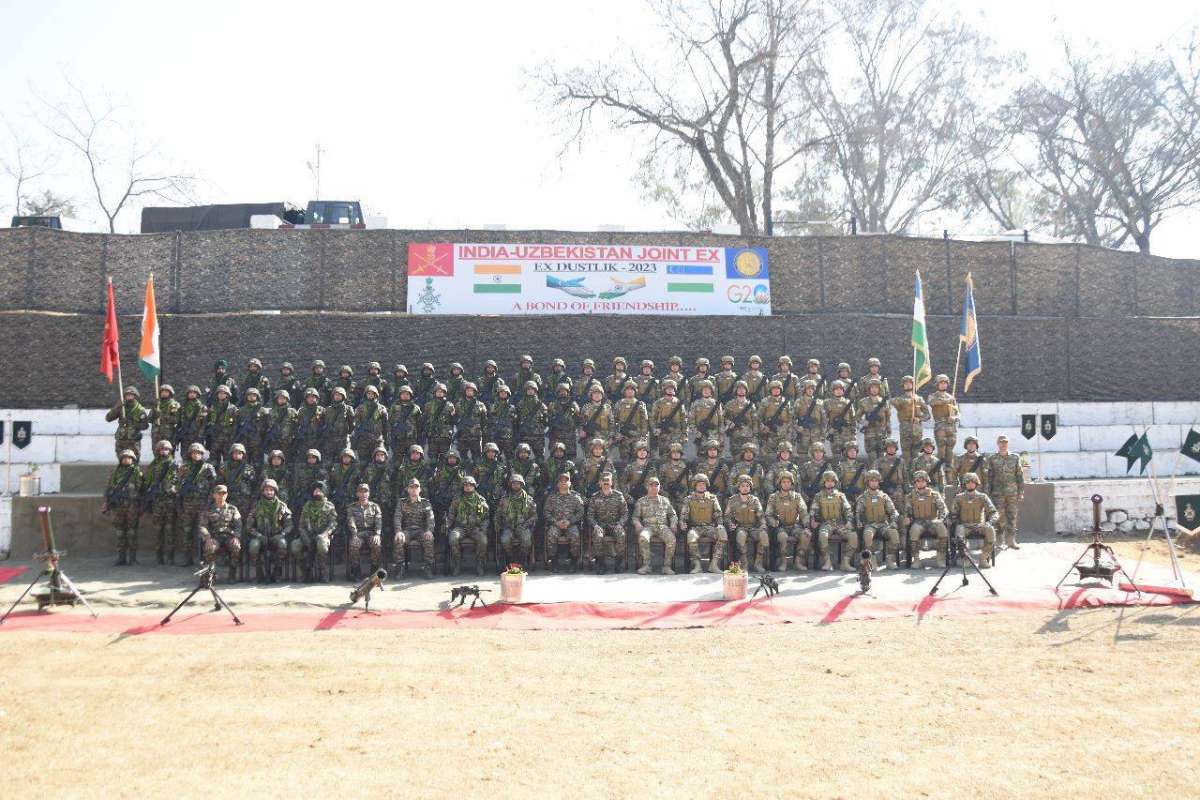
5 Soldiers each from Uzbekistan and Indian Army are participating in this exercise which is aimed at promoting positive relations between both armies…reports Asian Lite News
The 4th Edition of India-Uzbekistan Joint Military Exercise Dustlik commenced on Monday at Pithoragarh, Uttarakhand.
“The 14 days joint training will focus on sharing best practices in Sub Conventional Operations under UN mandate,” tweeted the Additional Directorate General of Public Information, Indian Army. India’s Garhwal Rifles from the Western Command participated in the exercise. And from Uzbekistan, the North Western Military command participated in the exercise. The exercise is biennial, meaning conducted once in two years.
“45 Soldiers each from Uzbekistan and Indian Army are participating in this exercise which is aimed at promoting positive relations between both armies. The Indian Army contingent comprises troops from an Infantry Battalion from the Garhwal Rifles Regiment,” said Indian Army.
It will include field training exercises, combat discussions, lectures, demonstrations and culminate with a validation exercise. Both sides will jointly train, plan and execute a series of tactical drills for neutralisation of likely threats, while learning to exploit new generation equipment and technology for conducting joint operations. Due emphasis is being laid on increasing interoperability between forces, read the Ministry of Defence.
The bonhomie, espirit-de-corps and goodwill generated during the exercise will go a long way in further strengthening the bonds between both armies by enabling understanding of each other’s organisation and methodology of conducting various operations, it added.
With more than 65,000 soldiers, the Army of Uzbekistan is one of the largest in Central Asia.
Uzbekistan is important to India for connectivity to Iran and the Central Asian region. India is trying to expand its trade in the Central Asian region. But the conflicts in Afghanistan are a big hindrance. To counter such security issues, India needs the support of other central Asian countries like Uzbekistan.
Moreover, the Hisar Air Base of Uzbekistan is jointly operated by Indian Air Force and Tajik Air Force. It is also called the Gissar Air Base. India used the base extensively during the Afghan crisis.
Indian Army is deploying the Garhwal Rifles in military exercises. The Garhwal Rifles participated in the recent Dharma Guardian military exercise conducted with Japan.
The 4th Edition of Joint Military Exercise Dharma Guardian commenced on February 17 at Camp Imazu, Japan.
During the 14-day training, troops from both Armies will share their expertise and experiences in Counter Terrorism operations in urban terrain. (ANI)
ALSO READ-WHO warns against use of Indian cough syrups in Uzbekistan