PM Modi and his Japanese counterpart spoke about the newly established India-Japan Industrial Competitiveness Partnership, and they acknowledged its success…reports Asian Lite News
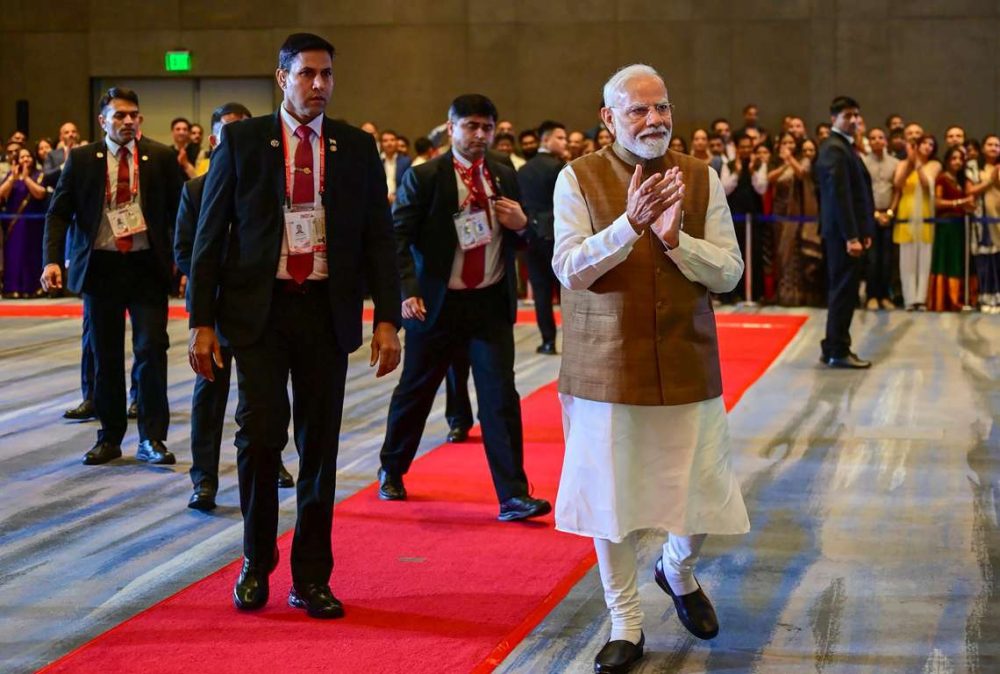
On Monday, Indian Prime Minister Narendra Modi and his Japanese counterpart Fumio Kishida, pledged to expand their countries’ global strategic partnership, citing its significance in promoting a peaceful, stable, and prosperous Indo-Pacific region, as well as benefiting both nations in various areas.
They met in New Delhi after Japanese Prime Minister Kishida arrived in India on Monday for a two-day visit aimed at boosting bilateral ties in multiple fields, besides exploring the convergence between India’s G20 presidency and Japan’s G7 presidency to tackle global issues. During the meeting, the two leaders discussed trade, defence, health, digital partnership, and the importance of reliable supply chains for critical technologies like semiconductors.
The meeting holds tremendous importance for India-Japan Economic Cooperation, as the partnership between both countries has made remarkable progress in recent years, covering all aspects of mutual engagement, including the growing convergence of political, strategic, and economic interests.
During the meeting, PM Modi emphasized that the India-Japan relationship is one of the most natural partnerships in the region, built on shared values of democracy, freedom, and respect for the rule of law. He added that economic cooperation is a vital component of the India-Japan Special Strategic and Global Partnership, which is crucial for promoting peace, prosperity, and stability in the Indo-Pacific region.
Apart from this, the two leaders also held substantive discussions on key topics of bilateral cooperation, including defense and security, climate and energy, people-to-people exchanges, skill development, and innovation. The leaders also discussed regional issues of significance, with a particular emphasis on economic cooperation.
Additionally, India and Japan have set ambitious targets for themselves in the economic sphere, and the two countries are committed to working together to achieve them. Japan has set a target of investing 5 trillion yen in India over the next five years. The two leaders expressed satisfaction with the progress made toward achieving this target.
Moreover, PM Modi and his Japanese counterpart spoke about the newly established India-Japan Industrial Competitiveness Partnership, and they acknowledged its success.
Their meeting also provided an opportunity to review the progress on the High-Speed Rail (Bullet Train) project between Mumbai and Ahmedabad.
India and Japan signed documents for the fourth tranche of the Japanese loan for the project. The exchange of notes for a loan of 300 billion Yen took place on the sidelines of the meeting between Prime Modi and Japanese PM Kishida in New Delhi.
This was the fourth tranche of the total of Rs 18,000 crore loan by Japan International Cooperation Agency (JICA) for the High Speed Rail project.
The project will use Japanese Shinkansen (Bullet Train) technology. It is envisaged that the 508-km distance between Mumbai and Ahmedabad will be covered in two hours and seven minutes with a maximum operational speed of 320 kilometer per hour (kmph).
ALSO READ- Kishida announces over $75 bn assistance for Indo-Pacific