Roshan deservedly was deemed to be the foremost exponent of the filmi qawwali, but his oeuvre was not limited to this form – it appears in just half-a-dozen of his 67 films…reports Vikas Dutta
He may have ended up as a mere footnote in the annals of Hindi cinema with music for just one flop film to his account, had his indulgent mentor been a more money-minded man. In the process, connoisseurs would have been deprived of scores of exquisite qawwalis, elegant love songs, and aesthetic compositions showcasing the immortal words of Tulsidas and Meera.
And for 21st-century Bollywood fans, would Hrithik Roshan have emerged, had his grandfather, drawn to films after hearing a K.L. Saigal bhajan, abandoned his ambitions?
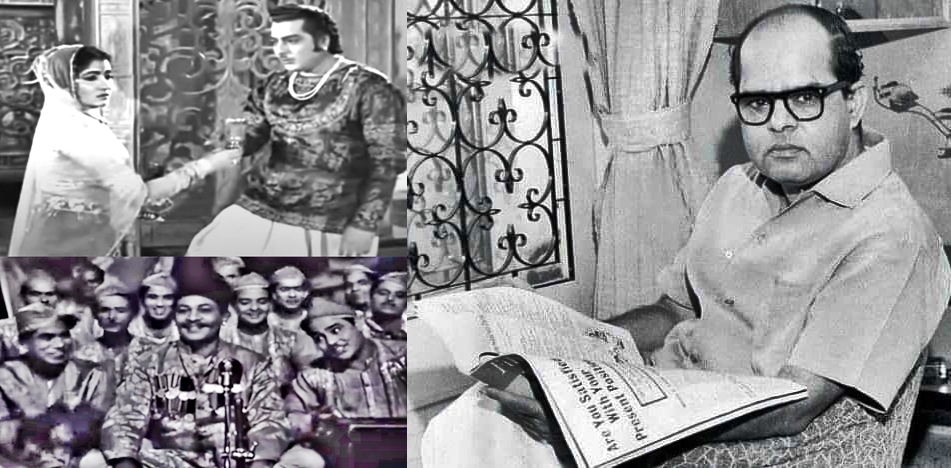
Roshan (1917-67), born Roshan Lal Nagrath on this day (July 14) in Gujranwala (undivided Punjab), spent just a third of his tragically short life in the film industry, but, in this span, he spun pure gold with his trademark classical music-based melodies. A leading music director, who also played a key role in his life, likened his music to honey dripping from a honeycomb.
Roshan deservedly was deemed to be the foremost exponent of the filmi qawwali, but his oeuvre was not limited to this form – it appears in just half-a-dozen of his 67 films.
On the other hand, there is “Khayalon mein kisi ke” (“Bawre Nain”, 1951), “Bade armanon se” (“Malhar”, 1951), “Main dil hoon ek armaan bhara” (“Anhonee”, 1952), “Salaam-e-hasrat qabool kar lo” (“Babar”, 1960), “Zindagi bhar nahi bhoolegi woh barsaat ki raat” (“Barsaat Ki Raat”, 1960). “Ab kya misaal doon main tumhare shabaab ki” (“Aarti”, 1962), “Laga chunri mein daag” (“Dil Hi To Hai”, 1963), “Jo vada kiya vo nibhana padega” (“Taj Mahal”, 1963), “Dil jo na keh saka” (“Bheegi Raat”, 1965), “Rahen na rahen ham” (“Mamta”, 1966) and “Hum intezar karenge” (“Bahu Begum”, 1967).
Above all, there is the Meera bhajan “Ae ri main to prem diwani” (“Naubahar”, 1952) and “Man re tu kaahe na dheer dhare” (“Chitralekha”, 1964), skillfully adapted by Sahir Ludhianvi from Tulsidas’ “Mana tu kahe na dheer dharat ab…” and rendered sublimely by Mohammad Rafi.
Then, gauge how Roshan imbued a spiritual feel to “Chhupa lo yun dil mein” from “Mamta”, aided by the dulcet tones of Hemant Kumar and Lata Mangeshkar, and Majrooh Sultanpuri’s poetry, while recalling his AIR days with the studio-based “Saari saari raat” (“Aji Bas Shukriya”, 1957).
But, as mentioned, all this would have never come to pass without the trust shown by legendary director, producer, lyricist and screenwriter KIdar Nath Sharma, who had spotted Roshan, then working with AIR Delhi as an esraj player, way back in 1945 and offered him a career in the film industry.
Roshan had refused then, but approached Sharma in 1949 when he moved to Bombay. Sharma offered him a chance to compose for his “Neki Aur Badi” (1949), convincing his own regular composer Snehal Bhatkar to sit it out and the latter obliged.
The film flopped and a distraught and disheartened Roshan told Sharma that he was no good and wanted to commit suicide. The filmmaker heard him patiently and asked him which Bombay beach he would prefer to do away with himself.
Then, on a serious note, he went on to say that if Roshan would defer his plans, he would offer him another chance in his forthcoming film.
This was not the end of the story.
During the film’s making, an influential distributor came to meet Sharma and in Roshan’s presence, promised him a large amount if only he would drop the music composer. Roshan went to another room and began sobbing, telling Sharma, who followed him, to accept the offer. Sharma, however, went back to his office and said no.
“Bawre Nain” (1951), with songs like “Teri duniya mein dil lagta nahi” and “Khayalon mein”, was a hit and started Roshan on his sparkling musical journey.
Sharma was more patient than Anil Biswas, who took direct action when Roshan began crying at his song recording, saying he would never be able to create such music. Biswas sought to calm him down, but when Roshan would not stop sobbing, he gave him a slap, wondering how he would succeed this way. It was Biswas only who likened his music to dripping honey.
Roshan, whose music reflected his classical training, also had a penchant for knowing when to let his tune yield to the lyrics or the singer. His — and Hindi cinema’s most famous qawwali — “Na to karvan ki talash hai” (“Barsaat ki Raat”) is a prime example and so is the same film’s “Maine shayad tumhe pehle bhi” where it just fills the gaps.
On the other hand, “Tum agar mujh ko na chaho” (“Dil Hi To Hai”) has a steady beat accompanying the singer.
There was much more music left in Roshan when he succumbed to a heart attack in 1967.
ALSO READ-Aftab Shivdasani Ventures into Musical Horror with ‘Kasoor’