May 18, 2024
3 mins read

Rishi Sunak’s Wealth Jumps £120M Amid Billionaire Slump

Despite a UK billionaire slowdown, Rishi Sunak and Akshata Murty’s wealth rose significantly to £651 million from £529 million last year, amidst challenging economic conditions, reports Asian Lite News

The fortune of Prime Minister Rishi Sunak and his wife, Akshata Murty, has experienced a remarkable surge, exceeding 120 million pounds in growth over the past year, thus elevating their combined wealth to a substantial 651 million pounds, UK-based broadcasting network iTV reported.

The latest annual Sunday Times Rich List revealed their wealth grew substantially despite the wider UK billionaire boom coming “to an end” in the face of tough economic conditions.

Despite a noted slowdown in the broader UK billionaire landscape due to challenging economic circumstances, Sunak and Murty have witnessed a significant increase in their wealth, which now stands at 651 million pounds compared to 529 million pounds in the previous year.

This impressive rise can be attributed largely to Murty’s ownership stake in Infosys, the esteemed Indian IT giant co-founded by her billionaire father. Murty’s shares in Infosys experienced a remarkable increase in value, soaring by 108.8 million pounds to nearly 590 million pounds within the span of a year, as reported by iTV.

However, it’s worth noting that the couple’s current wealth still falls short of its peak in 2022, when it reached approximately 730 million pounds.
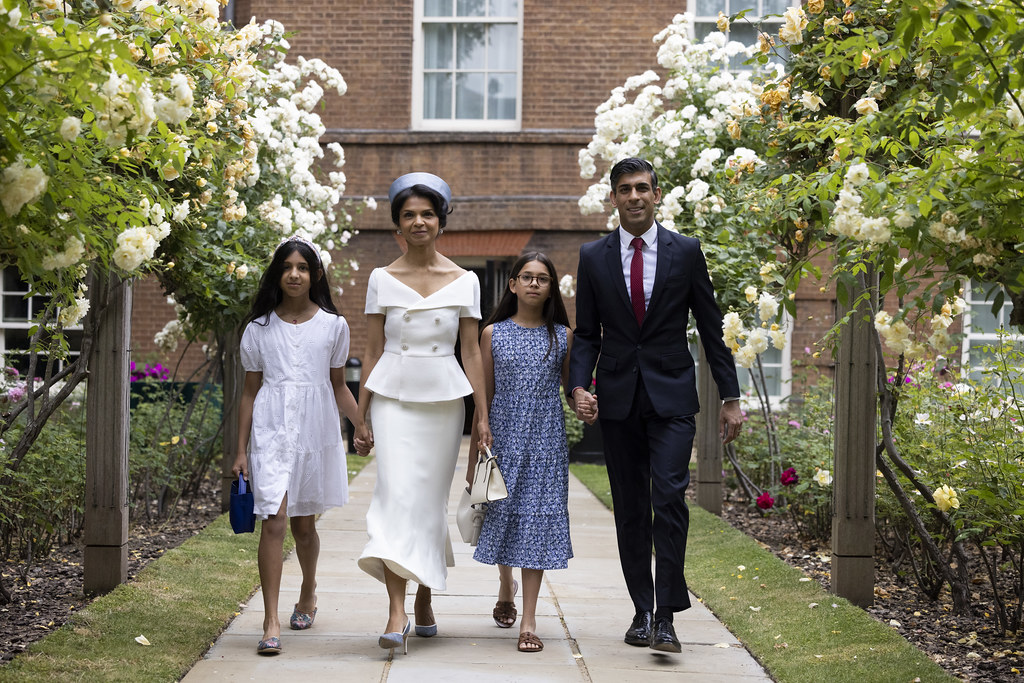
Prime Minister Rishi Sunak, his wife Akshata Murty and their children Krisna and Anoushka walk through the garden on their way to attend Trooping of the Colour on Horse Guards parade to celebrate King Charles III official birthday. (Picture by Simon Dawson / No 10 Downing Street)

The upward trajectory in wealth isn’t unique to Sunak and Murty alone; King Charles has also seen his fortune grow, climbing to 610 million pounds from 600 million pounds over the past year.

Despite these individual successes, the overall landscape for British billionaires is shifting. The number of billionaires in the UK has experienced a decline for the third consecutive year, dropping from a peak of 177 in 2022 to 165 in the current year. This decline is attributed to various factors, including some individuals witnessing a contraction in their private wealth due to high borrowing rates, while others have chosen to relocate from the country.

Robert Watts, the compiler of the rich list, suggests that Britain’s billionaire boom may have reached its zenith. He notes that while many homegrown entrepreneurs have seen their fortunes diminish, some of the global super-rich, who once favoured the UK as a base, are now seeking opportunities elsewhere. This trend raises questions about the implications for the British economy, as thousands of livelihoods are interconnected with the fortunes of the super-rich, according to iTV.

The latest data reveals that Britain’s 350 wealthiest individuals and families collectively possess a staggering combined wealth of 795.36 billion pounds. Topping the list once again are Gopi Hinduja and his family, who oversee the renowned Indian conglomerate Hinduja Group. Their wealth has ascended to 37.2 billion pounds from 35 billion pounds in the previous year.

Rishi Sunak and his wife Akshata Murty visit BAPS Swaminarayan Akshardham Temple. Picture by Simon Walker / No 10 Downing Street.

However, not all prominent billionaires have experienced growth in their fortunes. Sir Jim Ratcliffe, Manchester United investor and Ineos founder, witnessed the most significant decline, with his net worth plummeting by over 6 billion pounds to 23.52 billion pounds.

Similarly, Sir James Dyson saw his wealth diminish to 20.8 billion pounds from 23 billion pounds, while Sir Richard Branson’s fortunes dwindled to 2.4 billion pounds from 4.2 billion pounds, owing to challenges faced by his company, Virgin Galactic, throughout the year, iTV reported. (ANI)

ALSO READ: Hunt vows tax cut if Tories win polls

Newsdesk

Newsdesk

Aravind Rajeev is Deputy News Editor at Asian Lite, mostly covering the Middle East and GCC. He has over eight years of experience as a journalist, with a background in ground-level reporting, crime reporting, as well as international and regional news.

Previous Story

US Evacuates 17 American Doctors Stuck In Gaza

Next Story

‘Not Too Many More Vibrant Democracies In World Than India’

Previous Story

US Evacuates 17 American Doctors Stuck In Gaza

Next Story

‘Not Too Many More Vibrant Democracies In World Than India’

Latest from -Top News

Pakistan Risks Overstretching Itself in Yemen War

Pakistan’s expanding military role in Saudi Arabia amid the Yemen conflict could strain its defence resources and fragile finances…reports Asian Lite News Desk Pakistan’s military involvement in the war in Yemen may prove unsustainable because of mounting financial pressures and competing security demands, according to a new report. Islamabad’s growing military presence in Saudi Arabia risks stretching its defence resources while exposing the country to greater strategic and economic challenges. An article by Andrew Wilson in One World Outlook describes Pakistan’s involvement as a case of “fiscal and strategic overreach”, arguing that the country lacks the financial flexibility to sustain an expanded military commitment. Pakistan’s external finances depend heavily on an International Monetary Fund (IMF) programme, financial support from Gulf countries and remittances from Pakistani workers in the region. The report argues that deeper military involvement in the conflict could place additional pressure on these sources of financial stability. It also warns that deploying troops and military equipment abroad could weaken Pakistan’s capacity to address security challenges along its eastern border and deal with two domestic insurgencies. The move could also draw Islamabad into a conflict it has sought to approach cautiously. A Reuters report in May, citing Pakistani security and government sources, said Islamabad had deployed around 8,000 troops, a squadron of approximately 16 aircraft, mostly JF-17 fighter jets, two drone squadrons and a Chinese HQ-9 air-defence battery to Saudi Arabia. According to those sources, Riyadh was financing the deployment, with Pakistani personnel operating the equipment. The sources also said a confidential agreement contemplated the possibility of deploying up to 80,000 troops. Islamabad has not confirmed those figures, although it has acknowledged its military presence in Saudi Arabia, including the deployment of fighter jets at King Abdulaziz Air Base from April. The One World Outlook article argues that Saudi financial support can cover allowances and operating expenses but cannot easily replace military equipment needed elsewhere or resolve the political and strategic challenges of participating in the Yemen conflict. Pakistan’s defence budget is another concern. For the 2026-27 financial year, the federal government allocated PKR 3 trillion, or approximately $10.8 billion, to defence services. The allocation represents an 18 per cent increase from the original PKR 2.55 trillion provision and amounts to around 2.1 per cent of projected gross domestic product (GDP). Defence spending accounts for approximately 16 per cent of the federal government’s PKR 18.8 trillion expenditure. Military pensions are budgeted separately at PKR 822 billion, while debt servicing costs stand at approximately PKR 8 trillion, more than two-and-a-half times the defence allocation. The report argues that these competing financial obligations leave little room for additional military expenditure without placing further pressure on public finances. Pakistan’s reliance on IMF assistance also limits its fiscal flexibility. The country must meet the conditions attached to the programme, including a primary budget surplus target of 2 per cent of GDP and continued restraint on development spending. According to the article, these requirements make it difficult for Islamabad to finance an additional military commitment without compromising other budgetary priorities. Pakistan’s economic indicators offer limited reassurance. Economic growth for the 2025-26 financial year is estimated at between 3.6 and 3.7 per cent, while inflation reached approximately 10.3 per cent in September following an energy price shock. Foreign exchange reserves stood at around $21.5 billion at the end of September. Although this marks an improvement from the low levels recorded in 2023, the report notes that the reserves cover only a few months of imports. Financial assistance from Gulf partners remains central to Pakistan’s external stability. The article says Islamabad holds approximately $8 billion in Saudi deposits at its central bank. In July, the State Bank of Pakistan said Riyadh had extended the maturity of $5 billion in deposits to December 2028, easing the country’s immediate external financing requirements. A further $3 billion deposit was also extended in the spring. However, the article argues that these arrangements provide temporary relief rather than long-term financial independence, particularly as regional conflict threatens the stability of the Gulf economies on which Pakistan relies. The report concludes that Pakistan faces a difficult balance between supporting Saudi Arabia militarily and preserving the financial and military resources needed to address its domestic and regional challenges.

UK and Germany Ratify Kensington Treaty

Britain and Germany ratify the Kensington Treaty, agreeing new cooperation on AI, quantum research, defence and security while targeting investment, jobs and Russian hybrid threats…reports Asian Lite News Desk Britain and Germany

Economic tide is turning in Bangladesh

If there is one thing that can bring some comfort to the struggling Bangladeshi economy, it is good relations with India. Bangladesh should remember that Delhi’s backing, through easy supplies of essentials
Go toTop

Don't Miss

Russia-Ukraine war takes toll on India’s defence deals

India signed a $5 billion deal with Russia in October

How India made Delhi Declaration possible

Govt led more than “200 hours of non-stop negotiations” to