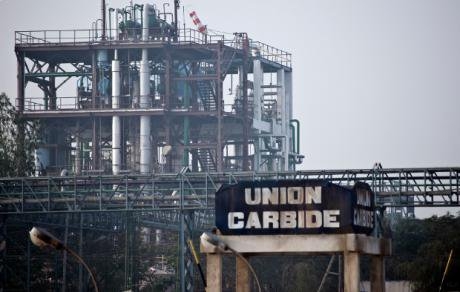
Social activists claim that 337 tonnes of hazardous waste remains in a shed of the now-defunct Union Carbide despite Rs 126 crore being given to the Madhya Pradesh government by the Centre for disposal. …reports Asian Lite news
Haunting memories of the Bhopal gas tragedy are still fresh for an ex-scientist at Union Carbide’s Research Centre even after 40 years, who vividly remembers waiting for a bus ride on December 3, 1984, unaware of the worst industrial disaster in the days of limited sources of information.
The scientist, who requested anonymity, left his home in Arera Colony around 8-8:12 AM and expected his usual bus ride to reach the Union Carbide research centre. However, as minutes ticked by and the bus didn’t arrive by 8:30 am, a sense of unease grew.
In the absence of the Internet, mobile phones or social media, people used to rely on landline phones, telegrams, radio bulletins, newspapers, paan and tea shops to keep them updated about happenings in their city and the country, he said.
“As we waited for the bus, a passerby hurriedly told us that gas had leaked resulting in many deaths. I heard about the gas tragedy at a paan shop. Rumours were spreading like wildfire which left us confused,” the scientist told PTI on Monday.
The scientist said he and others decided to go to the factory in an auto-rickshaw.
We saw people running helter-skelter en route to the office located atop Shyamala Hills overlooking the picturesque Upper Lake, he recalled.
“At the Union Carbide research centre, we saw the deployment of police at the gate who didn’t allow us to go inside,” he said.
The scientist further said he heard that gas had leaked from the plant and bodies piled up in the Government Hamidia Hospital.
“Finally, the company management informed us through a message that the research centre will remain closed for the day and asked us to go home,” he said, adding that they returned home around 9.30-9.45 am.
He learned about the magnitude of the tragedy, which turned out to be the world’s worst industrial disaster, from a colleague told about it by the company management.

After a week, the research centre staff was asked not to leave their houses.
“We were also told to remove our nameplates mentioning that we were working in Carbide for our safety considering the anger among people,” he said.
Senior press photographer Gopal Jain said nobody knew what happened exactly and rumours flew thick and fast.
“Around 2.30 am, a woman relative came to my house in the Teen Shade area with her eyes red. She told us dacoits had attacked the old Bhopal area by burning red chillies in large numbers. She said the entire area is engulfed in smoke,” he told PTI.
Jain immediately rushed out of his house to find several people running in the opposite direction of the Old Bhopal area towards the new Bhopal locality.
“Things became clear on December 3 morning when I went to Hamidia Hospital, which was a scene of chaos. Several bodies were lying at the hospital,” Jain reminisced.
The photographer said he learnt about the gas leak tragedy at the hospital.
“I immediately informed BBC veteran Mark Tully over the phone from the city exchange (Department of Telecommunication). Tully flew to Bhopal the same day in a special plane,” he said.
Senior journalist Virendra Sinha, who was working for Samachar Bharti news agency and residing in Old Bhopal, reminisced that he left the city on December 2 for Delhi via Uttar Pradesh to attend a marriage reception.
“I was getting ready in the Delhi office before leaving for Banda in UP when my brother sent a message on the office telex. ‘We all are fine and don’t worry about anything. Go ahead with your programme’,” Sinha said, adding that he was confused as everything was fine when he boarded the train.
He said the nature and scale of the gas tragedy was initially unclear as the incident occurred in the night. “Initial news reports suggested that 8 to 10 people died and 30 to 40 fell unconscious after gas leaked in Bhopal,” he said. Sinha said when he reached Banda the next day, he sent someone to fetch the newspaper “Aaj”.
“The newspaper edition had a banner headline about the Bhopal Gas Tragedy stating that nearly 10,000 people died and over 2 lakh injured,” he recalled.
Sinha decided to rush back to Bhopal without attending the marriage reception.
“The magnitude of the tragedy became clear later,” said Sinha, who retired from Bhasha news agency, the Hindi service of PTI.
On the intervening nights of December 2-3, 1984, the highly toxic methyl isocyanate gas leaked from the Union Carbide plant, killing 5,474 persons and maiming more than five lakh others.

However, even after 40 years, a sense of closure eludes some survivors who are afflicted by congenital disorders.
Bhopal resident Sharda Yadav’s two sons, in their 20s, are congenitally disabled, a disorder linked to the exposure of their father to the gas that leaked from Union Carbide’s plant.
Like Sharda Yadav, Abdul Saeed Khan, an ex-Union Carbide employee, is also living with his twin sons born with a congenital disability, which a senior doctor attributed to a “genetic mutation” among the victims of the industrial disaster.
Social activists claim that 337 tonnes of hazardous waste remains in a shed of the now-defunct Union Carbide despite Rs 126 crore being given to the Madhya Pradesh government by the Centre for disposal.
ALSO READ: India Charts Steady Growth Path