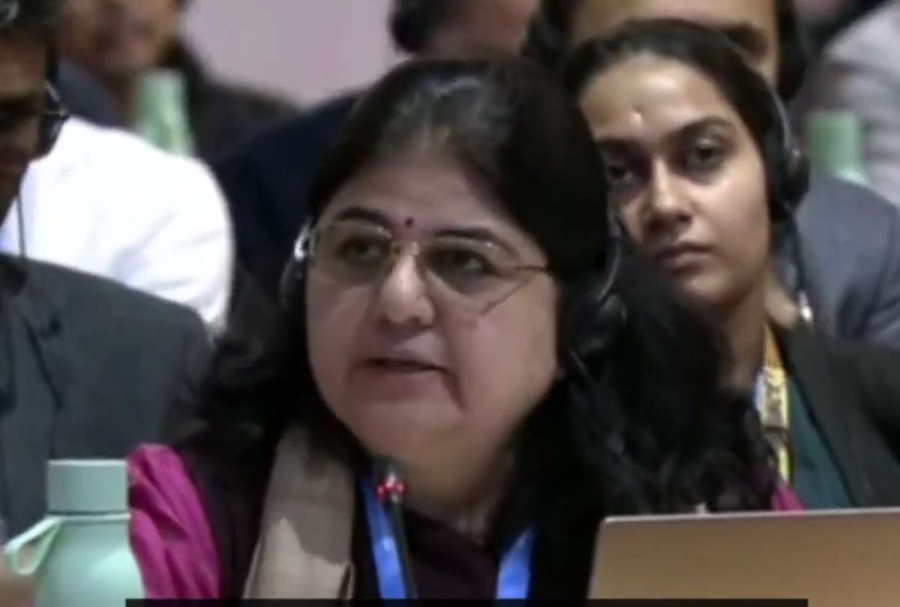
India’s representative Chandni Raina expressed disappointment over the outcome, accusing developed nations of shirking their responsibilities..reports Asian Lite News
India has strongly opposed the newly adopted $300 billion climate finance deal for the Global South at the United Nations COP29 Summit in Baku, Azerbaijan. The objection came after the financial package was already adopted, with India criticizing it as inadequate and untimely.
Chandni Raina, India’s representative and adviser to the Department of Economic Affairs, expressed disappointment over the outcome, accusing developed nations of shirking their responsibilities. “We are disappointed in the outcome, which clearly reflects the unwillingness of developed country parties to fulfill their obligations,” Raina said during the closing plenary session.
She also criticized the process, stating that India was denied the opportunity to speak before the deal’s adoption. “I regret to say that this document is nothing more than an optical illusion. It fails to address the enormity of the challenge we all face. Therefore, we oppose its adoption,” she said.
Raina emphasized that the $300 billion package fails to align with the principle of Common but Differentiated Responsibilities (CBDR) and equity, which underpin global climate action. She added, “This amount does not address the needs and priorities of developing countries battling the impacts of climate change.”
India’s stance found support from other nations. Nigeria called the $300 billion package a “joke,” while Malawi and Bolivia also criticized the deal, siding with India in opposing its adoption.
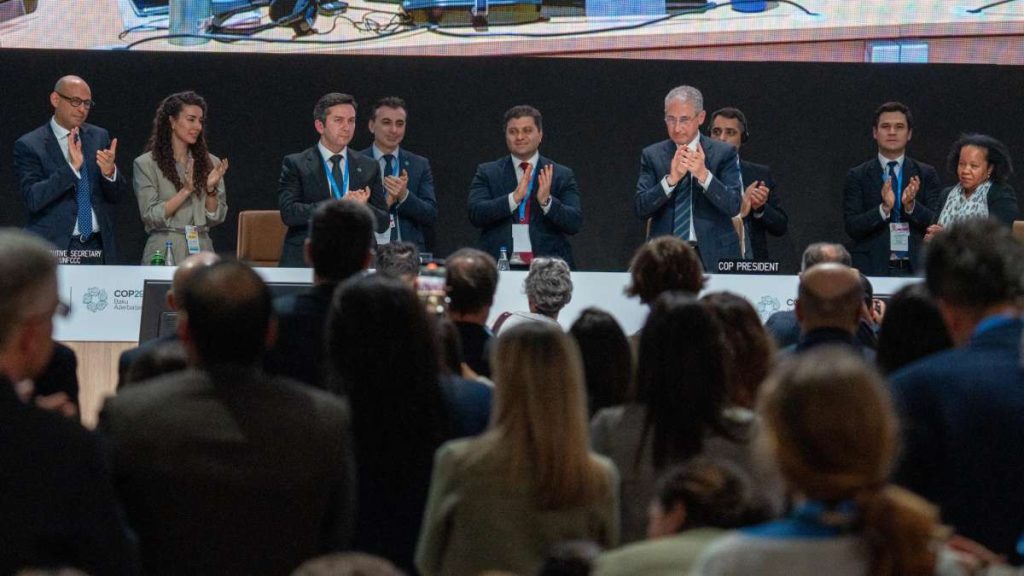
The deal was reached after more than two weeks of heated negotiations, marred by boycotts and disagreements. Talks nearly collapsed when representatives from small island states and the least-developed countries walked out in protest on Saturday. However, after 30 hours of extended discussions, negotiators managed to finalise the agreement early Sunday morning.
Simon Stiell, head of the United Nations Framework Convention on Climate Change, described the deal as “an insurance policy for humanity,” acknowledging the arduous process that led to its conclusion. “It has been a difficult journey, but we’ve delivered a deal,” he said. The funding will assist poorer nations in managing devastating climate impacts and transitioning to clean energy.
The USD 300 billion figure falls significantly short of the USD 1.3 trillion economists estimate is required to address the crisis in developing countries.
Tina Stege, climate envoy for the Marshall Islands, criticised the agreement for leaving vulnerable nations with “a small portion” of the funds they urgently need.
Stege also highlighted the obstructive role of fossil fuel interests in the negotiations, accusing them of undermining multilateral goals. “Fossil fuel interests have been determined to block progress,” she said in a statement, reported CNN.
The new agreement commits developed countries, including the US and European nations, to provide USD 300 billion annually by 2035. While there is an aspiration to eventually scale up to USD 1.3 trillion, developing nations argued for a greater share of the funding to come from grants rather than loans, fearing debt entrapment.
The G77 group of developing nations had called for USD 500 billion annually, but wealthier nations deemed this unfeasible under current economic conditions.
Avinash Persaud, special advisor to the President of the Inter-American Development Bank, acknowledged the compromise, stating, “We have arrived at the boundary between what is politically achievable today in developed countries and what would make a difference in developing countries.”
Efforts to include contributions from wealthier emerging economies like China and Saudi Arabia yielded little success. The agreement only “encourages” such countries to make voluntary contributions, without imposing any obligations.
Li Shuo, director of the China Climate Hub at the Asia Society Policy Institute, described the deal as “a flawed compromise,” reflecting the difficult geopolitical landscape.
COP29 unfolded against the backdrop of a record-breaking year for extreme weather, with catastrophic events highlighting the urgency of climate action. However, the summit faced significant challenges, from its host country’s status as a petrostate to the overwhelming presence of fossil fuel lobbyists.
More than 1,700 fossil fuel representatives attended the talks, outnumbering many national delegations. This prompted criticism from climate groups like Kick Big Polluters Out, which accused such interests of derailing meaningful progress.
ALSO READ: India Gate Spices Up Its Game