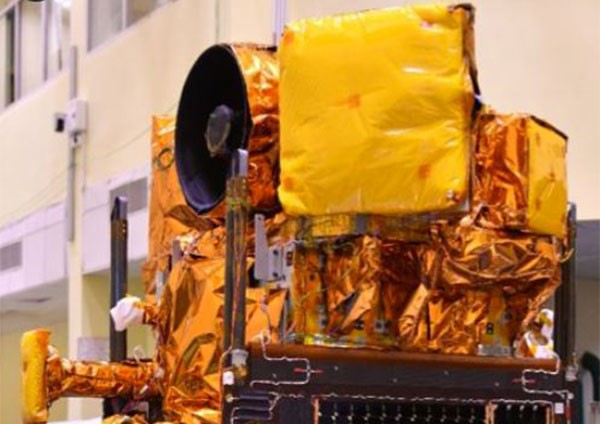
EOS-08 is ISRO’s latest Earth Observation Satellite, slated for launch by the Small Satellite Launch Vehicle (SSLV)-D3….reports Asian Lite News
ISRO’s Earth Observation Satellite-8 (EOS-8) is expected to be launched by the Small Satellite Launch Vehicle (SSLV)-D3 on August 15 from Sriharikota in Andhra Pradesh.
EOS-08 is ISRO’s latest Earth Observation Satellite, slated for launch by the Small Satellite Launch Vehicle (SSLV)-D3.
Taking to its official handle on microblogging site X, ISRO posted, “SSLV’s third and final flight will launch the EOS-08 microsatellite on August 15, 2024, at 9.27 IST from Sriharikota. It completes the SSLV Development Project and enables operational missions by Indian industry and NSIL.”
According to an official release from the space agency, “The primary objectives of the EOS-08 mission include designing and developing a microsatellite, creating payload instruments compatible with the microsatellite bus, and incorporating new technologies required for future operational satellites.”
Built on the Microsat/IMS-1 bus, the EOS-08 carries three payloads: the Electro Optical Infrared Payload (EOIR), the Global Navigation Satellite System-Reflectometry Payload (GNSS-R), and the SiC UV Dosimeter.
The EOIR payload is designed to capture images in the Mid-Wave IR (MIR) and Long-Wave IR (LWIR) bands, both during the day and night, for applications such as satellite-based surveillance, disaster monitoring, environmental monitoring, fire detection, volcanic activity observation, and industrial and power plant disaster monitoring.
The GNSS-R payload demonstrates the capability of using GNSS-R-based remote sensing for applications such as ocean surface wind analysis, soil moisture assessment, cryosphere studies over the Himalayan region, flood detection, and inland waterbody detection.
Meanwhile, the SiC UV Dosimeter monitors UV irradiance at the viewport of the Crew Module in the Gaganyaan Mission and serves as a high-dose alarm sensor for gamma radiation.
The spacecraft is designed for a mission duration of one year. (ANI)
ALSO READ: India, Zimbabwe explore ways to boost cooperation