June 10, 2024
3 mins read

Navies of India & Oman discuss op collaboration, info sharing

The Staff Talks focused on several critical areas of mutual interest. Both sides deliberated on common maritime security challenges that necessitate enhanced interoperability at sea…reports Asian Lite News

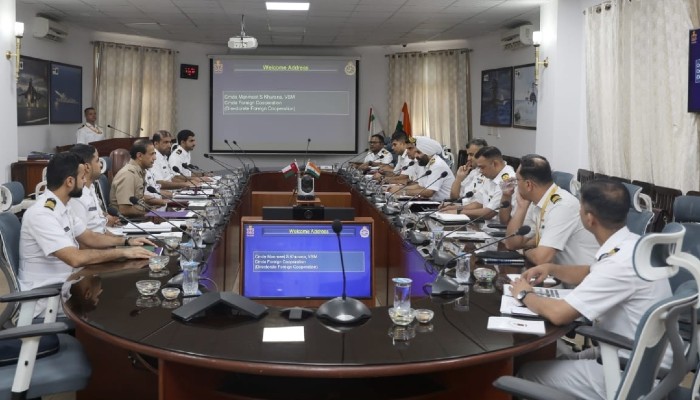
In a significant step towards enhancing maritime cooperation, the 6th edition of Staff Talks between the Indian Navy (IN) and the Royal Navy of Oman (RNO) was held in New Delhi on June 4-5, 2024. This crucial event underlined the strong and enduring defence relationship between the two nations, which share a long-standing history of maritime collaboration.

The Staff Talks focused on several critical areas of mutual interest. Both sides deliberated on common maritime security challenges that necessitate enhanced interoperability at sea. Key topics included operational collaboration, information sharing, Maritime Domain Awareness, training, meteorology, hydrography, and technical assistance. These discussions are essential for addressing mutual security concerns and improving the overall cooperation in the maritime domain.

Enhancing Operational Collaboration

One of the primary objectives of the talks was to enhance operational collaboration between the two navies. This involves coordinated efforts to ensure that both navies can work seamlessly together during joint operations. Improved interoperability is crucial for effective responses to maritime threats, including piracy, smuggling, and other illegal activities in the region.

Information Sharing and Maritime Domain Awareness

Information sharing is a cornerstone of the collaborative efforts between the Indian Navy and the Royal Navy of Oman. By exchanging crucial data and intelligence, both navies can enhance their Maritime Domain Awareness (MDA). MDA involves understanding and monitoring the maritime environment to ensure the safety and security of international waters. Enhanced information sharing allows for better situational awareness and more effective responses to potential threats.

Training and Technical Assistance

The talks also emphasized the importance of training and technical assistance. By sharing knowledge and expertise, both navies can improve their capabilities and readiness. Joint training exercises and technical exchanges ensure that personnel from both navies are well-prepared to handle a wide range of maritime challenges. These initiatives contribute to the overall strengthening of naval capabilities and foster a spirit of cooperation and mutual support.

Meteorology and Hydrography

Meteorology and hydrography are vital aspects of naval operations. Accurate weather forecasting and understanding of oceanographic conditions are essential for safe and efficient naval operations. The discussions covered these topics, with both navies exploring ways to enhance their capabilities in these areas. Collaborative efforts in meteorology and hydrography will lead to improved operational planning and execution.

The delegation from the Royal Navy of Oman was led by Commodore Jasim Mohammed Ali Al Balushi, Director General of Operations and Plans. The Indian delegation was headed by Commodore Manmeet Singh Khurana, Commodore (Foreign Cooperation). The talks are a clear indication of the robust bilateral relations between India and Oman, two countries that have historically been maritime neighbors with strong strategic ties.

The Oman Navy delegation also visited the Information Fusion Centre – Indian Ocean Region (IFC-IOR) in Gurugram. The IFC-IOR is a critical hub for maritime information sharing and collaboration. The visit provided an opportunity for the Omani delegation to gain insights into India’s efforts in enhancing regional maritime security. 

Additionally, the delegation met with Vice Admiral Tarun Sobti, Deputy Chief of Naval Staff of the Indian Navy. These interactions allowed for further discussions on strategic issues and reinforced the strong partnership between the two navies.

Oman is one of India’s closest partners in the Gulf region, and the regular conduct of these Staff Talks plays a vital role in consolidating gains in naval cooperation. The continued engagement through these talks ensures that both navies remain aligned in their efforts to address shared security challenges. The talks also contribute to deepening the existing partnership, which is crucial for maintaining regional stability and security in the Indian Ocean. (India News Network)

ALSO READ: India to host EAS meet on Maritime Security cooperation
Previous Story

India to host EAS meet on Maritime Security cooperation
Next Story

Taiwan govt asks citizens travelling to China to be careful

Previous Story

India to host EAS meet on Maritime Security cooperation
Next Story

Taiwan govt asks citizens travelling to China to be careful

Latest from -Top News

Pakistan Risks Overstretching Itself in Yemen War

Pakistan’s expanding military role in Saudi Arabia amid the Yemen conflict could strain its defence resources and fragile finances…reports Asian Lite News Desk Pakistan’s military involvement in the war in Yemen may prove unsustainable because of mounting financial pressures and competing security demands, according to a new report. Islamabad’s growing military presence in Saudi Arabia risks stretching its defence resources while exposing the country to greater strategic and economic challenges. An article by Andrew Wilson in One World Outlook describes Pakistan’s involvement as a case of “fiscal and strategic overreach”, arguing that the country lacks the financial flexibility to sustain an expanded military commitment. Pakistan’s external finances depend heavily on an International Monetary Fund (IMF) programme, financial support from Gulf countries and remittances from Pakistani workers in the region. The report argues that deeper military involvement in the conflict could place additional pressure on these sources of financial stability. It also warns that deploying troops and military equipment abroad could weaken Pakistan’s capacity to address security challenges along its eastern border and deal with two domestic insurgencies. The move could also draw Islamabad into a conflict it has sought to approach cautiously. A Reuters report in May, citing Pakistani security and government sources, said Islamabad had deployed around 8,000 troops, a squadron of approximately 16 aircraft, mostly JF-17 fighter jets, two drone squadrons and a Chinese HQ-9 air-defence battery to Saudi Arabia. According to those sources, Riyadh was financing the deployment, with Pakistani personnel operating the equipment. The sources also said a confidential agreement contemplated the possibility of deploying up to 80,000 troops. Islamabad has not confirmed those figures, although it has acknowledged its military presence in Saudi Arabia, including the deployment of fighter jets at King Abdulaziz Air Base from April. The One World Outlook article argues that Saudi financial support can cover allowances and operating expenses but cannot easily replace military equipment needed elsewhere or resolve the political and strategic challenges of participating in the Yemen conflict. Pakistan’s defence budget is another concern. For the 2026-27 financial year, the federal government allocated PKR 3 trillion, or approximately $10.8 billion, to defence services. The allocation represents an 18 per cent increase from the original PKR 2.55 trillion provision and amounts to around 2.1 per cent of projected gross domestic product (GDP). Defence spending accounts for approximately 16 per cent of the federal government’s PKR 18.8 trillion expenditure. Military pensions are budgeted separately at PKR 822 billion, while debt servicing costs stand at approximately PKR 8 trillion, more than two-and-a-half times the defence allocation. The report argues that these competing financial obligations leave little room for additional military expenditure without placing further pressure on public finances. Pakistan’s reliance on IMF assistance also limits its fiscal flexibility. The country must meet the conditions attached to the programme, including a primary budget surplus target of 2 per cent of GDP and continued restraint on development spending. According to the article, these requirements make it difficult for Islamabad to finance an additional military commitment without compromising other budgetary priorities. Pakistan’s economic indicators offer limited reassurance. Economic growth for the 2025-26 financial year is estimated at between 3.6 and 3.7 per cent, while inflation reached approximately 10.3 per cent in September following an energy price shock. Foreign exchange reserves stood at around $21.5 billion at the end of September. Although this marks an improvement from the low levels recorded in 2023, the report notes that the reserves cover only a few months of imports. Financial assistance from Gulf partners remains central to Pakistan’s external stability. The article says Islamabad holds approximately $8 billion in Saudi deposits at its central bank. In July, the State Bank of Pakistan said Riyadh had extended the maturity of $5 billion in deposits to December 2028, easing the country’s immediate external financing requirements. A further $3 billion deposit was also extended in the spring. However, the article argues that these arrangements provide temporary relief rather than long-term financial independence, particularly as regional conflict threatens the stability of the Gulf economies on which Pakistan relies. The report concludes that Pakistan faces a difficult balance between supporting Saudi Arabia militarily and preserving the financial and military resources needed to address its domestic and regional challenges.

UK and Germany Ratify Kensington Treaty

Britain and Germany ratify the Kensington Treaty, agreeing new cooperation on AI, quantum research, defence and security while targeting investment, jobs and Russian hybrid threats…reports Asian Lite News Desk Britain and Germany

Economic tide is turning in Bangladesh

If there is one thing that can bring some comfort to the struggling Bangladeshi economy, it is good relations with India. Bangladesh should remember that Delhi’s backing, through easy supplies of essentials
Go toTop

Don't Miss

India’s Olympic Journey and High Expectations for Paris

In three consecutive Olympics starting with the 1984 edition in

Russia backs India for permanent seat on UNSC

India is the only country to have the endorsement of