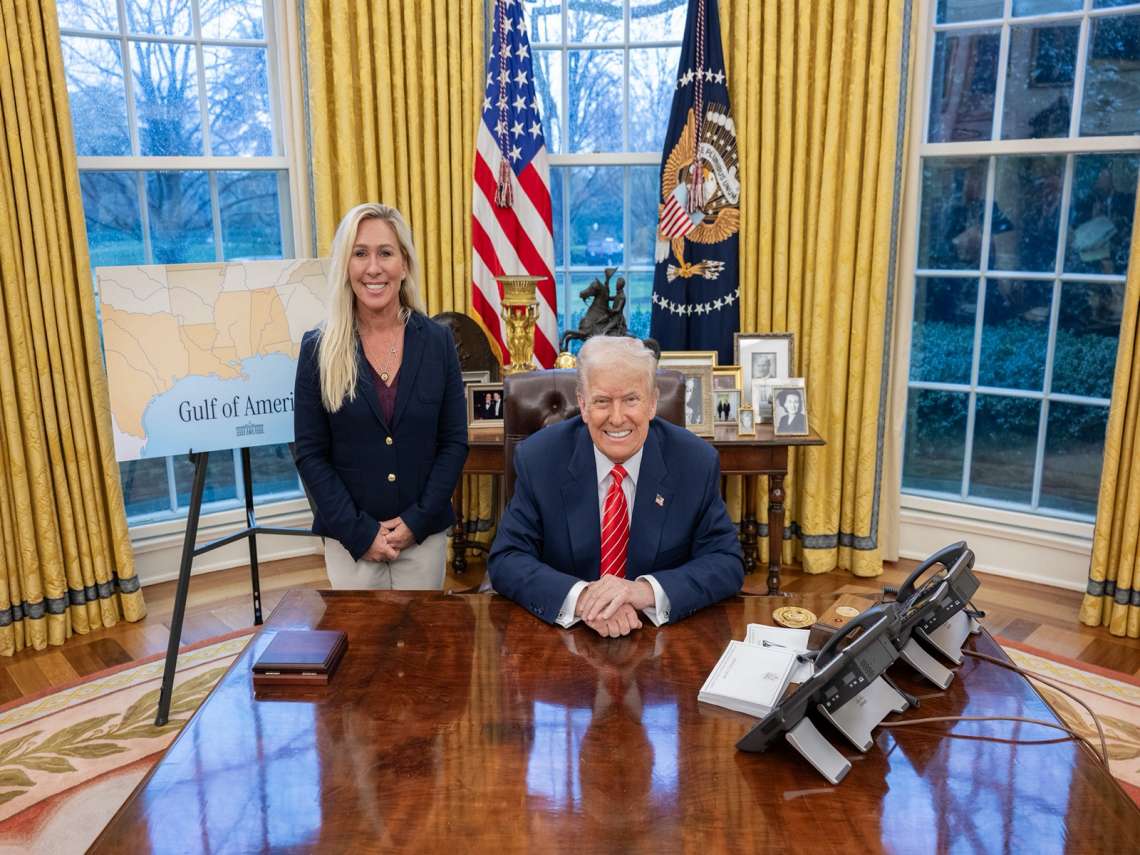
The Georgia congresswoman, once a Maga superstar and among Trump’s most ardent defenders, said she could no longer tolerate the president’s increasingly hostile attacks…reports Asian Lite News
Marjorie Taylor Greene, one of the most recognisable and polarising figures in US Republican politics, has announced she will resign from Congress — a dramatic turn in a bitter and highly public feud with President Donald Trump. Her departure, set for 5 January 2026, closes a turbulent chapter marked by fierce loyalty, sharp rebellion, and ultimately political rupture.
The Georgia congresswoman, once a Maga superstar and among Trump’s most ardent defenders, said she could no longer tolerate the president’s increasingly hostile attacks. In a video message announcing her resignation, she declared: “I refuse to be a ‘battered wife’ hoping it all goes away and gets better.”
Her exit follows months of escalating tensions. Greene’s relentless push for the release of documents related to late paedophile Jeffrey Epstein — a topic that had initially united Trump’s base — became a fault line when she accused the administration of deliberately delaying their publication. Trump, who had grown frustrated with Greene’s public criticism, responded by calling her a “traitor” and “wacky” in a series of social media blasts.
“For some reason, primarily that I refused to return her never ending barrage of phone calls, Marjorie went BAD,” he wrote on Truth Social. He later added: “Nevertheless, I will always appreciate Marjorie, and thank her for her service to our Country!”
In an interview with ABC News, Trump described her resignation as “great news for the country,” underscoring how far their alliance had deteriorated.
In her video and accompanying resignation letter, Greene accused the president of turning her advocacy for Epstein victims into a political weapon. “Standing up for American women who were raped at 14, trafficked and used by rich powerful men, should not result in me being called a traitor,” she wrote. She said Trump’s threats to support a Republican challenger in her district compelled her to step aside rather than force her constituents into what she called a “hurtful and hateful primary”.
Greene’s calls for transparency around the Epstein files — an issue that gained renewed attention across the political spectrum — appeared to push Trump to reverse course. After weeks of attacking Greene, the president signed a bill requiring the US Justice Department to release the documents within 30 days. But the policy concession did little to repair their fractured relationship.
Once a dominant voice within Maga circles, Greene had in recent months become more openly critical of both Trump and congressional Republicans. She chastised the president for failing to ease living costs, criticised his tariff policies, and accused the administration of abandoning its promise to “drain the swamp” by withholding the Epstein material. Her appearances on several high-profile news programmes intensified the clash, drawing rebukes from Republican colleagues who felt she was undermining party unity.
First elected in 2020, Greene quickly became known for promoting conspiracy theories — including QAnon claims and false assertions that school shootings and the 9/11 attacks were staged. She later apologised for those remarks, attempting to reposition herself as a firebrand conservative rather than a fringe figure. Despite controversies, she became a central player in Trump’s “America First” movement, joining him frequently on the campaign trail and loudly echoing his false claim that the 2020 presidential election was stolen.
In her resignation video, she touted her political victories and legislative battles, though she acknowledged the personal and political toll of Trump’s recent attacks. US media have reported that Greene previously considered running for governor of Georgia or for a Senate seat, ambitions Trump publicly discouraged by citing poor polling numbers. Greene has since said she does not plan to pursue either race.
Her departure leaves Republicans with an even slimmer majority in the House of Representatives, intensifying the stakes ahead of the 2026 midterm elections. With control of the chamber already uncertain, Greene’s resignation introduces new volatility into a political landscape defined by shifting allegiances and internal party warfare.
For now, Greene leaves Washington not in triumph but in defiance — part loyalist, part rebel, and still one of the most recognisable voices in a party grappling with its future.