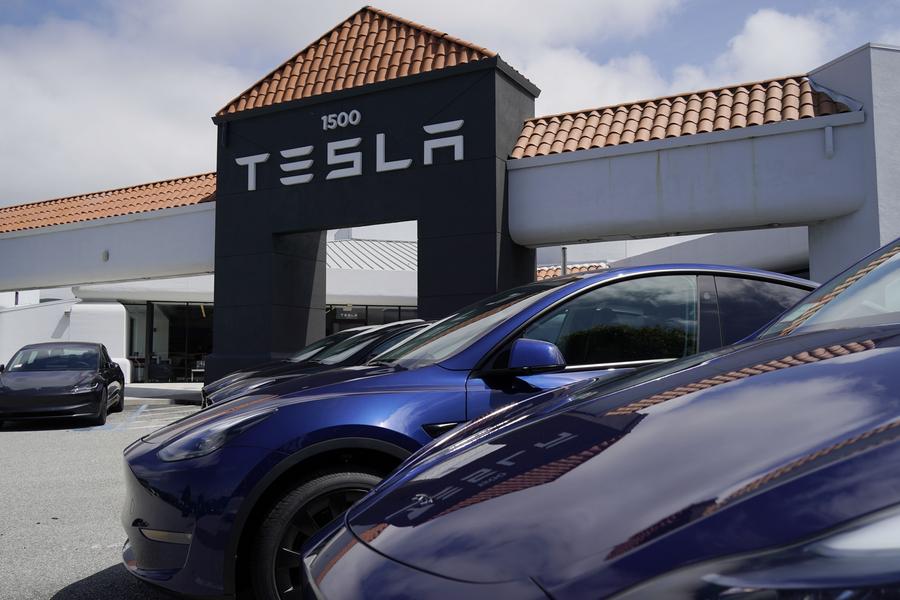
Analysts suggest that unless tariffs are reduced or Tesla establishes local manufacturing, its vehicles will remain priced beyond the reach of most Indian consumers…reports Asian Lite News
Tesla has sold only 600 cars in India since launching in the country in July, a figure that falls far short of expectations and highlights the challenges the American electric car maker faces as it tries to expand into the world’s most populous nation.
The sales figures, reported by Bloomberg, underscore the obstacles facing Tesla, led by Elon Musk, in a market that is proving far tougher than anticipated. India, seen by many global manufacturers as a crucial long-term growth market, has yet to deliver results for Tesla. The company had expected stronger demand for its vehicles but is grappling with a combination of high import tariffs, patchy charging infrastructure, and consumer hesitation around electric vehicles (EVs).
Tesla launched the Model Y in India at a price of about $70,000 (£55,000), making it one of the most expensive cars in its segment. Deliveries have so far been restricted to four cities—Mumbai, Delhi, Pune, and Gurugram—limiting its reach in a country where affordability and accessibility are central to car ownership.
The company now plans to ship between 350 and 500 more cars to India this year. However, analysts suggest that unless tariffs are reduced or Tesla establishes local manufacturing, its vehicles will remain priced beyond the reach of most Indian consumers. India imposes some of the highest import duties in the world on foreign EVs, with tariffs of up to 100 per cent.
While India’s government has set ambitious goals for electric mobility, consumer uptake has been modest. Demand for EVs is being held back by concerns about high upfront costs, limited driving range, and inadequate charging infrastructure. Charging points remain sparse and inconsistent across the country, particularly outside major urban centres.
Tesla’s disappointing debut in India is symptomatic of these wider issues. Although domestic carmakers such as Tata Motors have made inroads with lower-priced EVs, the overall EV market share remains under 2 per cent of total car sales.
The weak performance in India adds to Tesla’s broader difficulties in other markets. In France, Europe’s third-largest car market, Tesla’s sales nearly halved in August compared with a year earlier, even as overall car sales in the country rose by 2.2 per cent.
The company also reported its steepest quarterly fall in revenue in a decade, with sales in the three months to the end of June down 12 per cent to $22.5 billion (£17.8 billion). Musk has described the company as being in a “weird transition period” as it faces both declining demand and increased competition.
Elon Musk has warned investors that the coming months will be challenging. He pointed to the effects of US government tax changes that remove a $7,500 (£5,900) credit for most American-made EVs, reducing the financial incentive for buyers.
At the same time, Tesla has lost some of the advantages it once enjoyed over traditional carmakers. A scrappage programme that penalised conventional automakers for failing to meet emissions targets allowed them to purchase billions of dollars in credits from Tesla. As these programmes wind down, Tesla is expected to lose a significant source of revenue.
Tesla’s share price has reflected the uncertainty. Shares closed 0.5 per cent lower at $332.27 in New York, extending recent losses amid fears that the company may struggle to sustain growth. Investors remain concerned about slowing sales, high costs, and Musk’s warnings of “rough quarters” ahead.
Despite the disappointing start, India remains a key long-term market for Tesla. With a population of more than 1.4 billion and a rapidly growing middle class, the country represents a potentially vast consumer base for electric vehicles.
However, analysts argue that Tesla will need to adapt its strategy to succeed. Building a manufacturing facility in India, which Musk has previously discussed, would allow Tesla to bypass import tariffs and offer vehicles at more competitive prices. Additionally, partnerships with Indian firms to expand the charging network could help overcome one of the biggest barriers to EV adoption.
For now, Tesla’s entry into India highlights the difficulties of breaking into a market where affordability and infrastructure challenges persist. The company’s struggle to sell more than a few hundred cars since its launch underlines the gulf between its global ambitions and the realities of operating in emerging markets.