President Donald Trump returned to office for a second term on January 20, 2025, quickly reasserting his influence on global politics and trade…reports Asian Lite News
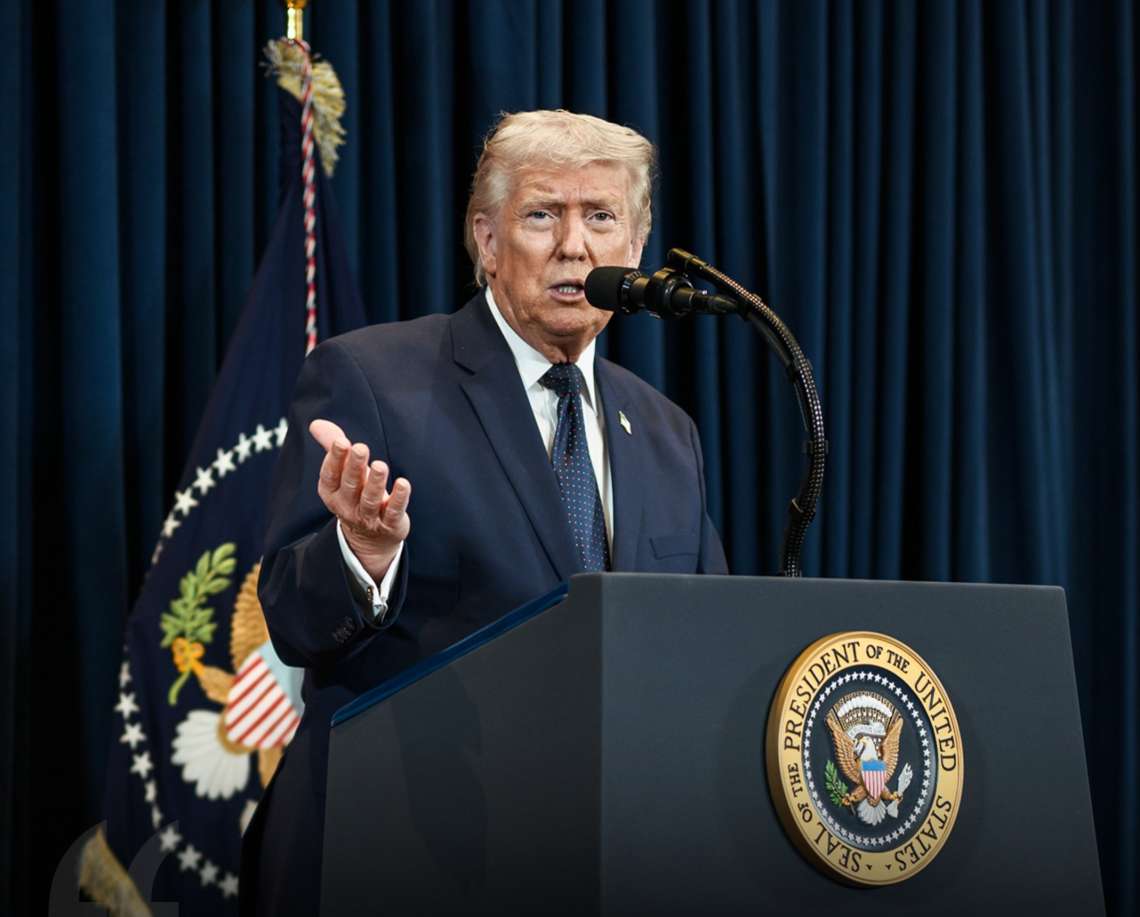
Donald Trump’s second term began with a rapid succession of executive orders that set the tone for his renewed presidency. These included a tougher immigration crackdown, the rollback of several climate-related policies introduced under the previous administration, and pardons for individuals convicted in connection with the January 6, 2021 Capitol riot. In his inaugural address, Trump struck an optimistic note about the future, promising what he described as a “golden age of America” while criticising the record of his predecessor, Joe Biden.
“We’re going to have … I say it’s the golden age of America. We have an age that’s coming up, the likes of which … this country has never seen. And I just look so forward to the results. You’re going to see results in six months to a year,” he said.
Trade policy has been one of the most visible areas of change. In his first 100 days, Trump imposed tariffs on imports from multiple countries, with China, Mexico and Canada among the main targets. These measures prompted swift retaliatory actions and added volatility to global markets. The most dramatic moment came on April 2, 2025, when Trump unveiled what he described as a “Liberation Day” tariff package, applying new duties on imports from more than 90 countries.
Brazil, India, Canada and Switzerland were among those most affected. Indian exports faced a 25 per cent “reciprocal” tariff, which the administration justified by pointing to India’s high duties on US goods. This was followed by an additional 25 per cent penalty tariff, effective from August 27, with Trump accusing India of indirectly funding Russia’s war in Ukraine through discounted oil purchases. In several sectors, combined duties reached 50 per cent, placing India among the countries facing the highest tariff rates.
Despite the sharp escalation, New Delhi and Washington have continued trade discussions. Commerce and Industry Minister Piyush Goyal said on December 22 that India was in advanced talks with the US on a trade agreement, even as India has finalised free trade agreements with other partners.
Alongside his hard-edged trade stance, Trump has projected himself as an active peacemaker on the world stage. He has repeatedly claimed credit for helping to defuse conflicts, including tensions between Russia and Ukraine and a military confrontation between India and Pakistan. Referring to South Asia, Trump said: “We stopped a potential nuclear war between Pakistan and India. The Prime Minister of Pakistan said that President Trump saved 10 million lives, maybe more.”
The remarks related to a four-day military confrontation that followed India’s Operation Sindoor, launched in response to the Pahalgam terror attack that killed 26 people. Trump has said he used the threat of trade tariffs to ease tensions, a claim that India has consistently rejected.
Ending the Russia–Ukraine war has remained a central foreign policy goal of Trump’s second term. His administration has worked on a peace plan reportedly containing around 20 points, covering ceasefire conditions, territorial questions, security guarantees and NATO-related issues. While Trump has warned Russia of possible sanctions and urged allies to back diplomatic efforts, fighting has continued and a comprehensive breakthrough has yet to materialise.
Immigration and skilled labour policy have also undergone major changes. In September 2025, Trump issued a proclamation imposing a $100,000 charge on new H-1B visa applications, a steep increase from previous fees that ran into only a few thousand dollars. The administration said the move was aimed at curbing misuse of the programme and prioritising American workers in high-skilled sectors.
Indians, the largest beneficiaries of the H-1B system for decades, have been particularly affected. Indian IT firms face higher costs, while many professionals in technology, finance and healthcare have expressed uncertainty, especially after the postponement of large numbers of work visa appointments. The administration has also scrapped the long-standing random lottery system, replacing it with a wage-weighted model from 2026, under which higher-paying job offers will have a greater chance of selection.
Travel policy has tightened further. Trump signed a proclamation expanding full or partial travel restrictions to 39 countries. Five new countries — Burkina Faso, Mali, Niger, South Sudan and Syria — were added, along with holders of travel documents issued by the Palestinian Authority. Laos and Sierra Leone, previously under limited restrictions, now face a full ban. The measures are due to take effect on January 1, 2026, with the White House citing terrorism risks, internal conflict and high visa overstay rates.
On the defence front, Trump announced plans in May for a $175 billion missile defence initiative known as the “Golden Dome”. “Golden Dome will protect our homeland,” he said. The system is designed to counter advanced threats such as hypersonic glide vehicles, cruise missiles and AI-enabled drone swarms, using an integrated network of ground- and space-based interceptors. While funding and political approval remain uncertain, Trump has said he wants the project completed by January 2029, before the end of his term.