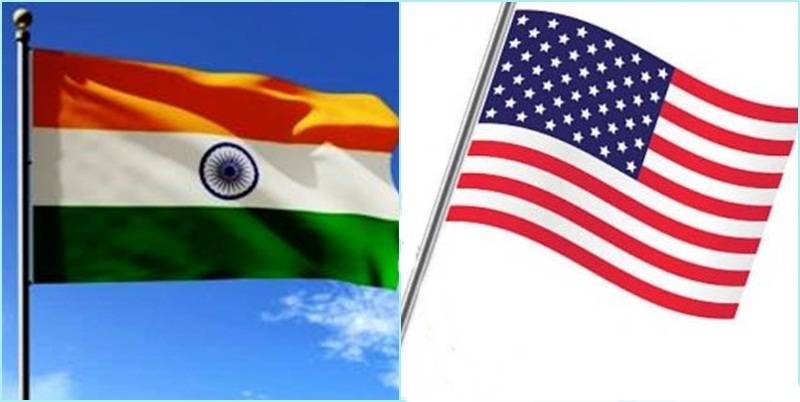
India is highlighted in the NDAA’s International Nuclear Energy Act of 2025, which designates New Delhi as an “ally or partner nation” on par with OECD members for global civil nuclear cooperation….reports Asian Lite News
The latest US defence bill elevates India’s strategic role, pushing sustained dialogue on nuclear liability rules and grouping New Delhi with key partners tasked with building an Indo-Pacific defence industrial network aimed at countering China.
Congressional leaders on Sunday released the compromise version of the fiscal 2026 National Defence Authorisation Act (NDAA), a sweeping policy measure that among other things embeds India across multiple strands of US strategic planning—from civil nuclear cooperation to defence co-production and regional maritime security. The bill, which has passed every year for six decades, is expected to move through the House later this week.
A major India-specific section of the NDAA mandates the United States to “establish and maintain…a joint consultative mechanism with the Government of the Republic of India” under the US–India Strategic Security Dialogue, convening regularly “to assess the implementation” of the 2008 civil nuclear cooperation agreement. The mechanism is also tasked “to discuss opportunities for the Republic of India to align domestic nuclear liability rules with international norms” and “to develop a strategy” for bilateral and multilateral diplomatic engagements on these issues.
The bill requires the Secretary of State to submit an annual report to Congress for five years detailing the outcomes of this joint assessment—an unusually sustained oversight requirement that signals renewed political attention in Washington to the long-stalled civil nuclear track with India.
India also features prominently in the NDAA’s International Nuclear Energy Act of 2025, which classifies New Delhi as an “ally or partner nation” alongside OECD members for the purposes of global civil nuclear cooperation. In addition, the legislation directs the administration to establish a 10-year strategy to expand US nuclear exports and explicitly analyse competition with “the Russian Federation and the People’s Republic of China up and down the supply chain.”
At the heart of the Indo-Pacific provisions, India is placed among a small circle of priority partners—alongside Australia, Japan, South Korea, the Philippines and New Zealand—in a new Partnership for Indo-Pacific Industrial Resilience. The initiative is intended “to strengthen cooperation among the defence industrial bases” of participating countries and to expand joint capability development, supply-chain security and defence innovation.
Under the program’s authorities, the Secretary of Defence may enter into agreements, establish working groups, provide technical assistance, and engage industry and academia to advance co-development and co-production goals. Annual reporting requirements run through 2031, underscoring the long-term weight Washington assigns to this industrial network.
Beyond industrial cooperation, Congress lays out a broader strategic directive for the region. It calls for “broadening United States engagement with India, including through the Quadrilateral Security Dialogue,” to advance “the shared objective of a free and open Indo-Pacific region” through military exercises, defence trade, humanitarian assistance and “greater cooperation on maritime security.” The NDAA also restates Congress’s expectation that the Pentagon continue to expand its regional posture and multilateral coordination to strengthen deterrence against China.
In another structural move, the bill authorises a new Ambassador-at-Large for the Indian Ocean Region, tasked with coordinating US diplomacy across Indian Ocean littoral states and “identifying…lines of effort” of greatest strategic interest. Among the envoy’s responsibilities is reinforcing US engagement “to counter malign People’s Republic of China influence activities in the Indian Ocean region.”
These provisions collectively signal that India is not only a beneficiary of US regional strategy but an integral contributor to the architecture Washington is building to manage long-term competition with Beijing. They also revive long-dormant nuclear cooperation channels by pressing for alignment on liability rules—a prerequisite for any major US reactor project in India.
In recent years, India–US defence ties have expanded through foundational agreements, intelligence-sharing arrangements, joint exercises, and emerging co-production programs. The Indo-Pacific has become the principal theatre where the two countries’ strategic interests converge, shaped by shared concerns over China’s maritime assertiveness and regional influence.