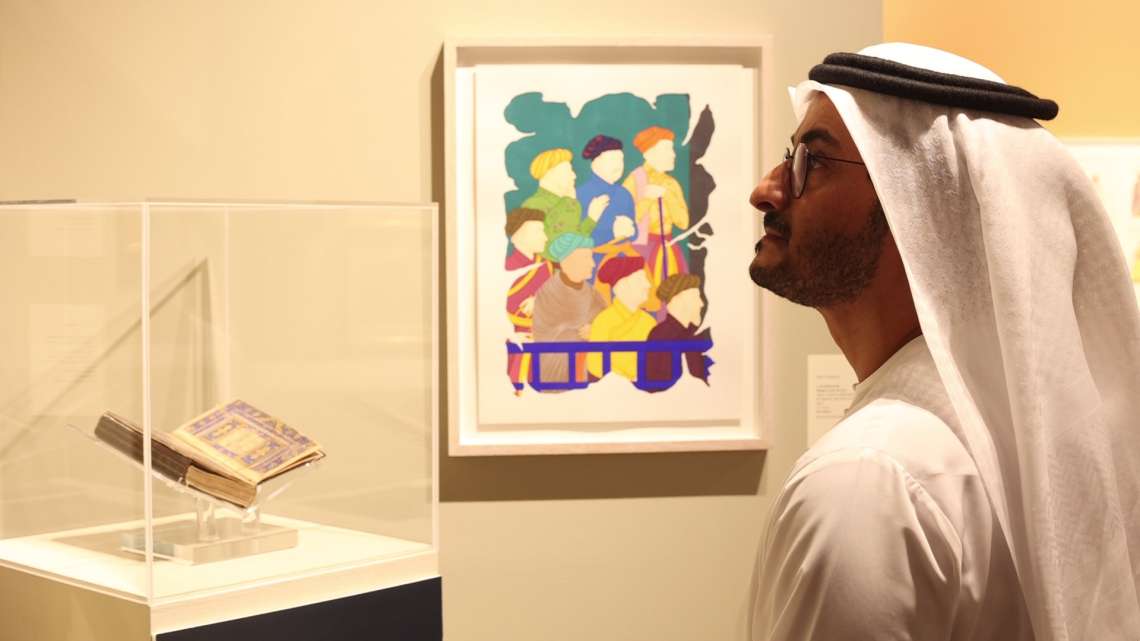
As of 2026, Art Abu Dhabi will evolve into Frieze Abu Dhabi, bringing with it the weight and wonder of Firenze London’s global art ecosystem, writes Soniya Kirpalani
Abu Dhabi Art has long been more than a fair—it has been a mirror, a meeting ground, and a movement, especially for the emerging artists from the UAE and the global south. Today, it stands at the pathway where East goes West.
Since its inception in 2007, it has not only secured its place on the global cultural calendar but also steadily redefined it. Each year, under the watchful curatorship of Director Dyala Nusseibeh, the fair has offered new perspectives, placing lesser-seen narratives on par with global blue-chip art. It is this curatorial boldness, this cultural diplomacy through art, that has now laid the groundwork for an exciting new chapter: Frieze Abu Dhabi 2026.

This November, as I wandered through Manarat Al Saadiyat—the venue that has housed this transformation for over a decade—the air felt thick with promise. Over 140 galleries from 52 cities and 37 countries came together under the banner of community focus, with striking highlights from Turkey, Nigeria, and the Gulf. Artworks pulsed with new energy, reminding us that the global South is no longer a footnote in art history—it is the headline.
Dyala Nusseibeh has consistently articulated this dual purpose: “Abu Dhabi Art functions as both a dynamic commercial hub for the art market and a marketplace for ideas.” The numbers bear her out: 40% growth in exhibitors and a 25% increase in international registrations this year alone. But more than metrics, it’s the ideas—plural, diverse, often dissonant — that have found sanctuary here.

And now, a new constellation forms. The announcement of a partnership between Frieze — one of the world’s most influential contemporary art platforms — and the Department of Culture and Tourism – Abu Dhabi, marks a landmark shift. As of 2026, Art Abu Dhabi will evolve into Frieze Abu Dhabi, bringing with it the weight and wonder of Firenze London’s global art ecosystem.
The significance is not just institutional; it’s ideological. Frieze, with its strongholds in London, New York, Seoul, and Los Angeles, is turning its gaze towards the East—and it’s not a superficial glance. This partnership signals a deeper commitment to fostering Global South narratives, embedding them into the architecture of contemporary art discourse, commerce, and curation.
So what is the impact?
Global Infrastructure Meets Local Insight: With Frieze’s international network and marketing clout, emerging and established artists from the Gulf, North Africa, and South Asia will find a bigger, bolder platform, taking the global south to the world.


Cultural Diplomacy & Soft Power: Abu Dhabi cements its position as a creative capital, not just regionally but globally, hosting a fair that will now attract the highest echelons of curators, collectors, and critics.
Curatorial Cross-Pollination: Expect deeper collaborations between institutions across continents, resulting in fresh curations, transnational exhibitions, and unprecedented dialogues.

From White Cubes to Experiential Arts: Frieze’s recent global editions have shown a marked shift away from sterile, hermetic art spaces. They’re now embracing alternative venues, performance-based installations, public art, and storytelling-driven curation. This could inspire and push regional galleries to rethink their models—perhaps evolving into cultural incubators, hybrid retail-experience spaces, or artist-led platforms, aligned with the way younger audiences engage with art.
Frieze Abu Dhabi has the potential to catalyze a renaissance for the region’s galleries, but only if it remains inclusive, contextually sensitive, and collaborative. There is a real danger of overshadowing local galleries that cannot afford participation fees or do not align with Frieze’s curatorial direction. The white cube is not dead—it just needs to become more porous, people-centric, and purpose-driven. And in that evolution, this partnership may be the spark that turns challenge into change.
Images: Santosh Rai