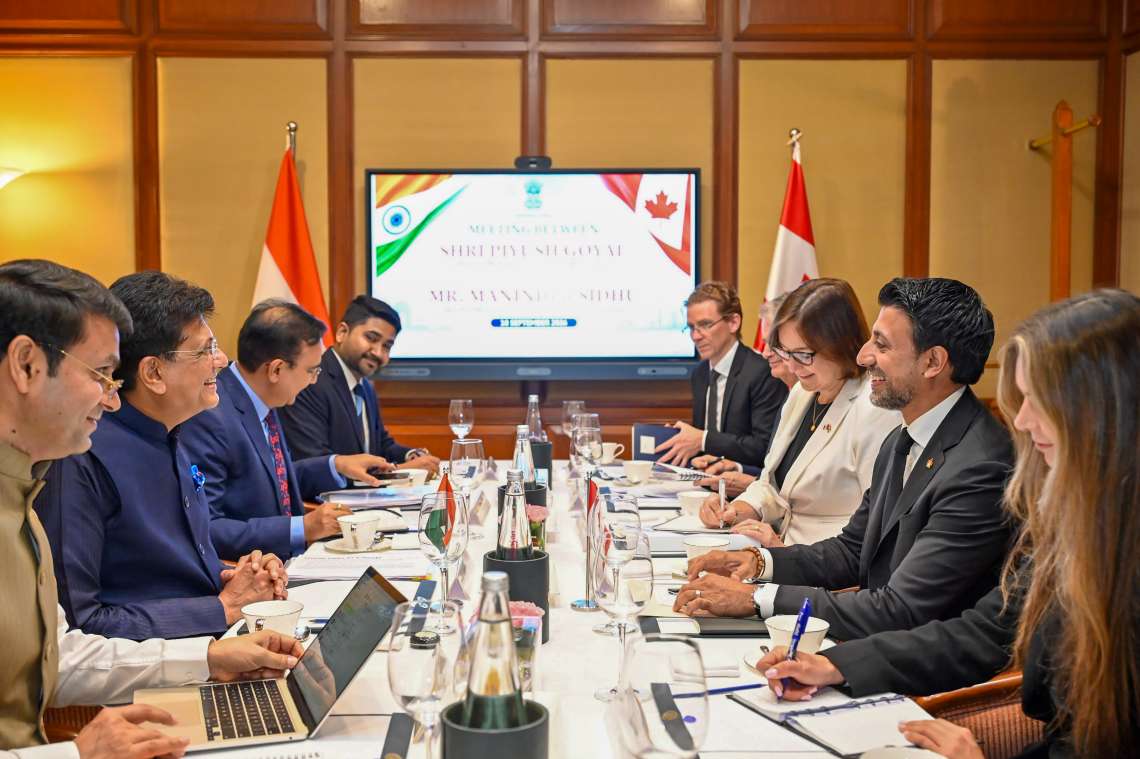
Commerce and Industry Minister Piyush Goyal stepped in to reassure stakeholders, clarifying that the full benefits of India’s arrangement with the US would become evident once the legal text of the interim agreement is finalised next month
India’s textile and apparel export sector is showing clear signs of recovery after months of uncertainty, with industry leaders expressing strong optimism that upcoming trade agreements will unlock a fresh growth cycle.
Exporters believe the combination of improved tariff structures and new Free Trade Agreements (FTAs) could push shipments sharply higher over the next two years. The renewed confidence follows clarity on India’s interim trade understanding with the United States and progress on long-pending negotiations with the European Union and the United Kingdom.
Animesh Saxena, General Secretary of the Garments Exporters and Manufacturers Association, said the sector is preparing for expansion. “With the United States reducing tariffs to 18 per cent and India’s FTA with the EU granting zero-duty access for textiles and apparel, we foresee business growing by at least 30–40 per cent over the next two years,” he noted.
Earlier this month, concerns had rippled across the industry after reports suggested that Bangladesh exporters could gain a competitive advantage through zero reciprocal tariffs under Dhaka’s trade arrangement with Washington. However, exporters now describe those fears as overstated.
Commerce and Industry Minister Piyush Goyal stepped in to reassure stakeholders, clarifying that the full benefits of India’s arrangement with the US would become evident once the legal text of the interim agreement is finalised next month.
Industry representatives also pointed out that Bangladesh’s arrangement reportedly carries specific conditions. R. K. Vij, President of the Textile Association (India), explained that exporters there may be required to source American cotton for garment production before shipping finished goods to the US.
“US cotton is expensive, and logistics costs will add to the final price. That could offset much of the duty advantage,” Vij said.
On concerns regarding the impact of cotton imports on domestic farmers, industry leaders emphasised that safeguards remain in place. India’s cotton growers are protected through the Minimum Support Price (MSP) mechanism and existing import duties. They also noted that only specialised varieties of higher-fibre-quality cotton, largely sourced from the US, are imported to meet specific manufacturing requirements.
“US cotton cannot flood the Indian market — it is costlier. Indian cotton remains the more economical option,” an industry executive said, adding that global cotton prices are inherently volatile.
Exporters argue that India may, in fact, hold a relative edge among Asian competitors. While India’s reciprocal tariff stands at 18 per cent, Bangladesh faces 19 per cent and Vietnam 20 per cent, according to industry estimates. When combined with the United States’ Most Favoured Nation (MFN) tariff of around 12 per cent on garments, the total effective duty remains broadly comparable across competing exporters.
Dinesh Babu, Executive Secretary of the Tiruppur Exporters’ Association, said clarity around the India–US trade understanding has stabilised sentiment. “The earlier uncertainty was the biggest concern. Now that matters are clearer, and with FTAs progressing with the EU and UK, the outlook appears strong,” he said.
India’s textile and apparel exports currently stand at approximately Rs 3.19 lakh crore globally, with shipments worth around Rs 62,700 crore directed to the EU. Once the EU agreement becomes operational — expected within six to seven months — Indian products are likely to gain zero-duty access across 27 member countries, significantly improving competitiveness.
However, recent export data underscores the need for revival. Between April 2025 and January 2026, textile exports recorded a contraction of 2.35 per cent. January 2026 saw textile exports decline 3.68 per cent year-on-year, while apparel exports fell 3.84 per cent, according to industry data.
Despite these short-term pressures, exporters remain confident that improved market access, tariff rationalisation and supply chain realignments will drive a sustained rebound.
As global demand stabilises and trade frameworks take effect, industry leaders believe India’s textile and apparel sector could be entering a new phase of resilience and expansion — positioning itself as a stronger contender in the international marketplace.