Both sides welcomed the upcoming ministerial meet as a platform to further strengthen dialogue and collaboration….reports Asian Lite News
India and the Arab League have reaffirmed their commitment to deepening political, economic and cultural engagement, ahead of the second India-Arab Foreign Ministerial Meet scheduled in New Delhi later this month.
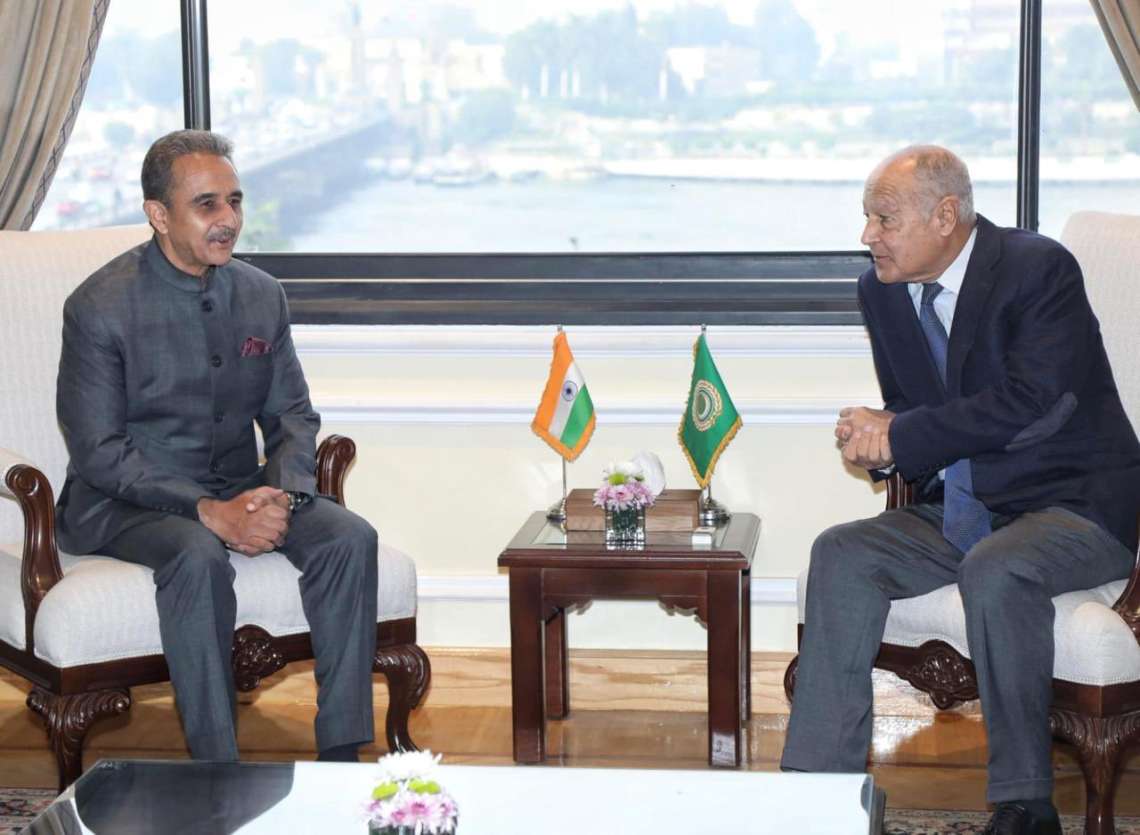
Minister of State for External Affairs Kirti Vardhan Singh met Arab League Secretary General Ahmed Aboul Gheit in Cairo to discuss wide-ranging bilateral and regional cooperation. Both sides welcomed the upcoming ministerial meet as a platform to further strengthen dialogue and collaboration.
“Pleased to meet H.E. Ahmed Aboul Gheit, the Secretary General of Arab League. Held productive discussions on India’s wide-ranging political, economic and cultural engagement with the Arab League. We also welcomed the upcoming 2nd India-Arab Foreign Ministerial Meet scheduled to take place in New Delhi at the end of the month,” Singh posted on X.
The meeting follows consultations held in November last year by Neena Malhotra, Secretary (South) at India’s Ministry of External Affairs, who met with Arab ambassadors in New Delhi to discuss opportunities to enhance cooperation across political, economic, and cultural spheres. MEA spokesperson Randhir Jaiswal highlighted that these interactions are part of a continuing effort to reinforce India-Arab relations.
India and the nations of the Arab League share deep-rooted historical, cultural, and economic connections dating back to ancient trade routes across the Arabian Sea and land routes linking India to West Asia. Shared language, religion, and cultural heritage continue to energise ties between India and the Arab world.
Established in Cairo in 1945, the Arab League now comprises 22 member states spanning North Africa and the Middle East. The League has historically played a key role in shaping political and economic developments across the region. India regards the Arab League as part of its extended neighbourhood and sees member states as critical partners for trade, energy security, and regional stability.
Trade between India and Arab League nations relies heavily on strategic waterways such as the Suez Canal, Red Sea, and Gulf of Aden, underscoring the importance of close economic and maritime ties. Over the last decade, cooperation between India and Arab countries has expanded significantly, encompassing new economic opportunities, technology partnerships, cultural exchanges, and sustainable development initiatives.
As India continues to strengthen its global economic and political footprint, engagement with the Arab League remains a cornerstone of its foreign policy. The upcoming India-Arab Foreign Ministerial Meet is expected to reinforce shared strategic priorities, deepen trade and investment relations, and build stronger people-to-people and cultural linkages.