Bangladesh votes in high-stakes parliamentary election and constitutional referendum, with Yunus hailing a new beginning as opposition leaders demand fairness and credibility….reports Asian Lite News
As millions of Bangladeshis queued at polling stations on Thursday, the country entered what many are calling its most consequential election in decades — a combined parliamentary poll and constitutional referendum unfolding in the shadow of the dramatic political upheaval of 2024.
Eighteen months after a student-led uprising forced long-time Prime Minister Sheikh Hasina from office, voters are choosing a new parliament while also deciding on constitutional changes that could reshape the balance of power in the republic. The vote is widely seen not merely as an electoral contest, but as a referendum on Bangladesh’s political future.
“Birthday of a New Bangladesh”
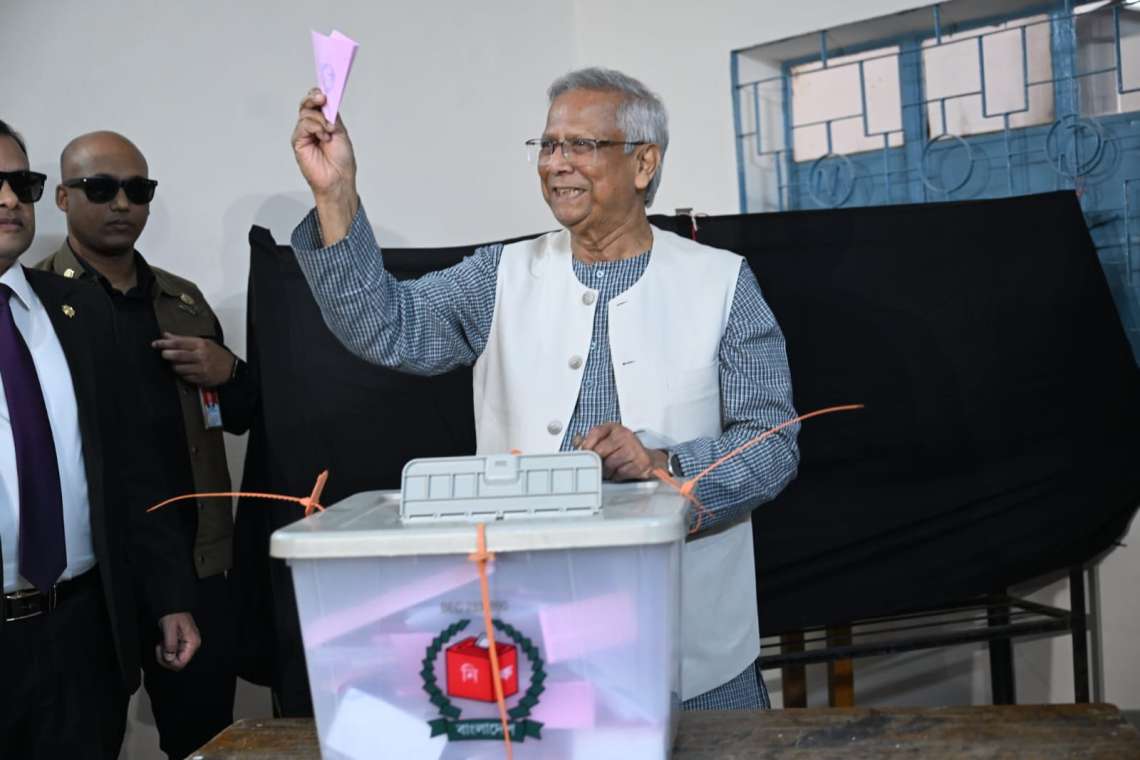
Interim government head Muhammad Yunus cast his ballot at the Gulshan Model School and College polling station in Dhaka at around 10 am local time, describing the day as historic and transformative.
“This is a day of great joy. Today is the birthday of a new Bangladesh,” Yunus said after voting. He framed the twin processes of election and referendum as a decisive break from what he called a “nightmarish past”, asserting that citizens now had the opportunity to rebuild the country at every step.
Yunus emphasised that while choosing parliamentary candidates was important, the constitutional referendum carried even greater weight. “The whole of Bangladesh will change,” he said, characterising the moment as one of liberation and renewal.
The interim administration he leads has been tasked with steering the country through this transitional period after the collapse of the Awami League government. For many voters, the credibility of this process is tied to whether it can restore confidence in democratic institutions after years of polarisation.
Opposition Voices Hope and Caution
Bangladesh Nationalist Party chairman Tarique Rahman, who cast his vote at the same Gulshan polling centre, described the day as long awaited.
“For more than a decade, the people of Bangladesh have been waiting for this day,” he said, calling on citizens to exercise their constitutional right in large numbers. The BNP had been barred from contesting the last general election, and Rahman himself had spent years in exile before returning to Bangladesh last year.
He acknowledged reports of “undesirable incidents” overnight but expressed hope that law enforcement agencies would act firmly to prevent disruptions. “If people across Bangladesh come out throughout the day and exercise their right to vote, any conspiracy can be thwarted,” he said.
Rahman pledged that if his party forms the government, it would prioritise women’s empowerment from its first day in office. “Half of Bangladesh’s population is women. We cannot move forward by leaving this half behind,” he said, highlighting commitments outlined in the BNP manifesto.
Jamaat-e-Islami Ameer Shafiqur Rahman, after casting his vote at the Monipur High School and College polling centre, said his party would accept the results only if the election was conducted in a free and fair manner. “If the voting is held in a free and fair manner, we will accept the results. Others should also accept the verdict of the people,” he said.
Rahman noted that he had been unable to vote in the previous three national elections due to imprisonment, calling his participation this time a significant personal milestone. He urged all parties to respect the people’s mandate and said he hoped a government would emerge that represented the country’s 180 million citizens rather than any single faction.
Generational Shift and Lingering Doubts
Political analyst Chris Blackburn described the election as part of a historic generational transition. With Sheikh Hasina removed from power and former Prime Minister Khaleda Zia no longer a political force, what was once termed the “Battle of the Begums” has effectively ended.
“We’re seeing a new breed coming through,” Blackburn said, referring to the political churn unleashed by the 2024 uprising. He characterised the upheaval as a “massive violent shift” that has set the stage for this vote.
However, he cautioned that questions over inclusivity and fairness remain. The absence of Awami League leadership from the contest has fuelled debate about legitimacy. “How can it be seen as all-inclusive when a very popular party and the oldest party in Bangladesh has been banned from having a part within the election,” he asked, describing the situation as disenfranchising.
Blackburn also cited reports of intimidation, isolated violence and alleged financial misconduct, urging international observers to assess the process candidly. On the ground, he said, many ordinary voters remain anxious, concerned as much about jobs, inflation and daily living costs as about constitutional theory.
As ballots are counted, the stakes extend beyond domestic politics. The outcome could influence Bangladesh’s regional alignments, including ties with India, and shape its standing in global forums.