The timing of the report is significant, as India prepares to host the India AI Impact Summit from February 16 to 20 at Bharat Mandapam in New Delhi
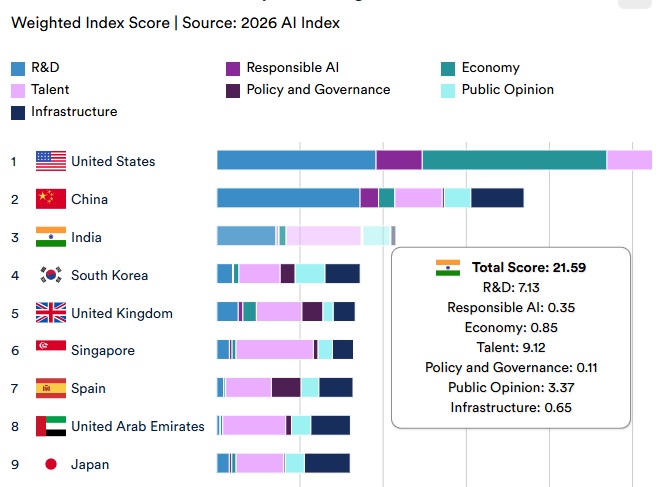
India has emerged as a global frontrunner in artificial intelligence (AI), topping an international index for AI skills penetration and AI hiring, while ranking just behind the United States and China overall in the 2026 Global Vibrancy Index (GVI).
The latest GVI, produced by Stanford University’s Institute for Human-Centred AI, places India second only to the US in economic competitiveness linked to AI, underlining the country’s rapid transformation into a major force in the global technology landscape.
Within the competitiveness category, India stands out in the talent sub-index, overtaking the US in key parameters such as AI Skills Penetration and AI Hiring Ratio. These indicators measure how deeply AI skills are embedded within the workforce and how actively companies are recruiting AI professionals. The findings signal that India’s AI ecosystem is not only expanding but also integrating AI capabilities at scale across industries.
India also ranks second in several innovation-driven subcategories, including AI-Related Social Media Conversations Net Sentiment, AI GitHub Projects, and AI GitHub Projects Stars. GitHub, a global platform used by developers to build and collaborate on software projects, serves as a critical benchmark for tracking open-source AI innovation and developer engagement.
The Institute for Human-Centred AI attributed India’s strong performance to renewed national initiatives aimed at strengthening its position in the global AI ecosystem. The report noted that countries around the world increasingly view AI as a strategic priority, and India’s focused push reflects that global trend.
India’s rise is particularly notable considering its position in earlier editions of the index. In the inaugural GVI released in 2017, India ranked seventh. The latest rankings show that the country has overtaken major economies such as Japan, Germany, Singapore and the United Kingdom, driven largely by advances in research and development, talent cultivation and policy support.
The timing of the report is significant, as India prepares to host the India AI Impact Summit from February 16 to 20 at Bharat Mandapam in New Delhi. The summit, organised by the Ministry of Electronics and Information Technology (MeitY) under the IndiaAI Mission, is expected to bring together governments, industry leaders, researchers, startups, students and civil society representatives from across the globe.
Envisioned as a platform for actionable outcomes rather than high-level dialogue alone, the summit aims to shape an inclusive, responsible and future-oriented AI agenda. Organisers say the event will focus on delivering tangible frameworks and collaborations that can support economic growth, social development and sustainable AI deployment.
The summit will revolve around three core pillars — People, Planet and Progress. Discussions under “People” will address employment, skilling and workforce transformation in the AI era. “Planet” will focus on sustainable and energy-efficient AI systems, while “Progress” will examine AI’s role in economic advancement and social inclusion.
Seven thematic working groups, co-chaired by representatives from both the Global North and Global South, are expected to present proposals covering AI Commons, trusted AI tools, shared compute infrastructure and sector-specific AI use cases.
Together, the global rankings and the upcoming summit signal India’s growing ambition to shape the next phase of the AI revolution — not just as a participant, but as a leader.