Beijing is using Belt and Road funding to expand Bangladesh’s infrastructure, opening markets for Chinese goods while developing roads, bridges and ports that could strengthen China’s strategic influence in the Bay of Bengal and Indian Ocean, writes Dr Sakariya Kareem
The railway network in India developed during the British rule typically connected the major ports like Bombay, Calcutta and Madras with their hinterlands. The objective behind this plan was two-fold: to wheel away raw materials for industries in Britain through Indian ports and reach to the interior Indian markets industrial products of Britain landing at these ports. Helping in the economic development of the remote corners of the sub-continent was not one of the aims of setting up ports and railways in India.
Beijing has adopted a similar strategy of promotion of China’s interest while extending to Bangladesh financial assistance under the Belt and Road Initiative for infrastructure development. China has been extending help in building a network of roads and bridges as well as seaports so that the markets in Bangladesh can be flooded with Chinese manufactured products, as well as semi-processed industrial inputs mainly for the readymade garment industries of Bangladesh. There is also an added dimension behind this plan for the development of infrastructure: to use the seaports as strategic hubs to extend the hegemony of China in Bay of Bengal and the Indian Ocean region.
Mapping of the spread of infrastructure projects in Bangladesh built with Chinese assistance makes this plan clear. The focus of the BRI is in the central and south eastern parts of Bangladesh covering the Dhaka and Chittagong divisions, leaving out the Chittagong Hill Tract area where mainly the Buddhist and Christian minority tribal groups live. These two division comprise the developed areas of Bangladesh.
Three major river systems pass through the territories in Bangladesh to meet the Bay of Bengal: the Padma, the Jamuna and the Meghna. Along the mouths of these rivers the main ports of Bangladesh are located. River Karnaphuli is in the east, draining the hills of CHT to the Bay of Bengal in the Chittagong area. Traditionally, inland waterways have been the cornerstone of the transportation system of Bangladesh, responsible for transporting over 50 percent of the total cargo of the country and 25 percent of the passenger traffic. By contrast, the share of inland waterways in total cargo movement in neighbouring India is only two percent.
The focus of the road and bridge projects in Bangladesh with Chinese assistance is in and around these river systems which connect the Dhaka and the Chittagong divisions with the sea. Dhaka and Chittagong are also the main centres of readymade garment manufacturing, the most important industry in Bangladesh. China is the largest source of machinery, raw materials and accessories for these garment manufacturing units. Around 80 percent of the raw materials used in the apparel industry in Bangladesh now originate in China. The infrastructure network built with BRI assistance helps Beijing reaching these inputs to the garment manufacturers in Bangladesh.
A few BRI projects have also been planned in the northern parts of Bangladesh along these northern reaches of Jamuna river which is a continuation of river Brahmaputra that originates in Tibet and passes through north-east India to enter Bangladesh in Kurigram.
On the other hand, large parts of Rangpur and Mymensingh divisions in the north, the Sylhet division in the north-east, the Khulna division in the south-west, the Barisal division in south and the hilly areas of Chittagong division in south-east are neglected and do not come under the focus of BRI infrastructure projects. None of these areas is along the course of the major river systems connecting to the Bay of Bengal. The forested Sunbarbans area which covers southern parts of Khulna and Barisal divisions is split into numerous river channels which are not suitable for riverine trade. The western parts of Rangpur, Rajshahi and Khulna divisions bordering India are also largely omitted from BRI projects.
Some of the road and bridge projects with Chinese assistance have already been completed. Among them is the Padma Multipurpose Bridge, a road-cum-rail bridge connecting the southern parts of Bangladesh with Dhaka, the national capital, opened in June 2022. The bridge had been built by China Major Bridge Engineering Company but former Prime Minister Sheikh Hasina had underscored that its construction was financed by the Bangladesh Government, and not by China. Later the China Railway Group has built a railway line over this bridge, connecting Dhaka with Jessore in western Bangladesh.
The Karnaphuli tunnel has also been built with Chinese assistance in the Chittagong division, an underwater tunnel extending for more than nine km. The tunnel is, however, proving to be a white elephant for Bangladesh because of its high maintenance cost which is not being covered by proceeds from the low volume of traffic of the tunnel. The traffic volume is only 14 percent of the original projection. The daily toll collection is about Taka 12 lakh while the daily maintenance cost is about Taka 22 lakh.
A few China – Bangladesh Friendship Bridges have come up, spanning local rivers; such as Dhaleswari river bridge and Arial Khan river bridge. The Dhaleswari river connects Padma with Meghna through Dhaka and Narayanganj while Arial Khan river takes off from Padma, connecting with river Meghna.
Among the infrastructure projects proposed to be built with Chinese assistance are the Second Padma Bridge, the Second Jamuna Bridge, as well as Dhaka – Chittagong Highway project under the Private Public Partnership model. The Second Padma Bridge will connect Manikganj in the Dhaka division with Rajbari on the western bank of the Padma, in Rajshahi. The Second Jamuna Bridge will connect the Gaibandha district on the west bank of Jamuna river to Jamalpur on the eastern bank. Gaibandha in the Rangpur division and Jamalpur in the Mymensingh division are both in north Bangladesh, alongside Jamuna.
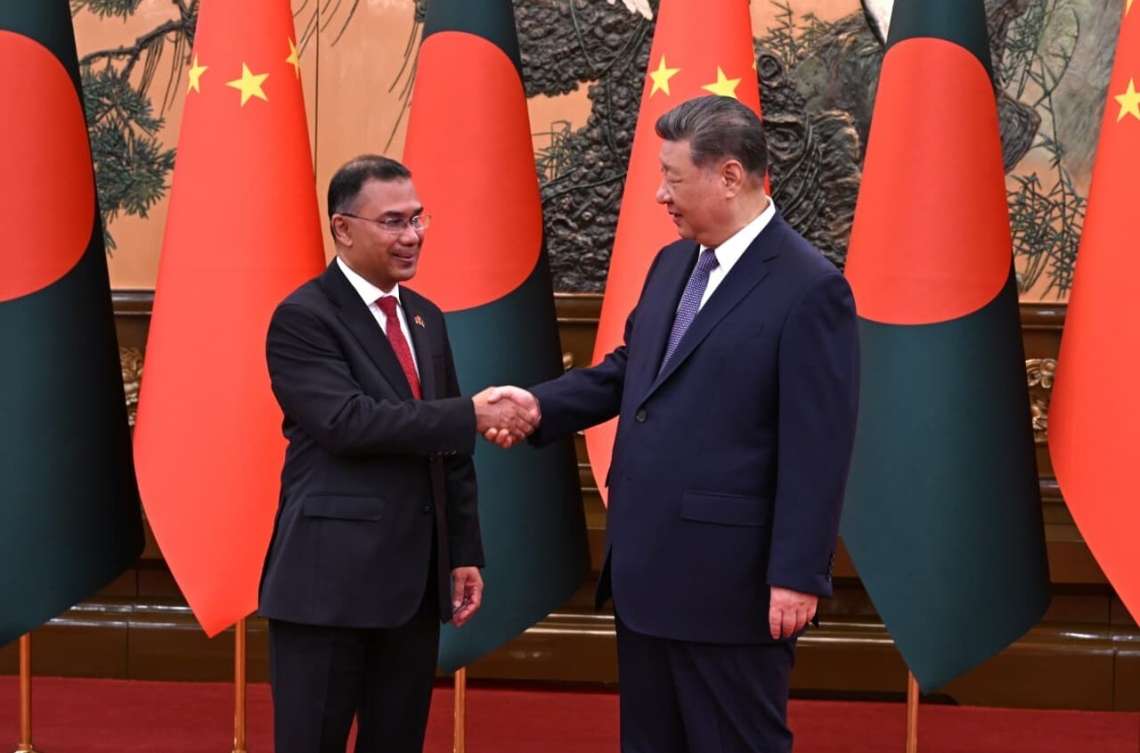
This network to flood markets in Bangladesh with finished products from China — a host of items like electrical and electronic equipment, machinery, plastics and iron and steel — as well as semi-finished inputs for the garment industry is capped by the seaports being developed with Chinese help. Among them is the Mongla Port which is closer to Dhaka than Chittagong and can be used to feed the garment industry in Bangladesh. China has also been assisting to strengthen the infrastructure at Chittagong port, like a single point mooring system, as well at Payra seaport. During the recent visit of Bangladesh Prime Minister Tarique Rahman to China, Beijing has suggested that the existing China Myanmar Economic Corridor be extended into a China Myanmar Bangladesh Economic Corridor so the seaports in Bangladesh on the Bay of Bengal can be accessed more easily from the Yunnan province of China.
Besides facilitating trade, these seaports in Bangladesh developed with Chinese assistance can be used as bases for the Chinese navy. From there, the influence of Beijing can be extended to the Bay of Bengal and the Indian Ocean region.