India pushes India–EU free trade deal towards finish line as Brussels talks intensify, Germany backs swift conclusion, and MSME-focused export reforms aim to unlock new global opportunities….reports Asian Lite News
India’s long-pending Free Trade Agreement with the European Union appears closer to fruition, as New Delhi and Brussels intensify negotiations amid growing geopolitical uncertainty and a global shift towards protectionism.
Recent high-level engagements led by Commerce and Industry Minister Piyush Goyal, coupled with strong political backing from Germany, have injected fresh momentum into the proposed India–EU FTA, which is now widely seen as strategically and economically consequential for both sides.
Brussels talks
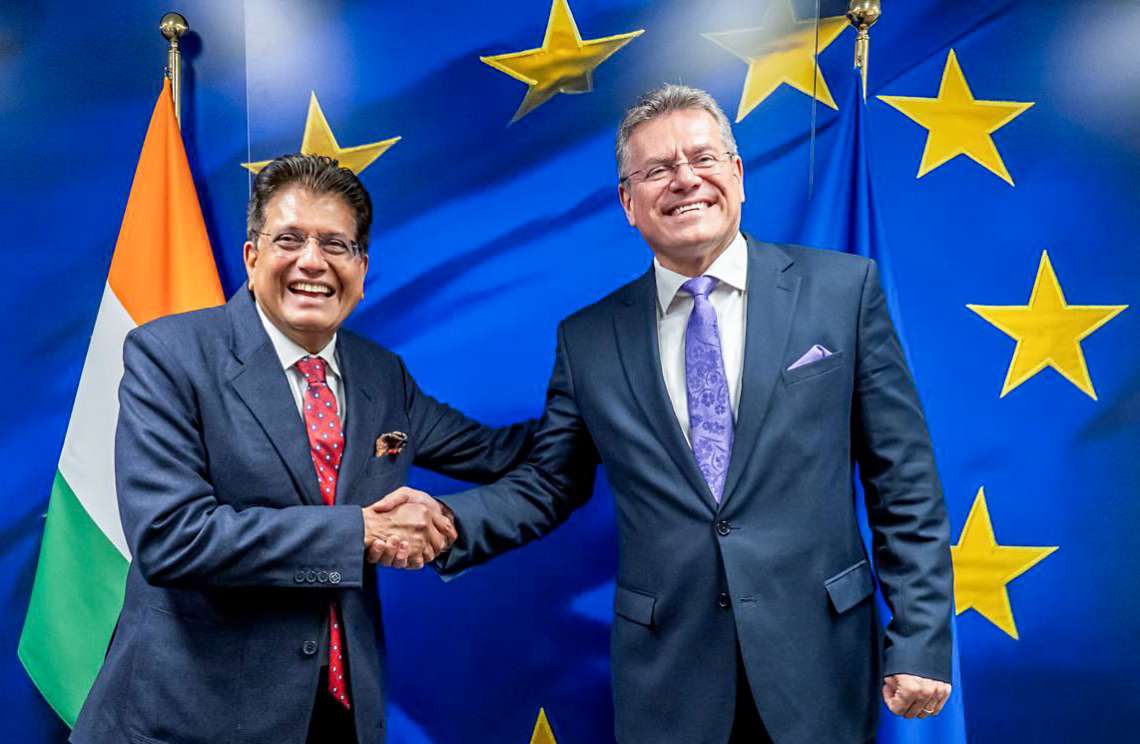
Minister Goyal’s visit to Brussels over the past week marked a critical phase in the negotiations. Holding what he described as “productive and detailed” discussions with EU Trade and Economic Security Commissioner Maros Sefcovic, Goyal stressed the importance of concluding a fair, balanced and ambitious trade agreement rooted in shared democratic values and a rules-based trading order.
The talks covered a broad range of unresolved issues, including market access, tariffs, supply-chain resilience and safeguards for sensitive sectors. India is pushing strongly for zero-duty access for labour-intensive industries such as textiles, leather, apparel, gems and jewellery, handicrafts and footwear — sectors that collectively employ millions and form the backbone of its export economy.
According to Goyal, the proposed agreement is not merely about lowering tariffs but about integrating Indian industry more deeply into global value chains while protecting farmers and micro, small and medium enterprises. He reiterated India’s commitment to a modern economic partnership that supports sustainable growth rather than one-sided market liberalisation.
Officials familiar with the discussions indicate that the negotiations have entered a “final-stage” phase, with political will on both sides now playing a decisive role in bridging remaining gaps.

Germany pitches India as EU’s partner of choice
The renewed push for the India–EU FTA has received a significant boost from Berlin. During his first official visit to India, German Chancellor Friedrich Merz openly backed the swift conclusion of the trade deal, describing India as a “desired partner” and “partner of choice” for Germany and Europe.
Speaking alongside Prime Minister Narendra Modi in Gandhinagar, Merz said concluding the India–EU FTA was essential to unlocking the full potential of India–Germany economic relations. He argued that free trade and open markets must be defended at a time when supply chains are increasingly being weaponised by major powers.
Merz underlined that both India and Germany oppose the use of raw materials and trade dependencies as geopolitical tools, calling instead for diversified, resilient supply chains. With India now the fastest-growing major economy in the G20, he said Europe’s engagement with New Delhi was no longer optional but strategic.
Germany’s strong endorsement carries weight within the EU, given its position as the bloc’s largest economy. Analysts see Berlin’s advocacy as a potential catalyst for overcoming lingering resistance within some European member states on issues such as regulatory standards and market access.
MSME exports placed at heart of trade strategy
Parallel to external negotiations, the Indian government has moved to strengthen domestic export capacity through the rollout of the Export Promotion Mission. As part of its initial phase, two key interventions under the Niryat Protsahan sub-scheme have been launched to support MSME exporters.
The first focuses on interest subvention for pre- and post-shipment export credit, reducing borrowing costs and easing working-capital pressures. A base interest subvention of 2.75 per cent has been announced, with additional incentives planned for exports to under-represented and emerging markets once operational systems are in place.
The second intervention addresses collateral constraints by providing credit guarantee coverage of up to 85 per cent for micro and small exporters and 65 per cent for medium enterprises, with a cap of ₹10 crore per exporter per financial year. Together, these measures are expected to improve liquidity, expand access to bank finance and reduce dependence on property-backed loans.
Officials say the scheme is designed to ensure that MSMEs are positioned to benefit directly from new trade agreements rather than being crowded out by larger firms.
Beyond Europe
While Europe remains a central focus, India’s trade diplomacy is unfolding on multiple fronts. Goyal confirmed that negotiations with the United States for a bilateral trade deal are continuing, even as differences persist over tariffs and market access.
The newly appointed US Ambassador to India, Sergio Gor, has also indicated that trade talks will remain active alongside cooperation in defence, technology, energy and education.