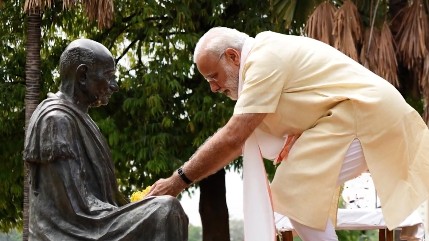
India celebrates the 157th birth anniversary of Mahatma Gandhi and pays tribute to Lal Bahadur Shastri, remembering their contributions to the freedom struggle and nation-building.
India is celebrating Gandhi Jayanti on October 2, commemorating the 157th birth anniversary of Mahatma Gandhi, the Father of the Nation, whose principles of truth, non-violence and peace continue to inspire generations. The day also marks the birth anniversary of former Prime Minister Lal Bahadur Shastri, who played a significant role in India’s freedom movement and the country’s development after Independence.
Gandhi Jayanti is observed every year across the country with prayer meetings, tributes, cleanliness drives and various programmes highlighting Mahatma Gandhi’s philosophy and his contribution to India’s freedom struggle. The day is also observed internationally as the International Day of Non-Violence, recognising Gandhi’s enduring message of peace and non-violent resistance.
Born on October 2, 1869, in Porbandar, Gujarat, Mohandas Karamchand Gandhi emerged as one of the most influential leaders of India’s independence movement. His philosophy of Satyagraha, based on truth and non-violent resistance, became a powerful instrument in the struggle against British colonial rule.
Gandhi returned to India from South Africa in 1915 and gradually became a central figure in the freedom movement. He led several landmark movements, including the Non-Cooperation Movement, the Salt March of 1930 and the Quit India Movement of 1942. Through these campaigns, he mobilised millions of Indians and encouraged people from different communities to participate in the struggle for independence.
The Dandi March, launched in March 1930, remains one of the most significant events in India’s freedom struggle. Gandhi and his followers marched from Sabarmati Ashram to Dandi to challenge the British salt tax. The campaign drew international attention and demonstrated the power of peaceful protest against colonial rule.
Beyond the freedom movement, Gandhi emphasised communal harmony, rural development, self-reliance, simplicity and social equality. He strongly opposed untouchability and advocated the upliftment of marginalised communities. His vision of an independent India was rooted in self-sufficiency, dignity of labour and peaceful coexistence.
On Gandhi Jayanti, educational institutions, government offices and social organisations organise events to spread awareness about his teachings. Prayer meetings and floral tributes are held at Raj Ghat, his memorial in New Delhi, where leaders and citizens pay their respects.
October 2 also marks the birth anniversary of Lal Bahadur Shastri, India’s second Prime Minister, who was born in 1904 in Mughalsarai, Uttar Pradesh. Remembered for his simplicity, honesty and commitment to public service, Shastri made significant contributions to India’s freedom struggle and later to the country’s political and economic development.
Inspired by the ideals of Mahatma Gandhi, Shastri joined the Indian independence movement at a young age. He participated in several national movements, including the Non-Cooperation Movement and the Quit India Movement, and was imprisoned multiple times by the British.
After Independence, Shastri held several important positions in the government before becoming Prime Minister in 1964, following the death of Jawaharlal Nehru. During his tenure, India faced significant challenges, including food shortages and the 1965 war with Pakistan.
Shastri’s famous slogan, “Jai Jawan, Jai Kisan,” highlighted the importance of soldiers and farmers in safeguarding the country’s security and strengthening its economy. The slogan continues to hold significance in India’s national consciousness.
His leadership during the 1965 war and his emphasis on agricultural development remain important aspects of his political legacy. Shastri also promoted self-reliance and encouraged citizens to contribute to the nation’s progress.
The shared birth anniversary of Gandhi and Shastri offers an opportunity to remember two leaders whose lives were shaped by service, simplicity and dedication to the country. While Gandhi is remembered globally for his philosophy of non-violence, Shastri is honoured for his integrity, humility and leadership during a challenging period in India’s history.
As the nation observes Gandhi Jayanti and Shastri Jayanti, their messages of peace, unity, honesty and public service remain relevant. The occasion serves as a reminder of the values that shaped India’s freedom struggle and the responsibility of citizens to uphold them in building a just, peaceful and prosperous nation.