New Delhi says expanding only non-permanent Security Council seats would leave global power structures unchanged….reports Asian Lite News Desk
India has strongly opposed proposals to expand only the non-permanent category of the United Nations Security Council (UNSC), warning that such a move would leave the existing power structure untouched and render long-awaited reforms “grossly inadequate, bordering on failure.”
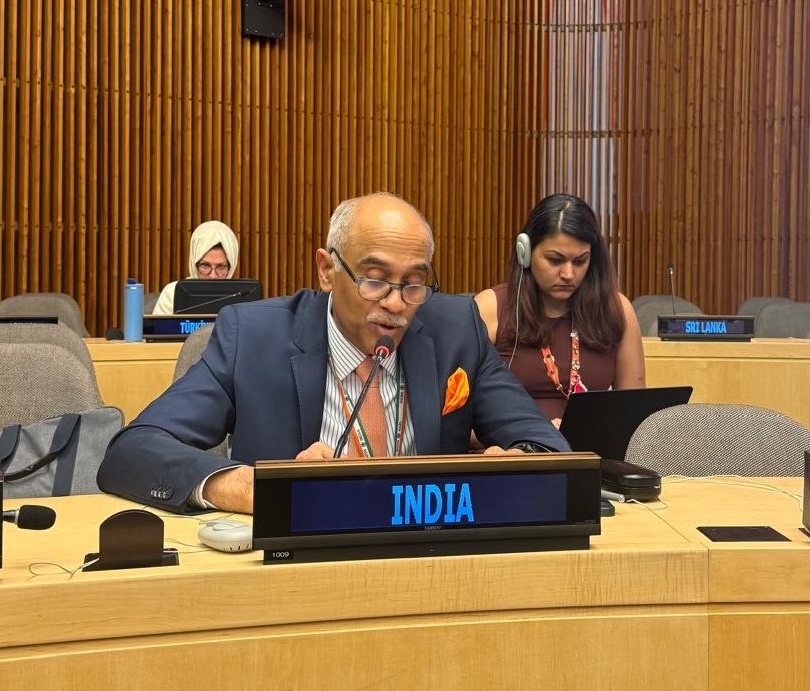
Speaking at a meeting of the Intergovernmental Negotiations (IGN) on Security Council reform on Monday, India’s Permanent Representative to the UN, P Harish, argued that meaningful reform must include an expansion of permanent membership to address longstanding imbalances in the Council.
“Groups and member states have waited this long for real and meaningful reform,” Harish said, adding that limiting expansion to non-permanent seats “would fundamentally not change the decision-making power structure” dominated by the Council’s five permanent members — the United States, Russia, China, Britain and France.
India has consistently advocated for an expansion of both permanent and non-permanent categories, maintaining that a broader permanent membership is necessary to make the Council more representative of contemporary global realities.

Without directly naming the 12-member Uniting for Consensus (UfC) group, which opposes the creation of new permanent seats, Harish accused supporters of the status quo of obstructing progress through procedural tactics.
“‘Nothing is agreed until everything is agreed’ must not become a tool to block progress,” he said, warning that such approaches risk entrenching existing inequities within the Security Council.
The UfC group, led by Italy and including Pakistan, has long resisted proposals to add new permanent members and has argued that consensus should precede the adoption of any negotiating text on reform. Critics, however, contend that the absence of a formal text has slowed progress on the issue.
Calling for a more structured reform process, Harish urged the IGN co-chairs to prepare a negotiating text and establish clear milestones and timelines.
“IGN cannot be fundamentally different from other UN processes, wherein negotiations are held on the basis of a text,” he said.
Harish also reiterated India’s position that expanding permanent membership is essential to creating a more balanced and equitable Security Council.
“The Council is fundamentally different by its very design,” he said, noting that unlike the UN General Assembly, where all member states enjoy sovereign equality, the Security Council’s structure reflects the power arrangements that emerged after World War II.
India further criticised the “Elements Paper” prepared by the IGN co-chairs, which seeks to consolidate member states’ views on reform. Harish objected to suggestions that the concept of permanent membership required further clarification.
“The UN Charter is very clear on this question, and there is no room for ambiguity,” he said.
Referring to Article 23 of the Charter, Harish noted that it clearly divides Security Council membership into two categories — permanent and non-permanent.
“Therefore, the definition of a permanent seat needs no further elaboration,” he added.
India, alongside fellow G4 nations Brazil, Germany and Japan, has long campaigned for permanent membership in an expanded Security Council, arguing that the UN’s most powerful body must better reflect current geopolitical realities and the aspirations of developing nations.