From diplomacy and defence to women’s empowerment and trade, the UAE and Kuwait reaffirm a decades-old bond as leaders launch a week-long celebration of Gulf brotherhood….reports Asian Lite News
The United Arab Emirates and Kuwait have reinforced their deep-rooted political, economic and social ties with a series of high-level meetings, agreements and public events marking the start of the “UAE and Kuwait: Brothers Forever” week, a nationwide celebration of one of the Gulf’s closest bilateral relationships.
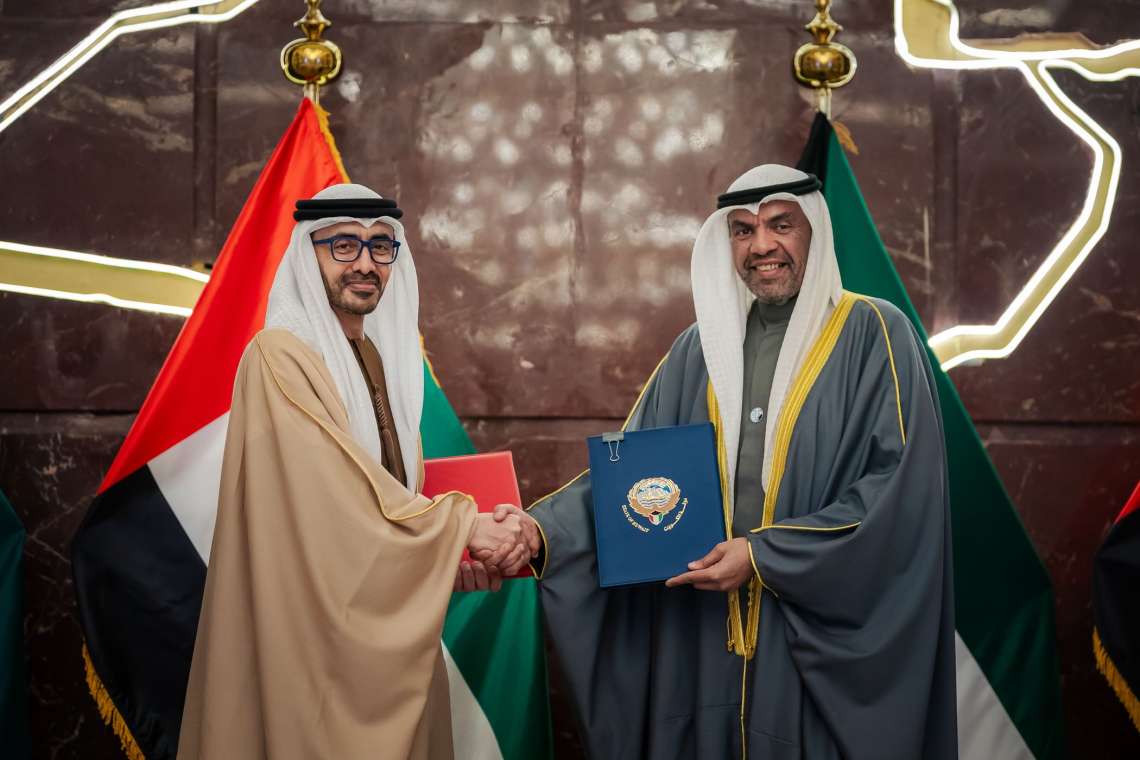
The week-long programme, running from January 29 to February 4, coincides with the sixth session of the UAE–Kuwait Joint Higher Committee, chaired in Kuwait by H.H. Sheikh Abdullah bin Zayed Al Nahyan, Deputy Prime Minister and Minister of Foreign Affairs of the UAE, and Abdullah Ali Al Yahya, Kuwait’s Minister of Foreign Affairs. The session underscored the growing breadth of cooperation between the two countries, spanning diplomacy, trade, health, technology, culture and regional security.
A partnership rooted in history
Addressing the committee, Sheikh Abdullah bin Zayed said relations between the UAE and Kuwait represent a unique model of fraternity and cooperation in the Arab world, built on foundations laid by the late Sheikh Zayed bin Sultan Al Nahyan and Sheikh Sabah Al Salem Al Sabah. He said those ties continue to strengthen under the leadership of President His Highness Sheikh Mohamed bin Zayed Al Nahyan and the Emir of Kuwait, His Highness Sheikh Mishal Al-Ahmad Al-Jaber Al-Sabah.
Sheikh Abdullah described the decision to dedicate a full week to celebrating the relationship as a milestone reflecting decades of shared positions, aligned visions and a common destiny. He reaffirmed that the UAE views Kuwait as a strategic partner and an essential part of the Gulf’s journey towards prosperity and stability.
Economic ties were highlighted as a central pillar of the relationship, with bilateral trade surpassing a record US$13.5 billion in 2024. The UAE is now Kuwait’s largest trade partner among Gulf and Arab states and its second-largest globally, while also serving as the world’s leading destination for Kuwait’s non-oil exports.
Cooperation has also deepened in health, with joint organ transplant programmes since 2021 resulting in 153 successful procedures for Kuwaiti patients in the UAE. Looking ahead, Sheikh Abdullah said both countries are aiming to expand collaboration in future-oriented sectors such as renewable energy, artificial intelligence, advanced industry and infrastructure.

Defence, diplomacy and regional stability
The strengthening partnership was further underlined in Abu Dhabi, where H.H. Sheikh Hamdan bin Mohammed bin Rashid Al Maktoum, Crown Prince of Dubai, Deputy Prime Minister and Minister of Defence, met Kuwait’s Minister of Defence Sheikh Abdullah Ali Abdullah Al-Salem Al-Sabah.
Sheikh Hamdan said the bonds between the two nations go beyond formal agreements, reflecting a shared commitment to security, stability and collective Gulf interests. He noted that the celebration week sends a message of unity and solidarity at a time of regional uncertainty, reaffirming the UAE and Kuwait’s aligned positions on regional and international issues.
Discussions between defence officials focused on expanding cooperation and exploring new opportunities that support the development priorities of both countries, while also reviewing key regional developments.
Women, culture and people-to-people ties
The human dimension of the relationship was showcased with the opening of the first UAE–Kuwaiti Women’s Forum in Abu Dhabi, held under the patronage of H.H. Sheikha Fatima bint Mubarak, the “Mother of the Nation”. Organised by the General Women’s Union in partnership with Kuwait’s Ministry of Foreign Affairs, the forum aims to strengthen cooperation in women’s empowerment and sustainable development.
Running until February 3, the forum features sessions on future-making, technology, peace and security, sport, media, climate action and renewable energy, alongside an exhibition highlighting women-led initiatives and cultural heritage from both countries.
Meanwhile, Dr Anwar Mohammed Gargash, Diplomatic Adviser to the UAE President, described the celebration week as a reflection of the UAE’s deep appreciation for Kuwait’s balanced and principled positions during times of regional challenge. Speaking at the UAE–Kuwaiti Media Forum, he said the relationship stands as a rare model of unity of destiny and shared responsibility within the Gulf.
Dr Gargash also noted that GCC states have collectively reaffirmed their commitment to de-escalation and regional stability, stressing that Gulf unity remains the strongest safeguard against conflict and uncertainty.
As events unfold across the emirates, the message from both capitals is clear: the UAE–Kuwait relationship is not only a legacy of shared history, but a living partnership shaping the future of the Gulf.