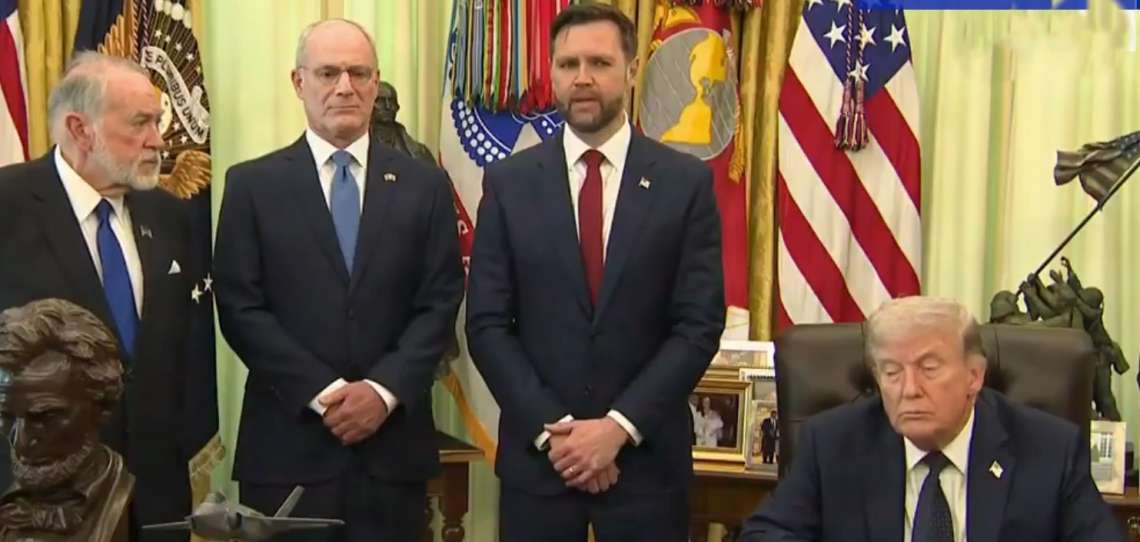
The announcement followed a high-level meeting at the White House attended by senior officials from both nations, including Lebanese Ambassador Nada Hamadeh Moawad and Israeli Ambassador Yechiel Leiter. The extension is expected to temporarily ease tension, reports Asian Lite Newdesk
US President Donald Trump has announced a three-week extension of the ceasefire between Israel and Lebanon, describing the development as a “historic” step and signalling the possibility of direct talks between the two sides in Washington.
The announcement followed a high-level meeting at the White House attended by senior officials from both nations, including Lebanese Ambassador Nada Hamadeh Moawad and Israeli Ambassador Yechiel Leiter. The extension is expected to temporarily ease tensions along the volatile Israel-Lebanon border, which has seen repeated flare-ups linked to militant activity.
Speaking after the meeting, Trump said both sides had agreed to prolong the ceasefire for an additional three weeks, emphasising that the pause in hostilities would create space for diplomacy. He added that leaders from Israel and Lebanon could travel to Washington in the coming weeks, raising the prospect of rare, direct engagement between two countries that do not maintain formal diplomatic relations.
US Vice President JD Vance described the extension as a “major historic moment”, crediting the President’s direct involvement for facilitating dialogue between the parties. He said the pause in fighting provides a critical window to explore a more durable settlement and reduce the risk of escalation.
Officials involved in the talks pointed to a shared security concern that could underpin future cooperation: the presence of Hezbollah. Both Israel and Lebanon, they said, face challenges linked to the group’s influence and military capabilities, which have long been a source of instability in the region.
Leiter said Israel remained committed to securing peace and ensuring the safety of its citizens, while also expressing a unified desire to counter Hezbollah’s role in the conflict. Moawad, meanwhile, welcomed Washington’s engagement, highlighting the importance of international support in stabilising Lebanon amid ongoing political and economic difficulties.
Trump linked the ceasefire initiative to broader US diplomatic efforts in the region, including its approach towards Iran, which backs Hezbollah. He suggested that the Israel-Lebanon track could prove less complex compared to other regional challenges, noting that both sides are aligned against a common threat.
At the same time, the US President reiterated Israel’s right to self-defence, stating that it would respond if attacked. He indicated that any such response would be measured and targeted, describing it as “careful” and “surgical,” in an apparent attempt to reassure both sides while maintaining deterrence.
Trump also hinted at a potential role for regional actors in supporting future negotiations, specifically referencing Saudi Arabia as a country that would welcome and possibly assist peace efforts. The involvement of Gulf states could add a broader diplomatic dimension to the process if talks progress.
Despite the optimism, the situation remains fragile. Israel and Lebanon are technically still in a state of war, and past ceasefires have often been short-lived, requiring sustained international mediation to prevent renewed violence. The presence of Hezbollah as a dominant armed force in southern Lebanon continues to complicate efforts to achieve a lasting resolution.
Analysts note that while the ceasefire extension offers a temporary reprieve, significant challenges remain before any long-term agreement can be reached. Issues such as border security, disarmament, and political recognition are deeply entrenched and have historically proven difficult to resolve.