The agreements strengthen the two countries’ Comprehensive Strategic Partnership while reaffirming their commitment to security and economic cooperation in the Indo-Pacific…reports Asian Lite News Desk
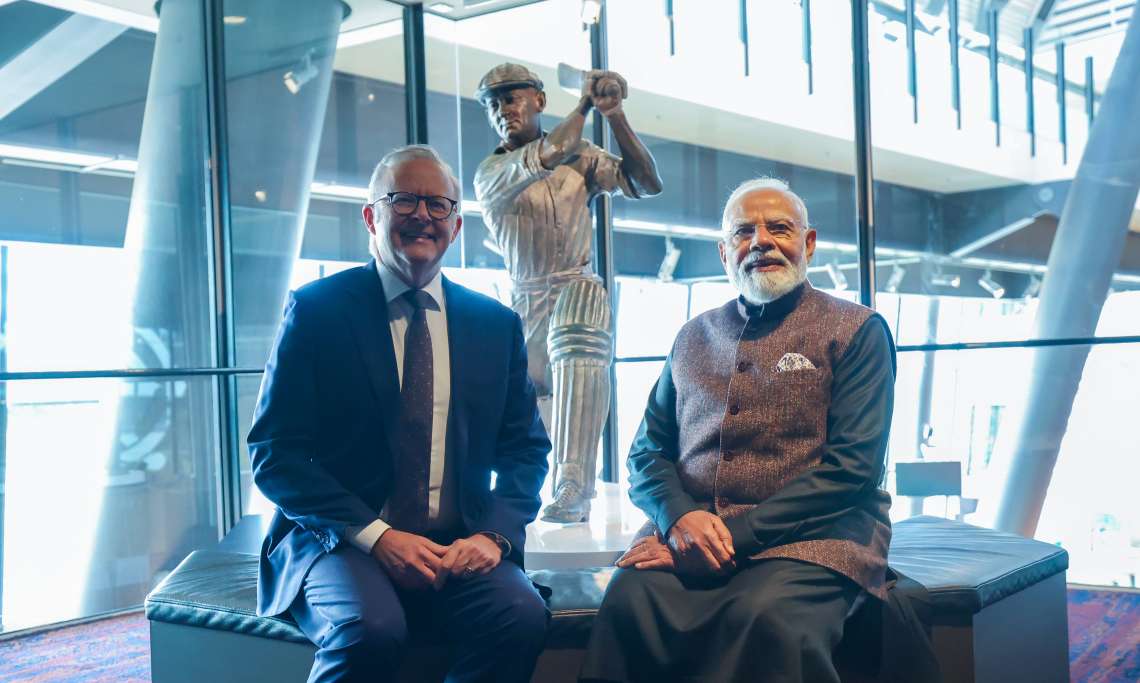
Prime Minister Narendra Modi and his Australian counterpart, Anthony Albanese, have concluded the third Australia-India Annual Leaders’ Summit in Melbourne, announcing a series of agreements aimed at strengthening defence, energy, technology, and economic cooperation under the two countries’ Comprehensive Strategic Partnership.
The summit marked six years of the partnership and produced agreements focused on reinforcing security in the Indo-Pacific, strengthening critical mineral supply chains and supporting the transition to clean energy.
A joint statement released by the Australian Prime Minister’s Office said the leaders adopted a new Joint Declaration on Defence and Security Cooperation, replacing the 2009 security agreement and expanding defence collaboration.
“Australia values India as a top-tier security partner, and the Declaration reflects our shared commitment to a peaceful, stable and prosperous Indo-Pacific region,” Prime Minister Albanese said. “We will boost strategic coordination, increase the complexity of our defence exercises and further build interoperability between our defence forces.”
Prime Minister Modi highlighted the practical impact of the new arrangements, announcing the creation of an India-Australia Defence Innovation Corridor.
“Through the India-Australia Defence Innovation Corridor, we will work to connect defence startups and industries,” Modi said. “Our maritime security collaboration roadmap will infuse new strength to our shared efforts in the Indo-Pacific.”
The leaders also confirmed the completion of the administrative arrangements needed to implement the 2015 Australia-India Nuclear Cooperation Agreement. The move clears the way for Australia to export uranium to India for peaceful civil nuclear energy programmes that the International Atomic Energy Agency safeguards.
“The arrangement facilitates Australian uranium exports to India to help increase the share of non-fossil fuel power capacity, providing an additional market for the Australian resources sector,” Prime Minister Albanese said.
Prime Minister Modi said the agreement would “give our clean energy objectives fresh momentum” as India seeks to expand its nuclear power capacity by 2047.
Economic security and clean energy also featured prominently during the summit. The two leaders launched the Australia-India Partnership on Cyber, Critical Technologies, and Supply Chains (PACTS), which includes plans to develop a critical minerals corridor to strengthen supply chains supporting clean energy technologies and advanced manufacturing.
A separate Memorandum of Understanding between Geoscience Australia and the Geological Survey of India will support joint efforts to identify and map critical mineral deposits.
Against the backdrop of regional security concerns, both countries reaffirmed their commitment to a “free, open, and prosperous” Indo-Pacific.
The summit also endorsed a Joint Maritime Security Collaboration Roadmap to improve information sharing and operational coordination between the Indian Coast Guard and Australia’s Maritime Border Command.
Addressing wider security issues, Prime Minister Modi stressed the importance of cooperation against terrorism. “Both India and Australia believe that terrorism is a serious challenge not just for one single country, but for entire humanity,” PM Modi declared. “That is why our fight against terrorism is shared and our resolve is unbreakable.”
The leaders also agreed to commission a temporary space-tracking terminal on the Cocos (Keeling) Islands to support India’s Gaganyaan human spaceflight programme by providing telemetry for future crewed missions. “As we expand our cooperation in science and technology, we have agreed to commission a temporary space tracking terminal on Cocos Keeling Islands, which will support India’s landmark Gaganyaan human spaceflight program,” Prime Minister Albanese announced.
Beyond strategic and economic issues, the summit highlighted the contribution of the Indian diaspora and wider people-to-people ties between the two countries. The leaders also announced the repatriation of an Australian First Nations ancestor held at the Government Museum in Chennai, alongside the return of cultural items from Australian galleries to India.