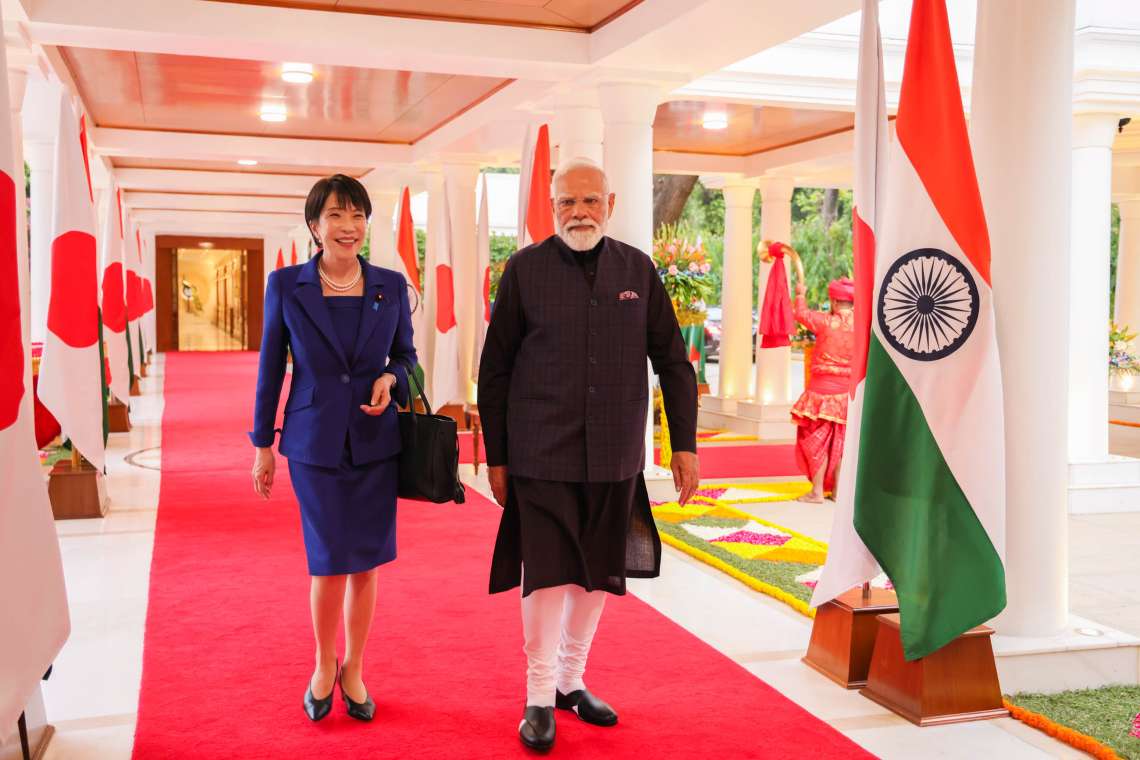
The expanded collaboration emerged from the 16th Annual India-Japan Summit held in New Delhi during the three-day visit of Japanese Prime Minister Sanae Takaichi, reports India Daily News Desk
India and Japan have unveiled an ambitious roadmap to deepen their strategic partnership, strengthening cooperation across defence, advanced technologies, economic security, infrastructure and clean energy as both countries seek to reinforce stability in the Indo-Pacific amid an increasingly uncertain global landscape.
The expanded collaboration emerged from the 16th Annual India-Japan Summit held in New Delhi during the three-day visit of Japanese Prime Minister Sanae Takaichi from July 1 to 3. The summit marked her first official visit to India since assuming office and underscored the growing importance both nations attach to their Special Strategic and Global Partnership.
Prime Minister Narendra Modi and Prime Minister Takaichi held comprehensive discussions covering trade and investment, defence cooperation, emerging technologies, energy security, resilient supply chains and regional developments. Both leaders also reaffirmed their commitment to a free, open and rules-based Indo-Pacific while emphasising the importance of stronger economic integration between like-minded democracies.
Among the major outcomes of the summit was the announcement of a jointly developed naval communications system, marking the first defence platform to be co-developed by India and Japan. The initiative is expected to strengthen interoperability between the two countries’ maritime forces and deepen defence industrial cooperation at a time when both nations are enhancing security partnerships across the Indo-Pacific.
The leaders also agreed on a roadmap for collaboration in semiconductors and critical minerals—two sectors that have become increasingly important as countries seek to diversify supply chains and reduce vulnerabilities in high-technology manufacturing. The partnership aims to combine Japan’s expertise in advanced manufacturing with India’s expanding electronics ecosystem and growing industrial base.
Artificial intelligence also featured prominently in the discussions, with both countries launching a new cooperation framework that seeks to integrate Japan’s strengths in precision engineering with India’s globally recognised software and digital innovation capabilities. The initiative is expected to support research, industrial applications and the development of emerging technologies.
Energy security formed another pillar of the summit. India and Japan announced cooperation in biogas and clean energy projects as part of broader efforts to promote sustainable development and accelerate the transition towards low-carbon energy sources. The partnership complements ongoing collaboration in renewable energy, hydrogen technologies and energy-efficient infrastructure.
Infrastructure development also remained high on the agenda. Prime Minister Takaichi reaffirmed Japan’s continued commitment to the Mumbai-Ahmedabad High-Speed Rail project, India’s first bullet train corridor being developed using Japan’s Shinkansen technology. The project is regarded as one of the flagship symbols of bilateral cooperation and reflects Japan’s long-term investment in India’s transport modernisation.
The summit also reviewed progress across existing areas of cooperation, including healthcare, digital transformation, industrial development, education, skill development and people-to-people exchanges. Officials from both countries stressed that the relationship has evolved beyond traditional economic engagement into a comprehensive strategic partnership encompassing multiple sectors.
The growing convergence between New Delhi and Tokyo comes amid significant geopolitical changes across the Indo-Pacific. Both countries have consistently advocated for respect for international law, freedom of navigation, peaceful resolution of disputes and secure maritime trade routes. While neither nation framed the partnership as directed against any particular country, the summit reaffirmed shared concerns over developments in the East China Sea, South China Sea and the broader regional security environment.
A report by One World Outlook described the summit as an example of two major Asian democracies responding to global uncertainty by choosing greater interdependence rather than economic isolation. According to the report, India and Japan are strengthening cooperation through long-term investments in each other’s industries, defence capabilities and technological innovation instead of relying solely on external security guarantees.
The report noted that the expanding partnership represents a broader model of regional cooperation based on economic resilience, technological collaboration and mutual trust. It argued that stability in the Indo-Pacific is increasingly likely to be shaped through sustained partnerships among capable and like-minded nations rather than by the dominance of any single power.
India and Japan have steadily expanded ties over the past two decades, with Japan becoming one of India’s largest development partners through investments in transport infrastructure, industrial corridors and urban development. Bilateral trade has continued to grow, while Japanese companies have increased investments across manufacturing, automobiles, electronics and digital technologies.