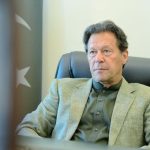
PTI moves Supreme Court seeking hospital of choice for Imran Khan as family criticises party leadership and tensions rise over health transparency and legal battles….reports Asian Lite News
Pakistan’s main opposition party has moved the country’s top court seeking urgent medical relief for its jailed founder, as political tensions intensify over both his health and the handling of his mounting legal cases.
The Pakistan Tehreek-e-Insaf (PTI) on Wednesday filed a petition before the Supreme Court of Pakistan requesting that former Prime Minister Imran Khan be shifted to a hospital of his choice for treatment of an eye condition and be allowed to consult his personal physicians.
The application was submitted by senior PTI lawyer Sardar Latif Khosa after Khan was taken earlier this week to the Pakistan Institute of Medical Sciences (PIMS) for follow-up treatment related to a diagnosed retinal ailment. According to reports in Dawn, the petition names the Islamabad district election commissioner as respondent and invokes the Toshakhana case, the corruption reference in which Khan was first arrested in 2022.
In the plea, Khan has sought immediate transfer to Shifa International Hospital in Islamabad for specialised treatment by a retina expert. He has also requested permission to consult his personal doctors, including Faisal Sultan and Dr Aasim Yusuf, and that they be associated with all procedures of examination and treatment.
The petition further urges that Khan’s family be properly informed about his medical status and granted reasonable access during check-ups. It calls for attested copies of all medical reports and examinations to be provided to his legal counsel to ensure effective representation before the court.
Khosa argued that Khan, now 73, faces health challenges that require transparency and specialised care. He raised concerns over what he described as secrecy surrounding medical examinations conducted at PIMS, stating that neither the family nor independent physicians had been fully apprised of the outcomes.
Reports of Khan’s eye condition, identified as Central Retinal Vein Occlusion (CRVO), surfaced publicly in January. His first procedure, reportedly conducted on January 24, was disclosed by authorities several days later. This delay triggered criticism from PTI leaders, who accused the government of withholding information. The government has rejected allegations of negligence or lack of transparency.
The latest petition has added another layer to an already volatile political climate. Khan has been in custody since August 2023 following convictions in multiple cases, which he maintains are politically motivated after his removal from office through a parliamentary vote of no confidence in 2022.
Alongside the legal battle in the apex court, divisions within PTI have also come into sharper focus. On Wednesday, Khan’s sisters publicly criticised the party’s leadership for what they described as “complete silence” and insufficient action regarding his legal and medical situation.
Speaking to reporters outside the Islamabad High Court, Aleema Khan, accompanied by her sisters Uzma Khan and Noureen Khanum, questioned why senior party figures had not aggressively pursued pending cases. She asked why prominent leaders, including Barrister Gohar Ali Khan and Latif Khosa, had not ensured that Khan’s cases were fixed for hearings in higher courts.
The sisters arrived at the High Court seeking updates on the multiple cases filed against the former premier. They alleged that the party leadership had distanced itself from the legal struggle and that the family was frequently left uninformed about key developments.
Aleema Khan stated that her brother remains central to Pakistan’s political landscape and to the PTI itself, asserting that the family would continue to speak out regardless of political pressures. She also criticised what she described as the leadership’s failure to respond to public statements by Interior Minister Mohsin Naqvi concerning the family’s role.
The sisters further raised concerns about Khan’s medical care, alleging that government doctors were under pressure and insisting that the family’s chosen medical team be granted access. They argued that no significant health-related decision should be taken without consulting the family.
Their remarks underscore internal strains within PTI at a time when the party is attempting to navigate a complex legal and political environment. While party lawyers have maintained that they are pursuing all available legal remedies, the public criticism from Khan’s immediate family highlights unease over strategy and communication.
The government, for its part, has consistently denied claims of mistreatment or secrecy. Officials have stated that Khan is receiving appropriate medical attention at state facilities and that due process is being followed in all legal proceedings.
Observers note that the issue of Khan’s health has become intertwined with broader political narratives. Supporters argue that transparency is essential to maintaining public confidence, while critics contend that the opposition is seeking to turn a medical matter into political leverage.
The Supreme Court’s response to PTI’s petition will now be closely watched. Any direction regarding hospital transfer, access to personal physicians, or disclosure of medical records could have significant legal and political implications.