Telegram founder Pavel Durov criticised India’s temporary restriction on the platform, arguing that it penalises millions of legitimate users rather than those responsible for examination related fraud….reports Asian Lite News Desk
Telegram founder Pavel Durov has criticised the Indian government’s decision to temporarily restrict access to the messaging platform ahead of the NEET (UG) 2026 re-examination, arguing that the move punishes millions of legitimate users while doing little to stop those responsible for examination-related fraud.
In a post on X, Durov said the week-long restriction affects more than 150 million Telegram users in India and questioned the effectiveness of the measure.
“India’s IT ministry banned Telegram for one week because some users shared leaked exam questions. This punishes 150M+ ordinary Telegram users in India, not the insiders who leaked the exam materials,” Durov said.
He also claimed that the restriction had failed to curb the spread of leaked content, alleging that such activities had simply shifted to other platforms.
“And the ban hasn’t stopped anything. The leaks just moved to other apps,” he added.
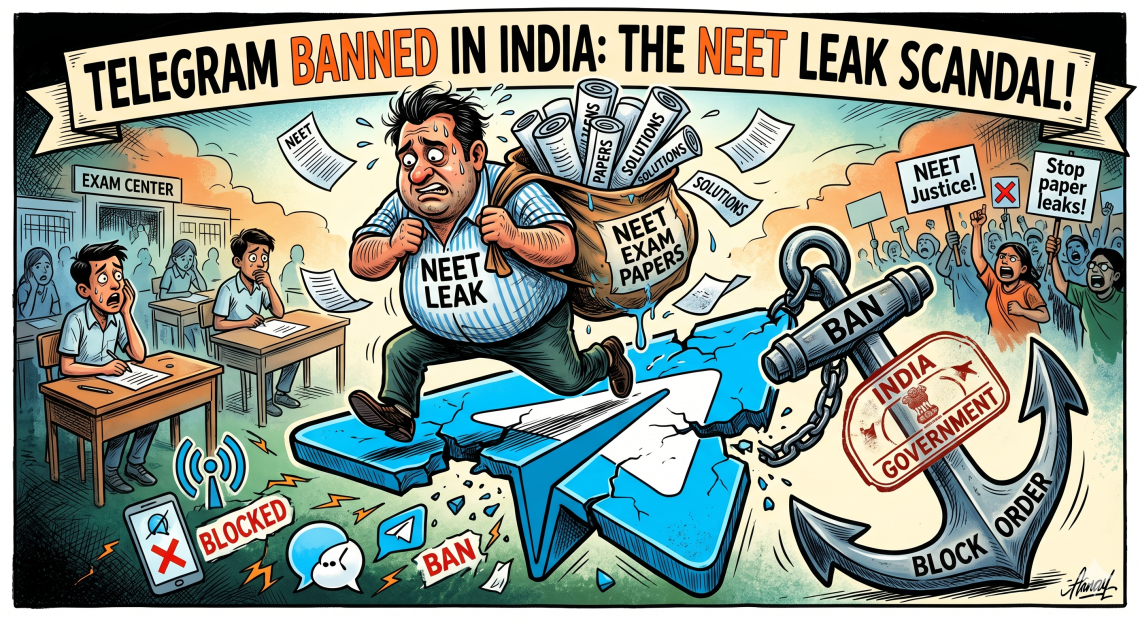
Durov’s remarks came after the Central government imposed a temporary restriction on Telegram across India until June 22 following recommendations from the National Testing Agency (NTA), ahead of the NEET (UG) 2026 re-examination scheduled for June 21.
According to the NTA, the Ministry of Electronics and Information Technology (MeitY) issued directions under Section 69A of the Information Technology Act, 2000, restricting access to the platform during a sensitive examination period to prevent examination-related fraud.
The agency said the measure was introduced to counter organised cheating syndicates that allegedly used Telegram channels and groups to spread misinformation and offer fraudulent examination-related services.
As part of the restrictions, Telegram was also directed to disable its message-editing feature in India until June 30. The NTA alleged that the feature had previously been misused to fabricate evidence of examination paper leaks by editing old messages and replacing attached files while retaining original timestamps.
Defending the platform’s efforts, Durov said Telegram had already taken action against channels involved in examination-related scams.
“Over the past few weeks, we removed hundreds of channels sharing leaked exam materials and related scams in India,” he said.

He also announced additional measures aimed at preventing manipulation of messages on the platform.
“We’re also making the ‘edited’ label more visible to prevent backdating scams,” Durov stated.
The NTA has maintained that the restrictions were introduced only after other measures, including channel-specific takedowns and enforcement actions, were deemed insufficient to address the scale of the problem.
According to the agency, state police forces, the Indian Cyber Crime Coordination Centre (I4C) and other enforcement agencies had facilitated the removal of numerous Telegram channels, groups and automated bots allegedly involved in examination fraud.
The NTA also alleged that several Telegram channels operating under names such as “Paper Leaked NEET”, “Re-NEET 2026” and similar titles had sought payments ranging from a few thousand rupees to several lakh rupees in exchange for purported access to examination papers.
The agency reiterated that no examination paper had been leaked and described such claims as fraudulent.
While acknowledging the inconvenience caused to genuine users, the NTA said the temporary restriction was a calibrated measure intended to protect the integrity of one of India’s largest entrance examinations.
Durov, however, insisted that blocking the platform was the wrong approach.
“Telegram is a force for good. Banning it, even temporarily, is a mistake,” he said.
The temporary restriction is scheduled to remain in place until June 22, while the suspension of Telegram’s message-editing feature in India is set to continue until June 30.