They found that there was a sizable difference in ice cloud formation at the low- and mid-levels (6500-20,000 feet) between summertime and winter…reports Asian Lite News.
A study by Japanese scientists has explained how marine aerosols contribute to ice cloud formation over the Southern Ocean at comparatively high temperature conditions – a finding, which, in turn, will help improve the accuracy of climate models.
Aerosols, or tiny particles suspended in the air upon which water vapour condenses at high altitudes, are a crucial factor to cloud formation, and understanding the contributions would help improve the accuracy of climate models, or digital simulations of the Earth’s climate system, calculating the interactions of various drivers of climate, such as land, sea, atmosphere, and humidity among others and forecast the future climate of the world.
Yet, simulating clouds, a key factor of the Earth’s climate system, has always been challenging. Their complex behaviour often leads climate modellers to misestimate cloud cover.
However, the climate scientist duo from Japan – Assistant Professor Kazutoshi Sato from Kitami Institute of Technology and Associate Professor Jun Inoue from the National Institute of Polar Research – have answered a few critical questions on cloud formation over Antarctica and the Southern Ocean in their research published in the journal ‘Geophysical Research Letters’.
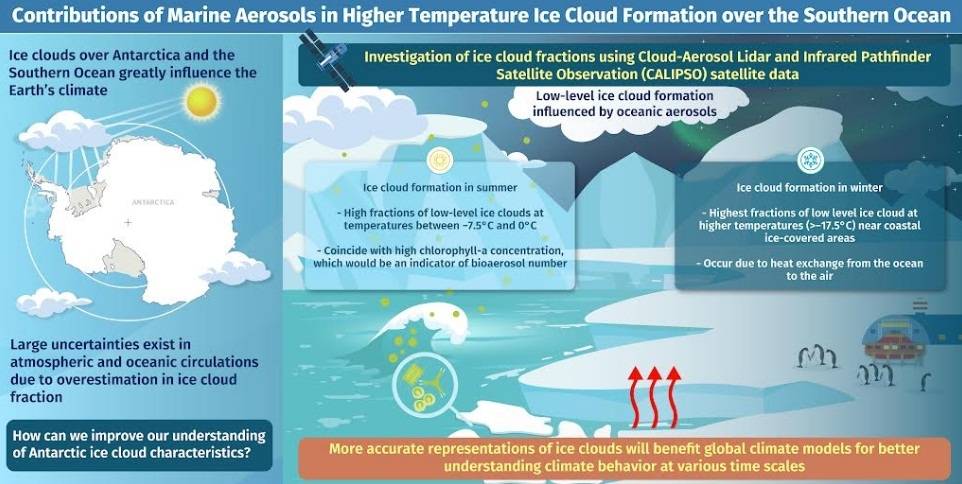
“Ice clouds are normally formed under very cold conditions (under minus 38 degrees C), but we observed the formation of low-level (under 6,500 feet) ice-clouds at significantly higher temperatures,” said Dr Sato.
Breaking waves and squally winds disperse aerosols from the sea into the atmosphere. These particles then become the starting particles for a type of cloud called “ice clouds” and are hence called “ice-nucleating particles”. As the ice cover on the polar sea surface changes with temperature, the concentration and activity of the particles changes too, thereby influencing cloud formation.
There are large uncertainties in current numerical climate models because of overestimation in ice-cloud fractions, especially in atmospheric and oceanic circulation. Understanding the sources of INPs will go a long way towards mitigating this issue, Dr Sato said.
The scientists used data captured by the Cloud-Aerosol Lidar and Infrared Pathfinder Satellite Observation (CALIPSO) satellite and estimated the seasonal variation in the ice cloud fraction over Antarctica and the Southern Ocean. They also investigated the relationship between low-level ice clouds and sea surface conditions in summer and winter.
As marine phytoplankton blooms are considered a source of bioaerosols, the scientists also used the satellite data to measure the concentration of chlorophyll on the sea surface to provide an indicator of phytoplankton abundance in the upper layers of the ocean. Finally, they re-analysed the existing data to understand precisely the extent of gas and particle exchange between the ocean and atmosphere, said a release from the Kitami Institute of Technology, Japan.
They found that there was a sizable difference in ice cloud formation at the low- and mid-levels (6500-20,000 feet) between summertime and winter. High fractions of low-level ice clouds were observed at comparatively high temperatures (above 7.5 degrees Celsius) over coastal Antarctic Sea ice areas in the summer. This increased ice cloud cover coincided with the highest estimated populations of phytoplankton. In winter, low-level ice clouds were observed at temperatures above 17.5 degrees C, a time during which substantial heat exchange took place from the ocean to the air near coastal areas.
Sato said: “Our findings suggest that marine aerosols emitted from the ocean contribute to low-level ice-cloud formation over the Southern Ocean even under higher temperatures.”
As ongoing climate change is causing rapid environmental changes, which are being felt acutely in the polar regions, Dr Sato highlighted the importance of their findings,
“Developing reliable global climate models are essential to improving our understanding and predictions of climate behaviour. By clarifying the relationship between ice clouds and marine aerosols, our study will help reduce the errors associated with cloud biases in a numerical climate model.”
“Improving the accuracy of climate models is the defining challenge of our time, but with findings like this to help us on our way, we are sure to succeed,” he said.