August 27, 2023
5 mins read

BRICS strengthens position as global grouping

When selecting new members, the bloc may have taken into consideration the pricing of energy products, and how their countries can reduce their liability and vulnerability in terms of the cost of oil…reports Asian Lite News

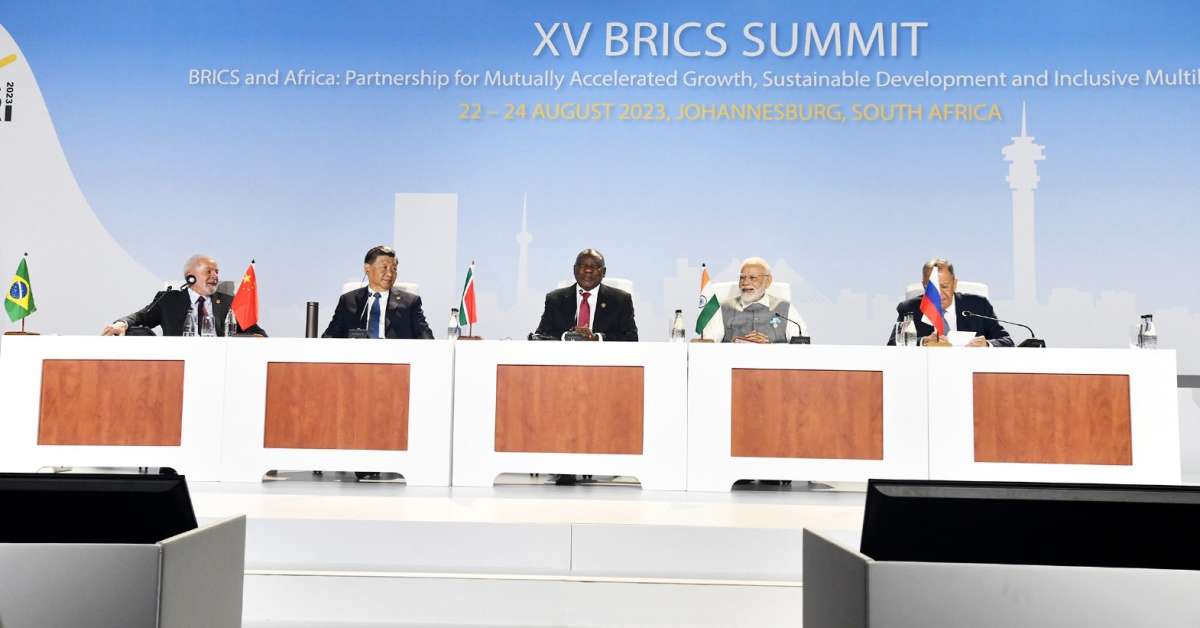
By doubling its number of members, from five to eleven in one quick sweep, the BRICS grouping has strengthened its position as a global grouping to be reckoned with. In addition, the choice of countries, bringing in four major players from the ‘Middle East region’: Egypt, Iran, Saudi Arabia and UAE, apart from Ethiopia and Argentina from Africa and South America, is significant, as it denotes a shift in the non-western economic grouping’s underpinnings, to make it a more politically relevant bloc.

Chief amongst the messages the BRICS has sent out is that despite misgivings and even mockery of the cohesion in the grouping in the west, it is an attractive club for members of the Global South. BRICS founders chose from 22 countries that formally applied for BRICS membership, and more than 40 in all that have evinced interest in the group. The message that the summit and the BRICS expansion took place despite the US and Europe’s moves to “isolate” Russia over its invasion of Ukraine, and to push for an ICC international warrant that prevented Russian President Vladimir Putin from travelling to Johannesburg would not be lost on the Western bloc either.

While India may not have been in favour of such a rapid expansion, officials have said it took the lead in drafting the criteria for membership, and the fact that most of the new members are strategic partners of India is the result of India’s efforts. The induction of Iran in BRICS sends a further message against US sanctions, just as Iran’s induction in the SCO this year did, and it is significant that Prime Minister Narendra Modi spoke to Iranian President Ebrahim Raisi before the summit and met him on the sidelines of the summit.

However, many international observers have pointed out that all the new members have very close economic ties to China, and the acceptance of Iran and Saudi-UAE to the same grouping has only been made possible by the peace deal brokered by Beijing earlier this year. This factor means that in the future, India may have to lobby harder to make its vote in the BRICS grouping count.

Briefing the media, Foreign Secretary Vinay Kwatra said the BRICS expansion would also bolster India’s push for UN reform, more representation of the global south and the expansion of the UN Security Council.

Another significant message is the induction of major energy players to the grouping, that is working on a plan for the use of national currencies for, six of the world’s top 10 oil producers will now be members of the BRICS, including Saudi Arabia, Russia, China, UAE, Brazil and Iran.

“Now that we are joined by such major players in the energy market as Saudi Arabia, Iran, the United Arab Emirates, of course, the topic of energy will shine in a new light and will be in great demand,” Russian Foreign Minister Sergey Lavrov said in a press conference after the summit ended, where he also clarified that the name of “BRICS” will not be changed as it now represents a recognised global “brand”.

Calling the induction of the UAE to BRICS as an “important milestone”, UAE’s Ambassador to India Abdulnasser Alshaali said, “For UAE-India relations, this is an opportunity to continue broadening and deepening our strategic cooperation and economic partnership.”

“It is hard to find commonalities among the six countries invited to join BRICS other than that they are each significant states in their region,” Danny Bradlow, a professor with the Centre for the Advancement of Scholarship at the University of Pretoria, told Al Jazeera.

With the inclusion of Saudi Arabia, Iran, UAE and Egypt, “you could argue it’s very Middle East centric”, according to Sanusha Naidu, a senior research fellow at the Institute for Global Dialogue, a South African think tank focusing on China and Africa.

“This has geo-economic, geostrategic and geopolitical implications,” Naidu argued, saying the latest additions will push some BRICS nations to think more about their Middle East policies, and for China and India to beef the existing policies.

China recently brokered the re-establishment of ties between Saudi Arabia and Iran, a role that would traditionally have been filled by a country like the United States. India’s recently signed an agreement with the UAE to trade in Indian rupees and Emirati dirhams instead of in the US dollar.

When selecting new members, the bloc may have taken into consideration the pricing of energy products, and how their countries can reduce their liability and vulnerability in terms of the cost of oil, she said.

“Besides Russia, all of [the core BRICS countries] are non-energy producing countries. They need to be able to make their economies function, but they don’t want to get caught in the secondary collateral damage of sanctions,” she explained.

The use of “unilateral sanctions” against countries and the continued dominance of the US dollar in global trade is something BRICS has vocally challenged.

The expansion “opens up new avenues for trade”, said Karin Costa Vasquez, a non-resident senior fellow at the Center for China and Globalization in Beijing.

ALSO READ-BRICS Summit Success Celebrated by South African Parliament
Previous Story

Michigan Hit by Series of Deadly Tornadoes, 5 Fatalities Reported

Next Story

India Club – a slice of history in heart of London closing down

Previous Story

Michigan Hit by Series of Deadly Tornadoes, 5 Fatalities Reported

Next Story

India Club – a slice of history in heart of London closing down

Latest from -Top News

Pakistan Risks Overstretching Itself in Yemen War

Pakistan’s expanding military role in Saudi Arabia amid the Yemen conflict could strain its defence resources and fragile finances…reports Asian Lite News Desk Pakistan’s military involvement in the war in Yemen may prove unsustainable because of mounting financial pressures and competing security demands, according to a new report. Islamabad’s growing military presence in Saudi Arabia risks stretching its defence resources while exposing the country to greater strategic and economic challenges. An article by Andrew Wilson in One World Outlook describes Pakistan’s involvement as a case of “fiscal and strategic overreach”, arguing that the country lacks the financial flexibility to sustain an expanded military commitment. Pakistan’s external finances depend heavily on an International Monetary Fund (IMF) programme, financial support from Gulf countries and remittances from Pakistani workers in the region. The report argues that deeper military involvement in the conflict could place additional pressure on these sources of financial stability. It also warns that deploying troops and military equipment abroad could weaken Pakistan’s capacity to address security challenges along its eastern border and deal with two domestic insurgencies. The move could also draw Islamabad into a conflict it has sought to approach cautiously. A Reuters report in May, citing Pakistani security and government sources, said Islamabad had deployed around 8,000 troops, a squadron of approximately 16 aircraft, mostly JF-17 fighter jets, two drone squadrons and a Chinese HQ-9 air-defence battery to Saudi Arabia. According to those sources, Riyadh was financing the deployment, with Pakistani personnel operating the equipment. The sources also said a confidential agreement contemplated the possibility of deploying up to 80,000 troops. Islamabad has not confirmed those figures, although it has acknowledged its military presence in Saudi Arabia, including the deployment of fighter jets at King Abdulaziz Air Base from April. The One World Outlook article argues that Saudi financial support can cover allowances and operating expenses but cannot easily replace military equipment needed elsewhere or resolve the political and strategic challenges of participating in the Yemen conflict. Pakistan’s defence budget is another concern. For the 2026-27 financial year, the federal government allocated PKR 3 trillion, or approximately $10.8 billion, to defence services. The allocation represents an 18 per cent increase from the original PKR 2.55 trillion provision and amounts to around 2.1 per cent of projected gross domestic product (GDP). Defence spending accounts for approximately 16 per cent of the federal government’s PKR 18.8 trillion expenditure. Military pensions are budgeted separately at PKR 822 billion, while debt servicing costs stand at approximately PKR 8 trillion, more than two-and-a-half times the defence allocation. The report argues that these competing financial obligations leave little room for additional military expenditure without placing further pressure on public finances. Pakistan’s reliance on IMF assistance also limits its fiscal flexibility. The country must meet the conditions attached to the programme, including a primary budget surplus target of 2 per cent of GDP and continued restraint on development spending. According to the article, these requirements make it difficult for Islamabad to finance an additional military commitment without compromising other budgetary priorities. Pakistan’s economic indicators offer limited reassurance. Economic growth for the 2025-26 financial year is estimated at between 3.6 and 3.7 per cent, while inflation reached approximately 10.3 per cent in September following an energy price shock. Foreign exchange reserves stood at around $21.5 billion at the end of September. Although this marks an improvement from the low levels recorded in 2023, the report notes that the reserves cover only a few months of imports. Financial assistance from Gulf partners remains central to Pakistan’s external stability. The article says Islamabad holds approximately $8 billion in Saudi deposits at its central bank. In July, the State Bank of Pakistan said Riyadh had extended the maturity of $5 billion in deposits to December 2028, easing the country’s immediate external financing requirements. A further $3 billion deposit was also extended in the spring. However, the article argues that these arrangements provide temporary relief rather than long-term financial independence, particularly as regional conflict threatens the stability of the Gulf economies on which Pakistan relies. The report concludes that Pakistan faces a difficult balance between supporting Saudi Arabia militarily and preserving the financial and military resources needed to address its domestic and regional challenges.

UK and Germany Ratify Kensington Treaty

Britain and Germany ratify the Kensington Treaty, agreeing new cooperation on AI, quantum research, defence and security while targeting investment, jobs and Russian hybrid threats…reports Asian Lite News Desk Britain and Germany

Economic tide is turning in Bangladesh

If there is one thing that can bring some comfort to the struggling Bangladeshi economy, it is good relations with India. Bangladesh should remember that Delhi’s backing, through easy supplies of essentials

DP World Lands 15-Year Bangladesh Port Deal

The agreement between the Chittagong Port Authority (CPA) and DP World covers the New Mooring Container Terminal…reports Asian Lite News Desk Bangladesh has signed a 15-year concession agreement with global ports operator
Go toTop

Don't Miss

PM Modi Welcomes BRICS Expansion

Modi said that these nations will give new energy and

BRICS: Jaishankar Flags Trade Barriers

Jaishankar called trade patterns and market access key global issues,