March 1, 2024
2 mins read

Yoon Stresses Partnership with Japan for Global Peace

Yoon Suk Yeol cited efforts under his administration to strengthen bilateral cooperation against North Korea’s nuclear and missile threats and build partnerships across industries…reports Asian Lite News

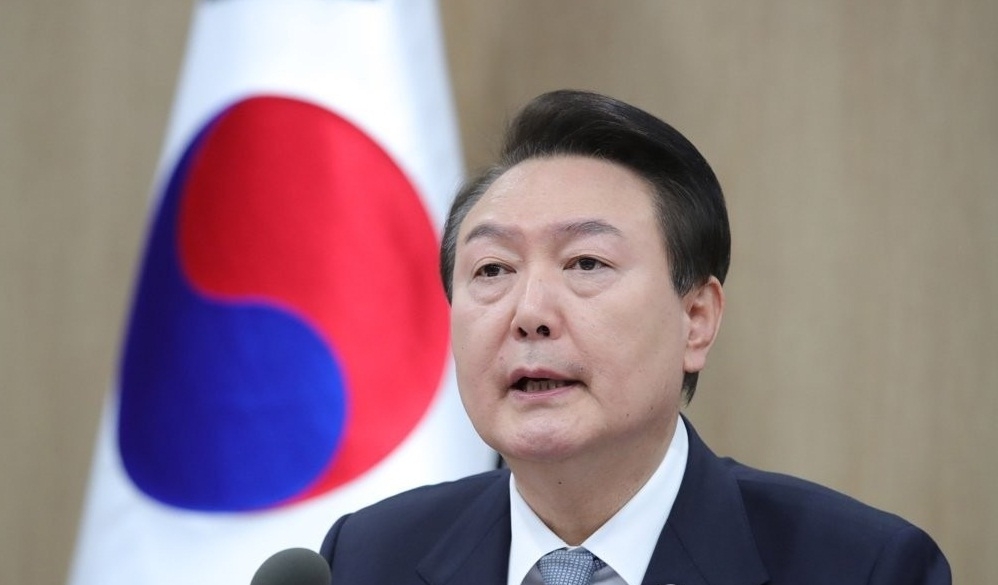
South Korean President Yoon Suk Yeol on Friday said that Seoul and Japan are partners in the pursuit of global peace and prosperity as they work to overcome their “painful past” and move toward a new future.

Yoon Suk Yeol made the remark as he marked the 105th anniversary of the March 1 Independence Movement against Japanese colonial rule, a watershed event during Japan’s 1910-45 brutal occupation of the Korean Peninsula, Yonhap news agency reported.

“Now, Korea and Japan are working together to overcome the painful past,” he said during a commemoration ceremony at the Memorial Hall of Yu Gwan-sun in Seoul. “Sharing the values of freedom, human rights and the rule of law, our two countries have become partners in the pursuit of common interests for global peace and prosperity.”

Yoon Suk Yeol cited efforts under his administration to strengthen bilateral cooperation against North Korea’s nuclear and missile threats and build partnerships across industries.

“If Korea and Japan build trust through mutual exchanges and cooperation and work together to resolve difficult challenges that history has left us, we will be able to usher in a new and brighter future for our bilateral relations,” he said. “I hope that the 60th anniversary of Korea and Japan normalising diplomatic relations next year will serve as an opportunity to take our bilateral relationship to a higher level, one that is more productive and constructive.”

He also said the independence movement will be made complete only when the Korean Peninsula achieves a unification that brings freedom and abundance to everyone, noting the repressive rule of the North Korean regime.

“Now, we must move toward a free, unified Korean Peninsula where the people are its rightful owners,” he said, noting the need to draw on the help of the international community.

“The tyranny and human rights abuses of the North Korean regime deny the universal values of humanity. Unification is precisely what is needed to expand the universal values of freedom and human rights,” he said.

President Yoon reiterated his commitment to helping the North Korean people, including defectors to the South, citing the government’s designation of July 14 as North Korean Defectors’ Day.

He also recalled that North Korea recently labeled the South its “primary foe” and “invariable principal enemy,” saying, “This is truly deplorable.”

Meanwhile, President Yoon called attention to the various types of independence movements that were carried out under colonial rule, including those who engaged in armed struggle and others who pursued diplomacy around the world or initiated educational and cultural movements to empower Koreans with necessary skills

“The blood and sweat of these independence activists enabled our country’s independence and became the foundation of the Republic of Korea,” he said, referring to South Korea by its formal name. “I believe that the significance of all of these independence movements must be duly recognised and their history should be passed down correctly generation after generation.”
ALSO READ-European Union, Japan plan security accord

Previous Story

Bill Gates Pins Hopes on Indian Innovators

Next Story

White House highlights achievements by Quad

Previous Story

Bill Gates Pins Hopes on Indian Innovators

Next Story

White House highlights achievements by Quad

Latest from -Top News

Pakistan Risks Overstretching Itself in Yemen War

Pakistan’s expanding military role in Saudi Arabia amid the Yemen conflict could strain its defence resources and fragile finances…reports Asian Lite News Desk Pakistan’s military involvement in the war in Yemen may prove unsustainable because of mounting financial pressures and competing security demands, according to a new report. Islamabad’s growing military presence in Saudi Arabia risks stretching its defence resources while exposing the country to greater strategic and economic challenges. An article by Andrew Wilson in One World Outlook describes Pakistan’s involvement as a case of “fiscal and strategic overreach”, arguing that the country lacks the financial flexibility to sustain an expanded military commitment. Pakistan’s external finances depend heavily on an International Monetary Fund (IMF) programme, financial support from Gulf countries and remittances from Pakistani workers in the region. The report argues that deeper military involvement in the conflict could place additional pressure on these sources of financial stability. It also warns that deploying troops and military equipment abroad could weaken Pakistan’s capacity to address security challenges along its eastern border and deal with two domestic insurgencies. The move could also draw Islamabad into a conflict it has sought to approach cautiously. A Reuters report in May, citing Pakistani security and government sources, said Islamabad had deployed around 8,000 troops, a squadron of approximately 16 aircraft, mostly JF-17 fighter jets, two drone squadrons and a Chinese HQ-9 air-defence battery to Saudi Arabia. According to those sources, Riyadh was financing the deployment, with Pakistani personnel operating the equipment. The sources also said a confidential agreement contemplated the possibility of deploying up to 80,000 troops. Islamabad has not confirmed those figures, although it has acknowledged its military presence in Saudi Arabia, including the deployment of fighter jets at King Abdulaziz Air Base from April. The One World Outlook article argues that Saudi financial support can cover allowances and operating expenses but cannot easily replace military equipment needed elsewhere or resolve the political and strategic challenges of participating in the Yemen conflict. Pakistan’s defence budget is another concern. For the 2026-27 financial year, the federal government allocated PKR 3 trillion, or approximately $10.8 billion, to defence services. The allocation represents an 18 per cent increase from the original PKR 2.55 trillion provision and amounts to around 2.1 per cent of projected gross domestic product (GDP). Defence spending accounts for approximately 16 per cent of the federal government’s PKR 18.8 trillion expenditure. Military pensions are budgeted separately at PKR 822 billion, while debt servicing costs stand at approximately PKR 8 trillion, more than two-and-a-half times the defence allocation. The report argues that these competing financial obligations leave little room for additional military expenditure without placing further pressure on public finances. Pakistan’s reliance on IMF assistance also limits its fiscal flexibility. The country must meet the conditions attached to the programme, including a primary budget surplus target of 2 per cent of GDP and continued restraint on development spending. According to the article, these requirements make it difficult for Islamabad to finance an additional military commitment without compromising other budgetary priorities. Pakistan’s economic indicators offer limited reassurance. Economic growth for the 2025-26 financial year is estimated at between 3.6 and 3.7 per cent, while inflation reached approximately 10.3 per cent in September following an energy price shock. Foreign exchange reserves stood at around $21.5 billion at the end of September. Although this marks an improvement from the low levels recorded in 2023, the report notes that the reserves cover only a few months of imports. Financial assistance from Gulf partners remains central to Pakistan’s external stability. The article says Islamabad holds approximately $8 billion in Saudi deposits at its central bank. In July, the State Bank of Pakistan said Riyadh had extended the maturity of $5 billion in deposits to December 2028, easing the country’s immediate external financing requirements. A further $3 billion deposit was also extended in the spring. However, the article argues that these arrangements provide temporary relief rather than long-term financial independence, particularly as regional conflict threatens the stability of the Gulf economies on which Pakistan relies. The report concludes that Pakistan faces a difficult balance between supporting Saudi Arabia militarily and preserving the financial and military resources needed to address its domestic and regional challenges.

UK and Germany Ratify Kensington Treaty

Britain and Germany ratify the Kensington Treaty, agreeing new cooperation on AI, quantum research, defence and security while targeting investment, jobs and Russian hybrid threats…reports Asian Lite News Desk Britain and Germany

Economic tide is turning in Bangladesh

If there is one thing that can bring some comfort to the struggling Bangladeshi economy, it is good relations with India. Bangladesh should remember that Delhi’s backing, through easy supplies of essentials

DP World Lands 15-Year Bangladesh Port Deal

The agreement between the Chittagong Port Authority (CPA) and DP World covers the New Mooring Container Terminal…reports Asian Lite News Desk Bangladesh has signed a 15-year concession agreement with global ports operator
Go toTop

Don't Miss

India, Japan Chart New Paths

India’s Ambassador-designate, Nagma Mohamad Mallick, met Special Advisor to the

Kenya, Japan Strengthen Ties During Princess Takamado Visit

Kenya and Japan have reaffirmed their longstanding partnership, with leaders