February 28, 2025
4 mins read

e& Sees Record Growth, Strengthens Global Footprint 

e& delivers record revenue and net profit in FY 2024 growing consolidated revenue 10.1% to AED 59.2 billion…reports Asian Lite News

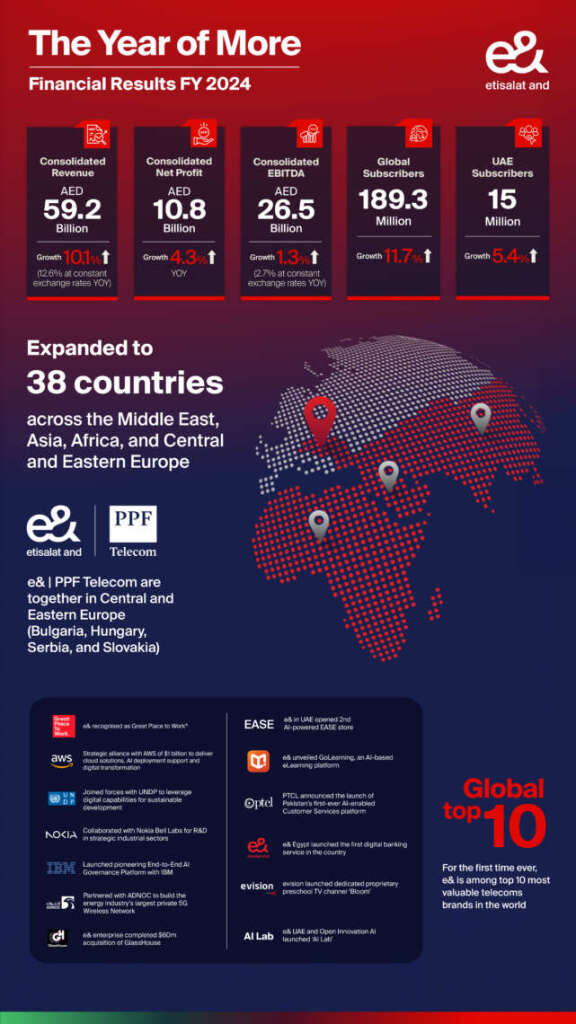
e& has delivered a record-breaking financial performance for the fiscal year 2024, reinforcing its position as a global technology leader. The Group reported a net profit of AED 10.8 billion, marking a 4.3% year-over-year (YoY) growth, while consolidated revenue surged by 10.1% to AED 59.2 billion. This outstanding performance reflects the Group’s ongoing transformation and expansion strategy across multiple markets and technology verticals. 

Sustained Growth and Strategic Expansion 

e& continued its upward trajectory across all business segments, driving revenue growth and digital innovation. The company’s EBITDA grew to AED 26.5 billion, up 2.7% YoY at constant exchange rates, further strengthening its financial position. 

The Group’s total subscriber base expanded to 189.3 million, an 11.7% increase from 2023, with e& UAE’s subscriber count surpassing 15 million, reflecting a 5.4% growth. 

Hatem Dowidar, Group CEO

Demonstrating its commitment to delivering long-term value, e& successfully implemented the first year of its three-year progressive dividend policy, which will see an incremental increase of 3 fils per year through FY 2026. For FY 2024, the Board has proposed a cash dividend of 41.5 fils per share for H2 2024, bringing the total annual dividend to 83 fils per share. 

Vision for Growth and Innovation 

H.E. Jassem Mohamed Bu Ataba Alzaabi, Chairman of e&, highlighted the company’s transformative growth: 

“2024 was a landmark year for e&, driven by bold strategic decisions, AI-powered innovations, and a commitment to digital transformation. Our net profit of AED 10.8 billion and subscriber base expansion to 189.3 million reinforce our leadership in the global telecom and technology ecosystem. 

Beyond financial success, real growth is measured by impact. Guided by the UAE’s visionary leadership, we continue to drive economic progress, empower businesses, and enhance digital connectivity across three continents. Our investments in AI, intelligent platforms, and industry-defining solutions solidify our role as a catalyst for change.” 

Alzaabi also emphasised e&’s dedication to talent development: “Our Emiratisation efforts and focus on upskilling the workforce provide us with a strategic advantage. By equipping the next generation with AI and digital expertise, we are building a future-ready workforce that will shape the UAE’s digital transformation.” 
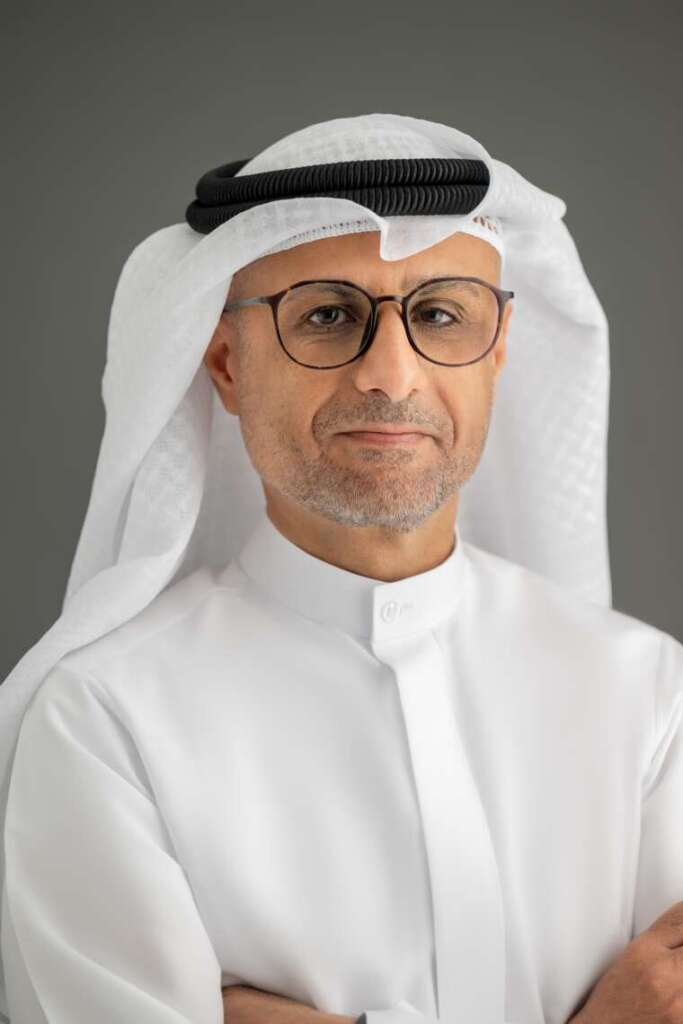
Jassem Mohamed Bu Ataba Alzaabi, Chairman

e&’s Global Expansion 

Hatem Dowidar, Group CEO of e&, echoed these sentiments, stating: 

“In 2024, e& accelerated its transformation into a global technology powerhouse. Our revenue exceeded AED 59.2 billion, growing 10.1% YoY, while EBITDA reached AED 26.5 billion. These figures reflect our commitment to investing in innovation, expanding our digital footprint, and delivering impactful solutions worldwide.” 

A key highlight of e&’s expansion strategy was the majority acquisition of PPF Telecom’s assets, marking its entry into Central and Eastern Europe. This move added over 10 million new subscribers across Bulgaria, Hungary, Serbia, and Slovakia, reinforcing the Group’s global presence and unlocking new digital growth opportunities. 

Additionally, e&’s acquisition of GlassHouse expanded its cloud, data, and SAP capabilities across Türkiye, South Africa, and Qatar, strengthening its leadership in enterprise digital transformation. These strategic investments underpin e&’s long-term goal of developing a robust, scalable digital ecosystem that supports businesses, governments, and communities worldwide. 

“As we closed 2024, we set out to ‘Go for More’—expanding our reach, pioneering AI-driven solutions, and delivering tangible value to our customers and stakeholders,” Dowidar added. “With a brand portfolio and investments exceeding USD 20 billion, e& has earned the title of the World’s Fastest Growing Brand, a testament to our relentless pursuit of innovation and global leadership.” 
Key Milestones and Industry Recognition 

In 2024, e& achieved several strategic milestones that reinforced its standing as a leading global technology group: 

Expansion into 38 countries, solidifying its presence across the Middle East, Asia, Africa, and Central and Eastern Europe. 

Recognised as the ‘World’s Fastest Growing Brand’ in Brand Finance’s Global 500 Report, with a brand strength score of 84.6 and an all-time high standalone brand value of USD 15.3 billion. 

Secured a place among the Top 10 Most Valuable Telecom Brands globally. 

Launched its new brand positioning, ‘Go for More’, reflecting its ambition to lead the future of digital connectivity and AI-driven transformation. 

Looking Ahead: AI and Digital Transformation 

With AI at the core of its strategic roadmap, e& is poised for greater growth in 2025 and beyond. The Group is committed to scaling AI-driven platforms, expanding its telecom and digital service offerings, and ensuring technology serves as a force for economic progress and social good. 

As it continues to push boundaries, e& remains dedicated to fostering collaboration, unlocking new digital frontiers, and shaping the future of global connectivity and digital services. 
Previous Story

UAE Floating Hospital treats thousands of Palestinians 

Next Story

MISSION ACCOMPLISHED? 

Previous Story

UAE Floating Hospital treats thousands of Palestinians 

Next Story

MISSION ACCOMPLISHED? 

Latest from Arab News

Riyadh airport attack: Bangladesh condemns Houthi strike

Bangladesh has condemned the 10 October attack on Riyadh’s King Khalid International Airport, which reportedly killed two Bangladeshi nationals and injured several others…reports Asian Lite News Desk Bangladesh has condemned a Houthi attack on King Khalid International Airport in Riyadh, Saudi Arabia, on 10 October 2026, which reportedly killed two Bangladeshi nationals and left

Pakistan Risks Overstretching Itself in Yemen War

Pakistan’s expanding military role in Saudi Arabia amid the Yemen conflict could strain its defence resources and fragile finances…reports Asian Lite News Desk Pakistan’s military involvement in the war in Yemen may prove unsustainable because of mounting financial pressures and competing security demands, according to a new report. Islamabad’s growing military presence in Saudi Arabia risks stretching its defence resources while exposing the country to greater strategic and economic challenges. An article by Andrew Wilson in One World Outlook describes Pakistan’s involvement as a case of “fiscal and strategic overreach”, arguing that the country lacks the financial flexibility to sustain an expanded military commitment. Pakistan’s external finances depend heavily on an International Monetary Fund (IMF) programme, financial support from Gulf countries and remittances from Pakistani workers in the region. The report argues that deeper military involvement in the conflict could place additional pressure on these sources of financial stability. It also warns that deploying troops and military equipment abroad could weaken Pakistan’s capacity to address security challenges along its eastern border and deal with two domestic insurgencies. The move could also draw Islamabad into a conflict it has sought to approach cautiously. A Reuters report in May, citing Pakistani security and government sources, said Islamabad had deployed around 8,000 troops, a squadron of approximately 16 aircraft, mostly JF-17 fighter jets, two drone squadrons and a Chinese HQ-9 air-defence battery to Saudi Arabia. According to those sources, Riyadh was financing the deployment, with Pakistani personnel operating the equipment. The sources also said a confidential agreement contemplated the possibility of deploying up to 80,000 troops. Islamabad has not confirmed those figures, although it has acknowledged its military presence in Saudi Arabia, including the deployment of fighter jets at King Abdulaziz Air Base from April. The One World Outlook article argues that Saudi financial support can cover allowances and operating expenses but cannot easily replace military equipment needed elsewhere or resolve the political and strategic challenges of participating in the Yemen conflict. Pakistan’s defence budget is another concern. For the 2026-27 financial year, the federal government allocated PKR 3 trillion, or approximately $10.8 billion, to defence services. The allocation represents an 18 per cent increase from the original PKR 2.55 trillion provision and amounts to around 2.1 per cent of projected gross domestic product (GDP). Defence spending accounts for approximately 16 per cent of the federal government’s PKR 18.8 trillion expenditure. Military pensions are budgeted separately at PKR 822 billion, while debt servicing costs stand at approximately PKR 8 trillion, more than two-and-a-half times the defence allocation. The report argues that these competing financial obligations leave little room for additional military expenditure without placing further pressure on public finances. Pakistan’s reliance on IMF assistance also limits its fiscal flexibility. The country must meet the conditions attached to the programme, including a primary budget surplus target of 2 per cent of GDP and continued restraint on development spending. According to the article, these requirements make it difficult for Islamabad to finance an additional military commitment without compromising other budgetary priorities. Pakistan’s economic indicators offer limited reassurance. Economic growth for the 2025-26 financial year is estimated at between 3.6 and 3.7 per cent, while inflation reached approximately 10.3 per cent in September following an energy price shock. Foreign exchange reserves stood at around $21.5 billion at the end of September. Although this marks an improvement from the low levels recorded in 2023, the report notes that the reserves cover only a few months of imports. Financial assistance from Gulf partners remains central to Pakistan’s external stability. The article says Islamabad holds approximately $8 billion in Saudi deposits at its central bank. In July, the State Bank of Pakistan said Riyadh had extended the maturity of $5 billion in deposits to December 2028, easing the country’s immediate external financing requirements. A further $3 billion deposit was also extended in the spring. However, the article argues that these arrangements provide temporary relief rather than long-term financial independence, particularly as regional conflict threatens the stability of the Gulf economies on which Pakistan relies. The report concludes that Pakistan faces a difficult balance between supporting Saudi Arabia militarily and preserving the financial and military resources needed to address its domestic and regional challenges.

Houthis Claim Missile Strike on Riyadh Airport

Yemen’s Houthi group claims a ballistic missile struck Riyadh’s King Khalid International Airport, with Saudi authorities yet to confirm the latest attack…reports Asian Lite News Desk Yemen’s Houthi group has claimed responsibility

Saudi Arabia to receive forces under Mecca Defence Alliance

Saudi Arabia, Pakistan and Turkiye have activated collective-defence commitments, agreeing to deploy military capabilities as regional tensions and threats against the Kingdom persist…reports Asian Lite News Desk Saudi Arabia, Pakistan and Turkiye
Go toTop

Don't Miss

‘Human capital – our true wealth’

The essential factor in the UAE’s growth is its experience

Sri Lanka getting soaked in red?

In light of the growing leverage due to high financial