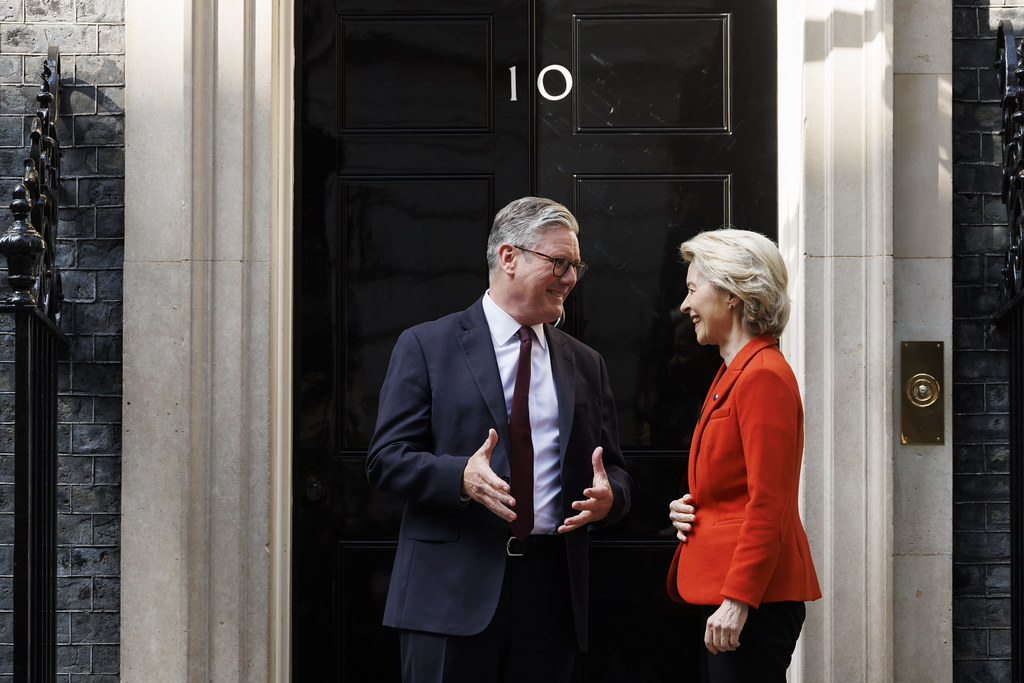
UK in advanced talks to join €150bn EU defence programme before November deadline…reports Asian Lite News
A deal allowing the United Kingdom to participate in the European Union’s €150 billion defence rearmament programme, known as SAFE, could be reached by mid-November, according to officials on both sides of the negotiations. If finalised ahead of the end-of-month deadline, it would enable EU member states to adjust their national procurement plans to include British-made weapons and components, marking a significant step in post-Brexit defence cooperation.
As a non-EU country, the UK is currently unable to fully engage with SAFE (Strategic Alliance for European Defence, or SAFE), which is designed to jointly procure European-made weapons and strengthen the bloc’s defence industry in response to growing security threats, including Russia’s war in Ukraine. However, both Brussels and London view the agreement as a mutually beneficial arrangement. The EU would secure access to British defence manufacturing capabilities, while the UK would gain a place in a major European defence scheme without drawing on EU loans.
Talks between the UK and the European Commission began in the summer and, according to officials, have accelerated in recent weeks. The European Commission confirmed on Friday that it expected negotiations to conclude within the next two weeks, leaving sufficient time for member states to adjust their national rearmament plans ahead of the 30 November deadline.
Thomas Regnier, a spokesperson for the European Commission, said: “Can we expect white smoke before 30 November? This is pretty much our hope. We’re engaged in deep and very efficient negotiations. We’re advancing at very quick speed.” He added: “And our objective is to find a solution and to have an agreement and to conclude the negotiations around mid-November.”
EU member states are required to submit their plans on how they intend to use their allocated portion of the €150 billion by the end of November. The Commission wants final decisions in place before the first disbursements to member states, which are expected by the end of the first quarter of next year at the latest.
Defence Commissioner Andrius Kubilius and the UK Defence Secretary, John Healey, were expected to discuss the status of the ongoing negotiations during a phone call on Friday, the Commission confirmed. The call comes as diplomatic efforts intensify to secure an agreement that would smooth cooperation between the UK and EU in procuring arms and equipment for European forces.
Under current rules, as a third-country participant, the UK’s involvement in the SAFE programme is limited to a maximum 35% contribution to joint procurement projects. Moreover, British companies cannot be guaranteed access to contracts unless certain conditions are met. SAFE contains a “European preference” stipulation, whereby at least two-thirds of any equipment purchased using the programme must be manufactured within the bloc.
Should a deal be struck, the UK would be treated in the same way as EU member states participating in the scheme, with no cap on its contribution. This aligns the UK’s status with that of other non-EU countries already granted exceptional access to the programme, including Norway, Ukraine and Iceland. However, the UK would remain ineligible for any of the EU-issued loans used to fund national rearmament plans, a condition Brussels insists protects the financial integrity of the programme.
With Europe seeking to rapidly expand its defence manufacturing base in response to Russia’s aggression, many EU member states are seen as broadly supportive of including the UK. Britain remains one of Europe’s largest defence exporters, with EU countries accounting for roughly one-third of its arms exports between 2019 and 2023. By involving British suppliers, member states could potentially access a wider range of equipment and technology while meeting joint procurement requirements.
One area of negotiation yet to be finalised is the scale of the UK’s financial contribution to SAFE. While London would not draw on EU loans, it is expected to pay into the scheme to gain access to joint procurement arrangements. Agreement on the financial structure is seen as crucial to ensuring the proposal is acceptable to all member states, some of whom remain cautious about granting the UK extensive privileges without equivalent responsibilities.
The timing of the agreement is critical. If concluded before the deadline, EU countries could revise their procurement plans to reflect the potential inclusion of British-made equipment. This is particularly significant, as SAFE requires at least three countries, including two EU member states, to participate in any joint order to qualify for funding.
The European Commission has said it aims to make the first tranche of reimbursement or support payments to member states by late March 2025. As the EU moves ahead with its ambitious plans to rearm and streamline defence procurement, interest from other close allies has grown. Australia and Canada have both expressed their desire to negotiate similar arrangements with Brussels to access the programme.
For the UK, agreement on SAFE participation would underline its continued role in European security architecture despite its departure from the bloc. While it would not restore full membership benefits, it offers a practical pathway for defence cooperation at a time of rising global instability.
For Brussels, bringing the UK into SAFE represents a pragmatic step towards strengthening European defence capabilities while maintaining strategic ties with one of the continent’s leading military powers.