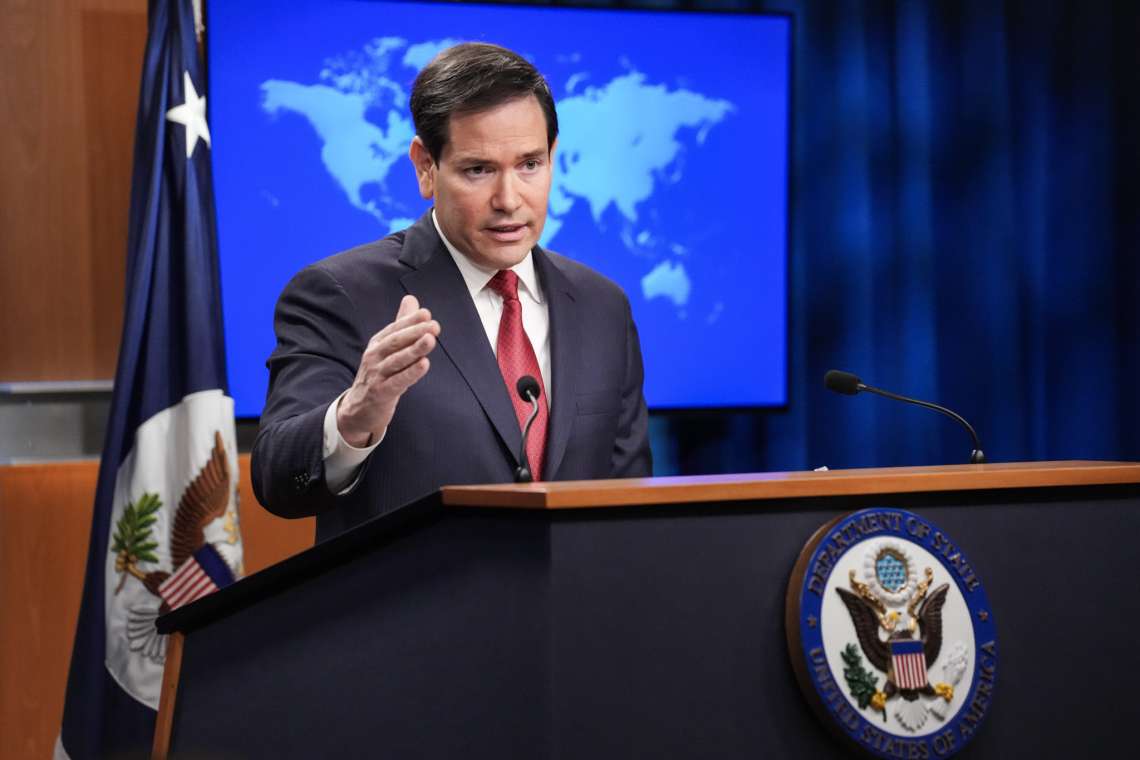
In a rare, unscripted year-ender, Secretary of State Marco Rubio outlined a disciplined US foreign policy built on priorities, realism and acceptance of limits.
A year-ending press conference by US Secretary of State Marco Rubio unfolded less like a choreographed Washington ritual and more like a deliberate exercise in reflection, signalling what he described as a necessary recalibration of American power in an increasingly crowded and contested world.
Rubio set the tone even before the substance began. Breaking with convention, he announced he would take questions from the back of the room first, working his way forward. Over more than two hours, he stuck to that promise, patiently fielding questions, allowing follow-ups and returning to voices he felt had been overlooked. The approach was emblematic of the message he sought to convey: diplomacy, he argued, is not about speed or spectacle, but about method, limits and priorities.
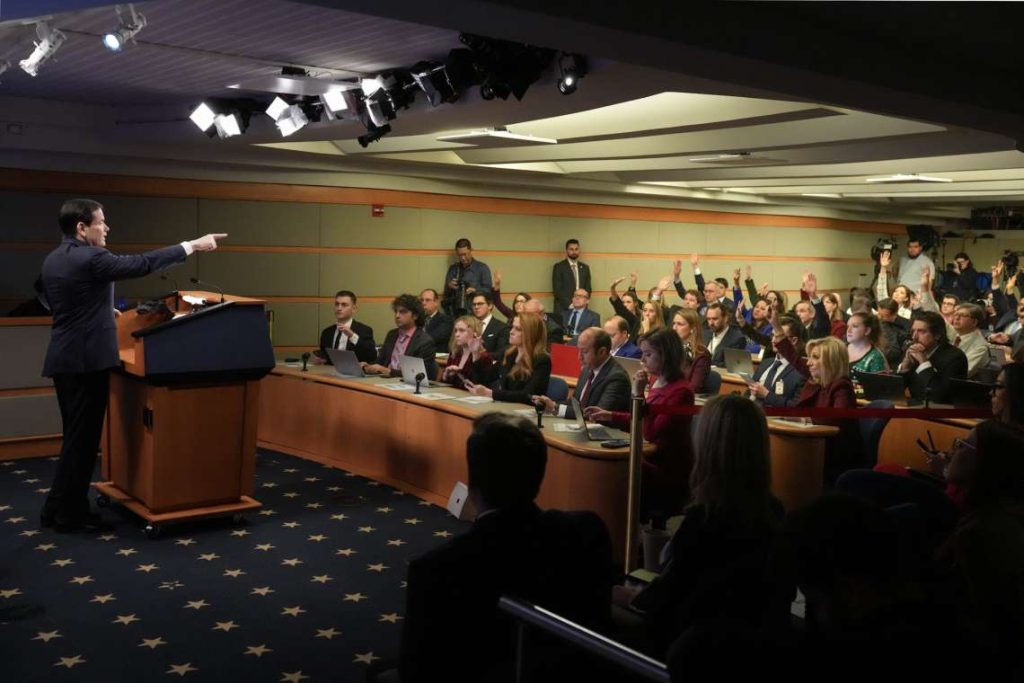
At the heart of Rubio’s remarks was a clear insistence that US foreign policy must be grounded in national interest and an honest assessment of capacity. The global system for which American institutions were designed, he said, no longer exists. Resources are finite, time is limited, and choices must be made accordingly. Recalibration, in his framing, was not retreat, but discipline — caring about global events while being realistic about what Washington can achieve.
That theme echoed across regions as Rubio moved seamlessly from topic to topic, often switching between English and Spanish. Nearly a quarter of the questions were taken in Spanish, underscoring the prominence he accorded to the Western Hemisphere. Latin America, he suggested, was not a peripheral concern but a core theatre of US foreign policy.
On Venezuela, Rubio struck a sharply critical note, accusing what he called the illegitimate regime in Caracas of cooperating with terrorists, criminal networks and drug trafficking organisations. Elsewhere in the region, however, he highlighted cooperation rather than confrontation, singling out Mexico and describing bilateral engagement as the strongest it has ever been.
The Middle East brought a more cautious and sequenced approach. On Gaza, Rubio acknowledged that while the war has not ended, its character has changed following a ceasefire. The next phase, he argued, should focus on governance rather than military presence, beginning with the establishment of a Palestinian technocratic body to manage daily affairs. Only after that, he said, could questions of stabilisation forces be addressed. In that context, he welcomed Pakistan’s expressed willingness to consider contributing, while noting that clarity on mandates and funding would be essential.
Rubio’s tone hardened into blunt realism when the discussion turned to Ukraine. He dismissed the prospect of a near-term surrender by either side and framed negotiations as unavoidable rather than optional. While asserting that the United States remains the only country capable of speaking credibly to both Kyiv and Moscow, he stressed that Washington would not impose a settlement. Any decision, he said, must ultimately rest with the two parties themselves.
Across the Indo-Pacific, Rubio rejected simplistic binaries in dealing with China. Acknowledging Beijing as a powerful and permanent factor in global politics, he argued that the task was not to eliminate tension but to manage it. Engagement, competition and deterrence, he suggested, must coexist. At the same time, he reaffirmed the importance of alliances with Japan and partnerships across the region, including with India.
In Sudan, Rubio dispensed with diplomatic euphemism, describing the situation as horrifying and driven by broken commitments and external interference. The US focus there, he said, was overwhelmingly humanitarian, with nearly all attention directed toward securing and sustaining a truce. On Lebanon and Israel, he avoided predictions, instead stressing that long-term stability depends on strong state institutions capable of asserting control and preventing militant threats.
As the press conference finally reached the front row, its cumulative effect was striking. There were no sweeping doctrines or rhetorical flourishes, but a consistent emphasis on limits, trade-offs and process. Rubio underscored that foreign aid is not charity but a responsibility to American taxpayers, and that power, however extensive, is never infinite.
In a world marked by overlapping wars, regional instability and strategic competition, Rubio’s extended exchange with the press offered not a grand vision but a governing philosophy. US foreign policy, he suggested, must be anchored in national interest, shaped by constraint and executed patiently — one question, and one choice, at a time.