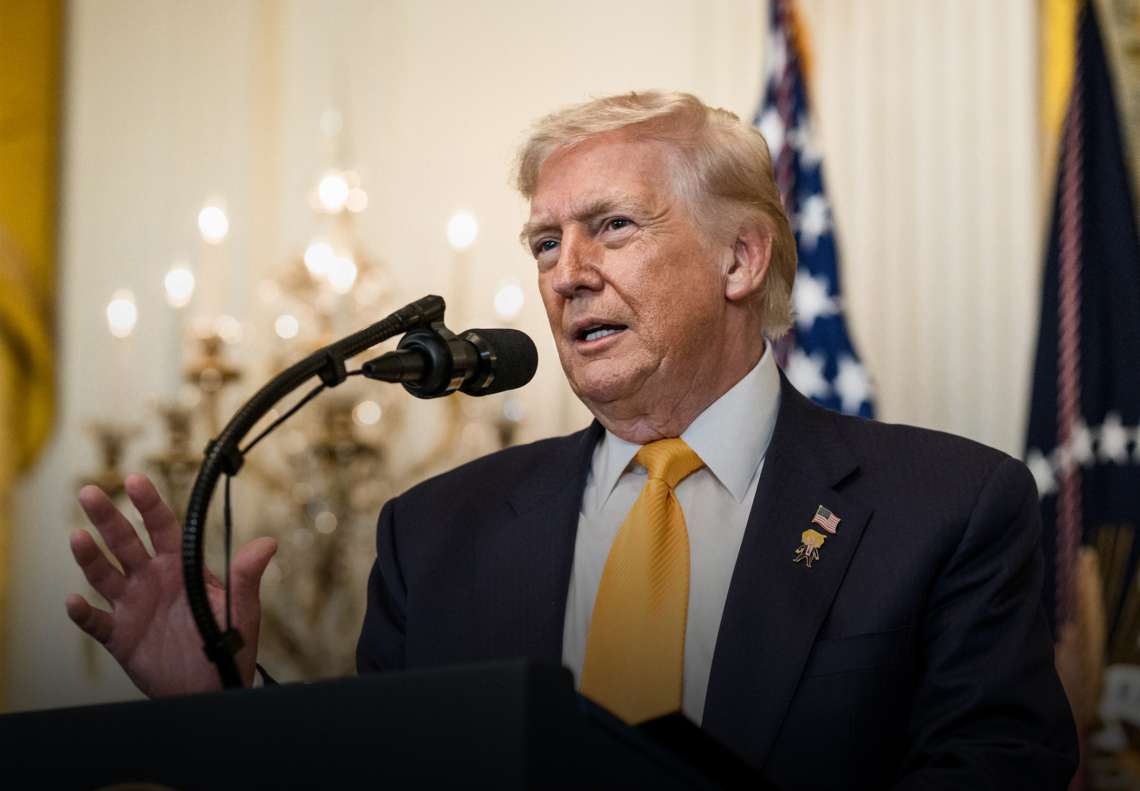
Trump invokes emergency trade powers to impose temporary 10 per cent global tariffs, citing balance-of-payments concerns after Supreme Court blocks earlier reciprocal duties.
US President Donald Trump has moved swiftly to reassert his trade agenda, unveiling a fresh round of global tariffs after the US Supreme Court struck down a previous set of reciprocal duties.
In a newly released White House Fact Sheet, President Donald Trump confirmed that he has invoked Section 122 of the Trade Act of 1974, a rarely used provision that allows the President to impose temporary import surcharges to address “fundamental international payment problems”.
Under the Proclamation, a 10 per cent ad valorem import duty will be imposed on articles imported into the United States for 150 days. The temporary tariff will take effect from February 24 at 12:01 a.m. eastern standard time.
The administration argues that the United States faces a “large and serious balance-of-payments deficit”, warning that declining domestic production has forced the country to import much of what it consumes, effectively sending dollars overseas and weakening the national economy. Officials say the temporary measure is designed to stem that outflow while policymakers explore longer-term structural solutions.
However, the new tariff regime will not apply uniformly. Certain goods deemed vital to the US economy have been exempted. These include critical minerals, specific metals used in currency and bullion, energy and energy products, natural resources and fertilisers, selected agricultural products, pharmaceuticals and pharmaceutical ingredients, certain electronics, and passenger vehicles.
The White House has also directed the Office of the United States Trade Representative to initiate investigations under Section 301 into what it describes as “unreasonable and discriminatory” foreign trade practices that burden US commerce. That move signals that further targeted trade actions could follow.
Unlike several other trade statutes, Section 122 does not require a formal investigation before tariffs are imposed, allowing the President to act rapidly. The provision also contains a built-in sunset clause: tariffs automatically expire after 150 days unless Congress votes to extend them.
Trade experts note that while the time limit appears clear, a President could potentially allow the duties to lapse and reintroduce similar measures by declaring a new balance-of-payments emergency. The Supreme Court’s ruling addressed a specific legal pathway rather than the broader authority to levy tariffs, leaving room for alternative mechanisms.