Rising energy costs and geopolitical tensions could slow expansion and drive inflation across developing Asia..reports Asian Lite News
The ongoing conflict in the Middle East is emerging as a major threat to economic stability in developing Asia, amplifying geopolitical risks and weakening growth prospects across the region, according to a new report by the Asian Development Bank.
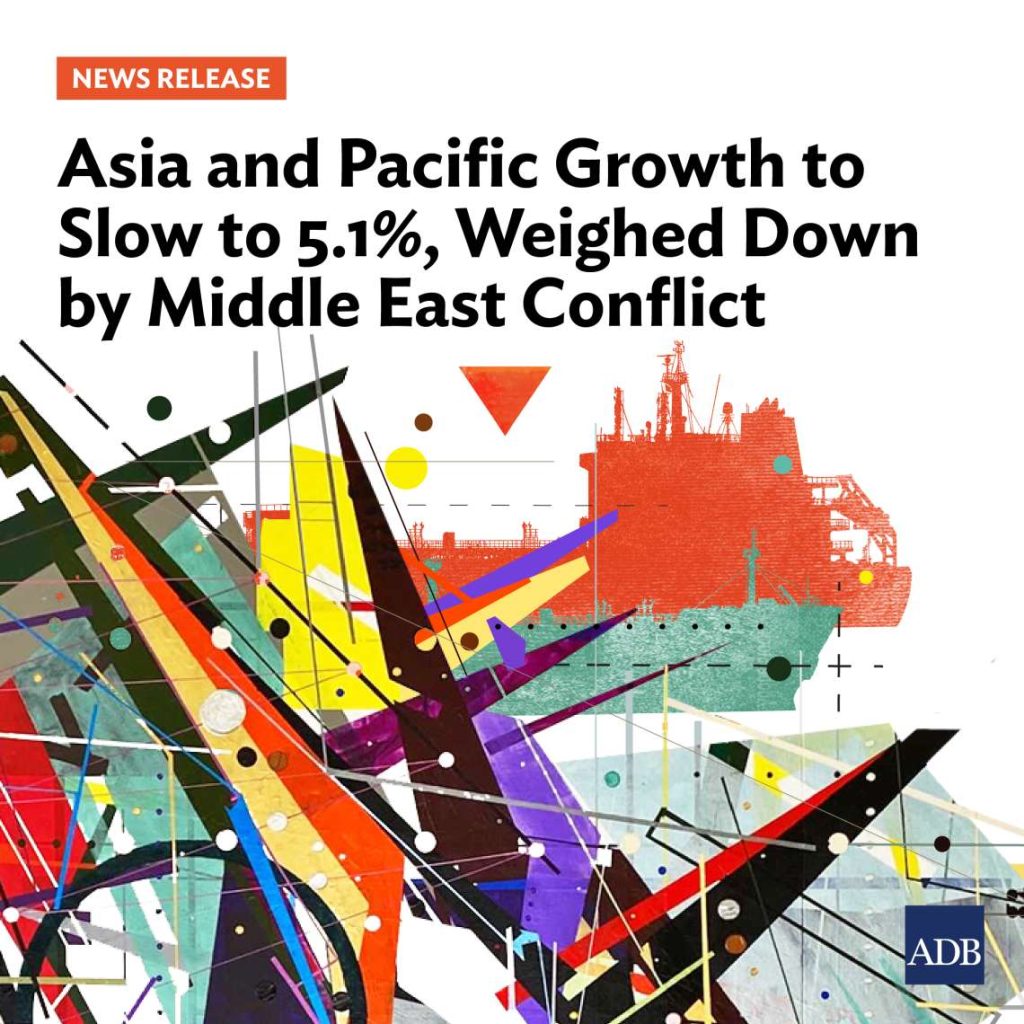
In its latest Asian Development Outlook (April 2026), the ADB said regional growth is expected to moderate in the coming years, even under relatively stable conditions. Growth across developing Asia and the Pacific is projected to ease to 5.1% in both 2026 and 2027, down from 5.4% in 2025.
However, the outlook becomes significantly more fragile if tensions in the Middle East persist. Under a scenario where disruptions extend through the third quarter of 2026, growth could slow further to 4.7% in 2026 and 4.8% in 2027.
According to Albert Park, the primary transmission channel of risk is through energy markets. Rising oil and gas prices are expected to increase production costs and push up consumer prices across the region.
He also noted that export growth is likely to soften following a surge in shipments last year, when businesses accelerated trade ahead of anticipated tariff increases by the United States.
“More persistent disruptions would intensify inflationary pressures and further weigh on growth,” Park warned, highlighting the compounding risks facing regional economies.
Inflation is already expected to trend upward. Under an early stabilization scenario, inflation in developing Asia is projected to reach 3.6% in 2026 and 3.4% in 2027, compared to 3% in 2025. However, prolonged instability in the Middle East could push inflation as high as 5.6% in 2026, significantly eroding purchasing power and increasing economic strain.
Despite limited direct trade exposure to Middle Eastern economies, the ADB emphasised that developing Asia remains highly vulnerable to indirect shocks. These include volatility in global energy markets, disruptions to trade and transport networks, and tightening financial conditions.
The report cautioned that sustained geopolitical instability could trigger broader economic consequences. Higher energy prices would not only drive inflation but also weaken industrial output and consumer demand. At the same time, an abrupt tightening in global financial conditions could increase borrowing costs for governments and businesses across the region.
Additional risks stem from evolving trade dynamics. Potential tariff increases and ongoing policy uncertainty could disrupt global supply chains, further dampening export demand and slowing economic momentum.
“The conflict in the Middle East has amplified global geopolitical risks,” the report stated. “More persistent disruptions would push energy prices even higher, raising inflation and weighing further on growth across the region.”
The findings underscore the interconnected nature of today’s global economy, where regional conflicts can have far-reaching consequences well beyond their immediate geography. For developing Asia, the challenge lies in navigating these external shocks while sustaining growth and maintaining macroeconomic stability.
As uncertainty surrounding the Middle East conflict continues, policymakers across the region may face increasing pressure to balance inflation control with growth support, while preparing for potential volatility in energy prices and financial markets.
The ADB’s outlook ultimately highlights a critical reality: even economies with limited direct exposure to conflict zones are not insulated from the ripple effects of global instability.