India’s envoy tells the UN Security Council that Pakistan fosters hostility to distract from domestic political and economic challenges….reports Asian Lite News Desk
India has accused Pakistan of operating an organised “factory of hate” that uses religious terminology and misinformation to foster hostility towards India, alleging that such efforts are aimed at helping Pakistan’s powerful establishment maintain political control and divert attention from domestic challenges.
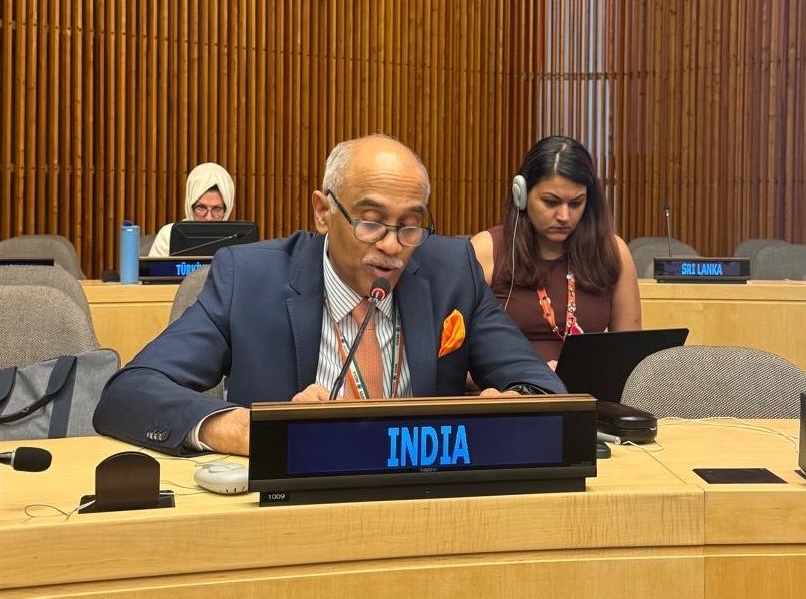
Addressing a meeting of the United Nations Security Council on Afghanistan on Monday, India’s Permanent Representative to the UN, P Harish, said Pakistan was attempting to deflect attention from its own internal problems by blaming neighbouring countries.
“Blaming neighbours for its own failures is an old Pakistani habit. This attempt to hoodwink the world will fail,” Harish told the Council.
The Indian envoy criticised Pakistan’s reported use of the term “Fitna al Hindustan” by state agencies to describe certain groups operating within its borders, arguing that the move represented state backed misinformation.
According to Harish, the terminology was being used to frame internal security challenges through a religious lens while directing hostility towards India.
“Calling groups inside its own borders ‘Fitna al Hindustan’ is nothing but officially sponsored misinformation and disinformation dressed in religious terminology,” he said.
The Arabic term “Fitna” is commonly used in Islamic discourse and can be interpreted as sedition, discord or rebellion depending on the context.
Harish alleged that such narratives formed part of a broader strategy by Pakistan’s establishment to cultivate anti India sentiment among its population.
“This is an outcome of an organised factory of hate coming from the deep state of Pakistan, which aims to keep their citizens in a state of permanent hostility with India in order to perpetuate their stay in power and control of national resources and distract them from core political and economic problems,” he said.
The Indian diplomat also referred to Pakistan’s military establishment, which New Delhi has frequently described as exerting significant influence over the country’s political system.
Harish claimed that recent constitutional developments in Pakistan had further consolidated the military’s authority.
“The de facto coup by the military through the 27th Constitutional Amendment is only its most recent manifestation,” he said.
India’s remarks come amid continued tensions between the two neighbours and ongoing concerns over cross border terrorism.
During his address, Harish also called for stronger international cooperation to combat terrorism in the region and highlighted the threat posed by extremist groups operating in South Asia.
“Only coordinated efforts of the international community can ensure that ISIL and Al Qaida and their affiliates, including Lashkar e Tayyiba and Jaish e Mohammed, and proxies of Lashkar e Tayyiba such as The Resistance Front, along with those who facilitate their operations, no longer indulge in cross border terrorism,” he told the Security Council.
India has repeatedly accused Pakistan based terror groups of carrying out attacks targeting Indian interests and civilians, allegations that Islamabad has consistently denied.
Harish referred to the April attack in Pahalgam, Jammu and Kashmir, in which 25 people, including 24 Hindu tourists and one Christian visitor, were killed. India has said that The Resistance Front, which it describes as a proxy of Lashkar e Tayyiba, claimed responsibility for the attack.
The Indian envoy stressed that addressing terrorism required sustained international engagement and accountability for those who support, finance or facilitate extremist organisations.
The exchange reflects the continuing diplomatic tensions between India and Pakistan at international forums, where both countries frequently raise concerns relating to security, terrorism and regional stability.
Pakistan has not immediately responded to Harish’s latest remarks at the United Nations.